

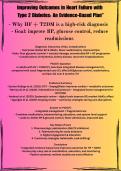
Improving Outcomes in Heart Failure with
Type 2 Diabetes: An Evidence-Based Plan”
- Why HF + T2DM is a high-risk diagnosis
- Goal: improve BP, glucose control, reduce
readmissions
Diagnosis: Outcomes, Risks, Complications
- Outcomes: Better BP & HbA1c, fewer readmissions, improved QoL
- Risks: Poor glycemic control → vascular damage, uncontrolled BP → HF progression
- Complications: Arrhythmias, kidney disease, recurrent hospitalizations
PICO(T) Question
In adults with HF + T2DM (P), how does integrated disease management (I),
compared with usual fragmented care (C), affect BP/glucose control, readmissions,
and QoL (O) over 6 months (T)?
Evidence Summary
- Santos-Gallego et al. (2021): RCT – Empagliflozin improves cardiac + metabolic outcomes
- Bernocchi et al. (2024): Telemedicine trial protocol – integrated home management for
HF/T2DM
- Ambrosi et al. (2025): Systematic review – digital tools improve BP, modest HbA1c effect
- Ogungbe et al. (2025): Scoping review – continuity strategies during care disruptions
Answer to PICO(T)
- Integrated management > fragmented care
- Combines medications, telemonitoring, education, and system-level support
- Leads to: better BP & glucose control, fewer admissions, improved QoL
Key Steps of Care
1. Pharmacologic optimization (SGLT2 inhibitors)
2. Telemonitoring for early detection
3. Digital engagement & education
4. Continuity strategies (telehealth, task-shifting)
Conclusion
- Integrated evidence-based care improves outcomes for HF + T2DM
- Nurses play a key role in coordination, education, and monitoring
- Patient-centered, resilient models are most effective
Type 2 Diabetes: An Evidence-Based Plan”
- Why HF + T2DM is a high-risk diagnosis
- Goal: improve BP, glucose control, reduce
readmissions
Diagnosis: Outcomes, Risks, Complications
- Outcomes: Better BP & HbA1c, fewer readmissions, improved QoL
- Risks: Poor glycemic control → vascular damage, uncontrolled BP → HF progression
- Complications: Arrhythmias, kidney disease, recurrent hospitalizations
PICO(T) Question
In adults with HF + T2DM (P), how does integrated disease management (I),
compared with usual fragmented care (C), affect BP/glucose control, readmissions,
and QoL (O) over 6 months (T)?
Evidence Summary
- Santos-Gallego et al. (2021): RCT – Empagliflozin improves cardiac + metabolic outcomes
- Bernocchi et al. (2024): Telemedicine trial protocol – integrated home management for
HF/T2DM
- Ambrosi et al. (2025): Systematic review – digital tools improve BP, modest HbA1c effect
- Ogungbe et al. (2025): Scoping review – continuity strategies during care disruptions
Answer to PICO(T)
- Integrated management > fragmented care
- Combines medications, telemonitoring, education, and system-level support
- Leads to: better BP & glucose control, fewer admissions, improved QoL
Key Steps of Care
1. Pharmacologic optimization (SGLT2 inhibitors)
2. Telemonitoring for early detection
3. Digital engagement & education
4. Continuity strategies (telehealth, task-shifting)
Conclusion
- Integrated evidence-based care improves outcomes for HF + T2DM
- Nurses play a key role in coordination, education, and monitoring
- Patient-centered, resilient models are most effective


