

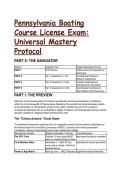
Pennsylvania Boating
Course License Exam:
Universal Mastery
Protocol
PART 0: THE NAVIGATOR
Section Cognitive Tier Target Assessment Focus
PART I The Preview Critical Axioms & Operational
Hard Deck
PART II Tier 1 (Questions 1–10) Foundational Syntax &
Statutory Application
PART II Tier 2 (Questions 11–20) Complex Application &
Hydrodynamic Simulation
PART II Tier 3 (Questions 21–30) Grandmaster Synthesis &
High-Stakes Crisis Response
PART I: THE PREVIEW
Welcome to the absolute apex of maritime operational command and statutory compliance
within the Commonwealth of Pennsylvania. Mastering this specific test bank translates directly
to the elimination of critical failure points on the water, transforming you from a passive
recreational participant into an authoritative, legally compliant, and strategically dominant vessel
operator capable of mitigating lethal hydrodynamic risks.
The "Critical Axioms" Cheat Sheet
The following frameworks represent the non-negotiable operational boundaries established by
the Pennsylvania Fish and Boat Commission (PFBC). Deviation from these parameters
constitutes a failure of seamanship and invites catastrophic liability.
Operational Variable Statutory Mandate / Formula Core Mechanism
The PFD Triad Children 12 and under MUST Age-based buoyancy mandate.
wear on vessels 20 feet or less.
Cold Weather Wear November 1 – April 30: ALL Hydrothermic shock prevention.
must wear on boats <16ft & all
kayaks/canoes.
Power & Age Matrix Born \ge Jan 1, 1982: Requires Cognitive maturity threshold.
,Operational Variable Statutory Mandate / Formula Core Mechanism
BSEC for >25 HP. No one \le 11
may operate >25 HP or PWC.
BUI Hard Deck Adult limit: 0.08% BAC. Minor Pharmacological marine
"Zero Tolerance": 0.02% BAC. impairment.
Capacity Calculation Maximum Persons = (Vessel Hydrodynamic freeboard limits.
Length x Vessel Width) / 15
Proximity & Wake 100-foot slow, no-wake zone for Kinetic energy dissipation.
standard vessels; 200-foot for
wake surfing.
Accident Reporting Death/Disappearance: Administrative triage protocol.
Immediate. Injury: 48 Hrs.
Damage >$2,000: 10 Days.
PART II: THE ELITE TEST BANK
Tier 1: Foundational Syntax & Application
Q1: A family of four is preparing to depart a marina on a 19-foot motorized bowrider during a
busy July afternoon. The passenger manifest includes a 45-year-old operator, a 40-year-old
passenger, a 14-year-old teenager, and a 10-year-old child. The vessel contains four properly
sized, USCG-approved wearable life jackets stowed in the forward bow compartment. Based on
the principles of Pennsylvania Personal Flotation Device (PFD) compliance, which immediate
action is MANDATORY before the vessel transitions from moored to underway? A) The
10-year-old and the 14-year-old must both physically don a USCG-approved PFD, securing all
straps and closures. B) All four passengers must physically don a USCG-approved PFD
because the vessel is under 20 feet in length. C) The 10-year-old must physically don a
USCG-approved PFD, while the remaining three jackets may remain stowed but readily
accessible. D) The operator must ensure an inflatable PFD is provided to the 10-year-old to
guarantee rapid automatic deployment if swamped.
● The Answer: C (The 10-year-old must physically don a USCG-approved PFD, while the
remaining three jackets may remain stowed but readily accessible.)
● Distractor Analysis:
○ A is incorrect: The strict statutory wear requirement applies specifically and
exclusively to children 12 years of age and younger. The 14-year-old is exempt
from the mandatory wear rule in July.
○ B is incorrect: While wearing a PFD is universally recommended for adults, it is not
legally mandated for individuals over 12 during the summer months on a 19-foot
vessel.
○ D is incorrect: Inflatable PFDs are strictly prohibited by federal and state regulations
for use by children under 16 years of age, as they require mature cognitive
interaction and maintenance.
The Mentor's Analysis: The law bifurcates safety parameters based on physical maturity and
vessel stability. When facing PFD compliance variables, the immediate priority is calculating the
youngest passenger's age against the vessel length threshold (20 feet or less). By utilizing the
12-and-Under Wear Rule, you bypass the common novice trap of assuming all minors fall under
identical wearable mandates. Professional/Academic Intuition: Age 12 and Vessel Length 20
dictate the absolute threshold for mandatory, continuous PFD wear during standard summer
, operations.
Q2: A 24-year-old individual, born in 2002, recently purchased a heavily modified aluminum
motorboat equipped with a 40-horsepower outboard engine. They intend to operate it strictly on
inland Commonwealth waters. According to Pennsylvania state law, what is the MINIMUM legal
requirement this specific individual must fulfill to operate this vessel without facing immediate
interdiction? A) They must possess a valid Pennsylvania vehicular driver's license and carry
specialized marine liability insurance. B) They may operate the vessel without restriction, as
they have legally surpassed the majority age of 21. C) They must successfully complete a
NASBLA-approved Boating Safety Education Course and physically carry the resulting
certificate on board. D) They must complete a supervised on-water practical examination
administered by a certified Coast Guard Auxiliary instructor.
● The Answer: C (They must successfully complete a NASBLA-approved Boating Safety
Education Course and physically carry the resulting certificate on board.)
● Distractor Analysis:
○ A is incorrect: A vehicular driver's license has zero legal standing for marine vessel
operation in Pennsylvania; the domains are entirely distinct.
○ B is incorrect: The law targets a specific birth year, not simply the achievement of
adulthood. Anyone born on or after January 1, 1982, is captured by this permanent
mandate.
○ D is incorrect: Pennsylvania law requires cognitive mastery via a classroom or
online knowledge-based course; a practical on-water exam is not a statutory
prerequisite for a state certificate.
The Mentor's Analysis: Statutory operational privileges in Pennsylvania are mathematically
fixed to a chronological anchor: the year 1982. When facing operational eligibility, the immediate
priority is checking the birth year against the 25-horsepower threshold. By utilizing the 1982 /
>25 HP Axiom, you bypass the novice assumption that adults are automatically exempt from
foundational education requirements. Professional/Academic Intuition: If the engine exceeds
25 HP and the operator was born on or after January 1, 1982, the Boating Safety Education
Certificate is a non-negotiable operational passport.
Q3: During a routine safety inspection at a crowded launch ramp, a Waterways Conservation
Officer inspects the Hull Identification Number (HIN) of a newly purchased fiberglass motorboat.
To verify the vessel was built in accordance with federal construction parameters, where
EXACTLY must this permanent 12-character identifier be located? A) On the port side of the
forward bow, directly adjacent to the state-issued registration decals. B) Affixed directly to the
manufacturer's capacity plate near the operator's primary helm station. C) On the upper
starboard side of the transom, positioned above the waterline. D) Engraved onto the internal
bilge stringer nearest to the primary engine block.
● The Answer: C (On the upper starboard side of the transom, positioned above the
waterline.)
● Distractor Analysis:
○ A is incorrect: The port and starboard sides of the forward bow are exclusively
reserved for state registration numbers and validation decals, not the HIN.
○ B is incorrect: While the capacity plate contains vital operational limits, the HIN
must be located on the extreme exterior of the hull structure to facilitate rapid law
enforcement identification.
○ D is incorrect: While manufacturers do hide a secondary, classified HIN internally
for theft recovery, the primary, legally verifiable HIN must be externally visible on the
transom.
Course License Exam:
Universal Mastery
Protocol
PART 0: THE NAVIGATOR
Section Cognitive Tier Target Assessment Focus
PART I The Preview Critical Axioms & Operational
Hard Deck
PART II Tier 1 (Questions 1–10) Foundational Syntax &
Statutory Application
PART II Tier 2 (Questions 11–20) Complex Application &
Hydrodynamic Simulation
PART II Tier 3 (Questions 21–30) Grandmaster Synthesis &
High-Stakes Crisis Response
PART I: THE PREVIEW
Welcome to the absolute apex of maritime operational command and statutory compliance
within the Commonwealth of Pennsylvania. Mastering this specific test bank translates directly
to the elimination of critical failure points on the water, transforming you from a passive
recreational participant into an authoritative, legally compliant, and strategically dominant vessel
operator capable of mitigating lethal hydrodynamic risks.
The "Critical Axioms" Cheat Sheet
The following frameworks represent the non-negotiable operational boundaries established by
the Pennsylvania Fish and Boat Commission (PFBC). Deviation from these parameters
constitutes a failure of seamanship and invites catastrophic liability.
Operational Variable Statutory Mandate / Formula Core Mechanism
The PFD Triad Children 12 and under MUST Age-based buoyancy mandate.
wear on vessels 20 feet or less.
Cold Weather Wear November 1 – April 30: ALL Hydrothermic shock prevention.
must wear on boats <16ft & all
kayaks/canoes.
Power & Age Matrix Born \ge Jan 1, 1982: Requires Cognitive maturity threshold.
,Operational Variable Statutory Mandate / Formula Core Mechanism
BSEC for >25 HP. No one \le 11
may operate >25 HP or PWC.
BUI Hard Deck Adult limit: 0.08% BAC. Minor Pharmacological marine
"Zero Tolerance": 0.02% BAC. impairment.
Capacity Calculation Maximum Persons = (Vessel Hydrodynamic freeboard limits.
Length x Vessel Width) / 15
Proximity & Wake 100-foot slow, no-wake zone for Kinetic energy dissipation.
standard vessels; 200-foot for
wake surfing.
Accident Reporting Death/Disappearance: Administrative triage protocol.
Immediate. Injury: 48 Hrs.
Damage >$2,000: 10 Days.
PART II: THE ELITE TEST BANK
Tier 1: Foundational Syntax & Application
Q1: A family of four is preparing to depart a marina on a 19-foot motorized bowrider during a
busy July afternoon. The passenger manifest includes a 45-year-old operator, a 40-year-old
passenger, a 14-year-old teenager, and a 10-year-old child. The vessel contains four properly
sized, USCG-approved wearable life jackets stowed in the forward bow compartment. Based on
the principles of Pennsylvania Personal Flotation Device (PFD) compliance, which immediate
action is MANDATORY before the vessel transitions from moored to underway? A) The
10-year-old and the 14-year-old must both physically don a USCG-approved PFD, securing all
straps and closures. B) All four passengers must physically don a USCG-approved PFD
because the vessel is under 20 feet in length. C) The 10-year-old must physically don a
USCG-approved PFD, while the remaining three jackets may remain stowed but readily
accessible. D) The operator must ensure an inflatable PFD is provided to the 10-year-old to
guarantee rapid automatic deployment if swamped.
● The Answer: C (The 10-year-old must physically don a USCG-approved PFD, while the
remaining three jackets may remain stowed but readily accessible.)
● Distractor Analysis:
○ A is incorrect: The strict statutory wear requirement applies specifically and
exclusively to children 12 years of age and younger. The 14-year-old is exempt
from the mandatory wear rule in July.
○ B is incorrect: While wearing a PFD is universally recommended for adults, it is not
legally mandated for individuals over 12 during the summer months on a 19-foot
vessel.
○ D is incorrect: Inflatable PFDs are strictly prohibited by federal and state regulations
for use by children under 16 years of age, as they require mature cognitive
interaction and maintenance.
The Mentor's Analysis: The law bifurcates safety parameters based on physical maturity and
vessel stability. When facing PFD compliance variables, the immediate priority is calculating the
youngest passenger's age against the vessel length threshold (20 feet or less). By utilizing the
12-and-Under Wear Rule, you bypass the common novice trap of assuming all minors fall under
identical wearable mandates. Professional/Academic Intuition: Age 12 and Vessel Length 20
dictate the absolute threshold for mandatory, continuous PFD wear during standard summer
, operations.
Q2: A 24-year-old individual, born in 2002, recently purchased a heavily modified aluminum
motorboat equipped with a 40-horsepower outboard engine. They intend to operate it strictly on
inland Commonwealth waters. According to Pennsylvania state law, what is the MINIMUM legal
requirement this specific individual must fulfill to operate this vessel without facing immediate
interdiction? A) They must possess a valid Pennsylvania vehicular driver's license and carry
specialized marine liability insurance. B) They may operate the vessel without restriction, as
they have legally surpassed the majority age of 21. C) They must successfully complete a
NASBLA-approved Boating Safety Education Course and physically carry the resulting
certificate on board. D) They must complete a supervised on-water practical examination
administered by a certified Coast Guard Auxiliary instructor.
● The Answer: C (They must successfully complete a NASBLA-approved Boating Safety
Education Course and physically carry the resulting certificate on board.)
● Distractor Analysis:
○ A is incorrect: A vehicular driver's license has zero legal standing for marine vessel
operation in Pennsylvania; the domains are entirely distinct.
○ B is incorrect: The law targets a specific birth year, not simply the achievement of
adulthood. Anyone born on or after January 1, 1982, is captured by this permanent
mandate.
○ D is incorrect: Pennsylvania law requires cognitive mastery via a classroom or
online knowledge-based course; a practical on-water exam is not a statutory
prerequisite for a state certificate.
The Mentor's Analysis: Statutory operational privileges in Pennsylvania are mathematically
fixed to a chronological anchor: the year 1982. When facing operational eligibility, the immediate
priority is checking the birth year against the 25-horsepower threshold. By utilizing the 1982 /
>25 HP Axiom, you bypass the novice assumption that adults are automatically exempt from
foundational education requirements. Professional/Academic Intuition: If the engine exceeds
25 HP and the operator was born on or after January 1, 1982, the Boating Safety Education
Certificate is a non-negotiable operational passport.
Q3: During a routine safety inspection at a crowded launch ramp, a Waterways Conservation
Officer inspects the Hull Identification Number (HIN) of a newly purchased fiberglass motorboat.
To verify the vessel was built in accordance with federal construction parameters, where
EXACTLY must this permanent 12-character identifier be located? A) On the port side of the
forward bow, directly adjacent to the state-issued registration decals. B) Affixed directly to the
manufacturer's capacity plate near the operator's primary helm station. C) On the upper
starboard side of the transom, positioned above the waterline. D) Engraved onto the internal
bilge stringer nearest to the primary engine block.
● The Answer: C (On the upper starboard side of the transom, positioned above the
waterline.)
● Distractor Analysis:
○ A is incorrect: The port and starboard sides of the forward bow are exclusively
reserved for state registration numbers and validation decals, not the HIN.
○ B is incorrect: While the capacity plate contains vital operational limits, the HIN
must be located on the extreme exterior of the hull structure to facilitate rapid law
enforcement identification.
○ D is incorrect: While manufacturers do hide a secondary, classified HIN internally
for theft recovery, the primary, legally verifiable HIN must be externally visible on the
transom.


