

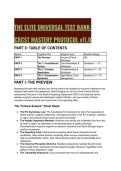
THE ELITE UNIVERSAL TEST BANK:
CRCST MASTERY PROTOCOL v11.0
PART 0: TABLE OF CONTENTS
Section Cognitive Tier Subject Focus Question Range
PART I The Preview Axioms & Prime N/A
Directives
PART II Tier 1: Foundational Core Parameters & Questions 1 – 10
Syntax Definitions
PART II Tier 2: Complex Troubleshooting & Questions 11 – 20
Application Simulation
PART II Tier 3: Grandmaster High-Stakes Crisis Questions 21 – 30
Synthesis Management
PART I: THE PREVIEW
Mastering this test bank ensures your clinical actions are dictated by structural compliance and
objective data rather than guesswork, directly forging you into an A-level Central Service
professional. Precision in the Sterile Processing Department (SPD) is the absolute barrier
between surgical success and catastrophic patient infection, and your mastery of these
concepts translates directly into saved lives on the operating table.
The "Critical Axioms" Cheat Sheet
● The IFU Supremacy Law: The manufacturer's Instructions for Use (IFU) supersede all
facility policies, surgeon preferences, and legacy practices. If the IFU is absent, outdated,
or vague, the medical device simply cannot be processed.
● The Aseptic Separation Mandate: Workflow must strictly and unilaterally flow from dirty
to clean to sterile, as cleanliness is the absolute basis of aseptic technique.
Decontamination requires negative air pressure; Assembly and Sterile Storage require
positive air pressure.
● The Spaulding Triad: Critical devices (entering sterile tissue) demand terminal
sterilization. Semi-critical devices (contacting intact mucous membranes) require
High-Level Disinfection (HLD). Non-critical devices require low-to-intermediate-level
disinfection.
● The Universal Precaution Directive: Standard precautions mandate that all human
blood, bodily fluids, and tissues must be treated as highly infectious, regardless of the
patient's known diagnosis or origin.
● The Traceability Imperative: Every processed item must be mathematically and
, biologically traceable to the specific patient, the specific sterilizer load, and the specific
biological/chemical indicator results.
PART II: THE ELITE TEST BANK
TIER 1: Foundational Syntax & Application
Q1: A technician is receiving a delivery of heavy, multi-level orthopedic sets from a vendor for a
total joint replacement scheduled for the following morning. According to the foundational
principles of aseptic technique and workflow in the Sterile Processing Department, which
conclusion regarding the handling of these sets is the MOST ACCURATE? A) The sets can
bypass decontamination and go straight to sterilization if the vendor provides a certificate of
sterility. B) The sets must be kept separate from facility-owned instruments to avoid
cross-contamination of different biological markers. C) Cleanliness is the absolute basis of the
aseptic technique, meaning all vendor trays must be treated as contaminated and routed
through decontamination first. D) The sets should be immediately placed into an ultrasonic
cleaner to ensure all unseen bioburden is removed before visual inspection.
● The Answer: C (Cleanliness is the absolute basis of the aseptic technique, meaning all
vendor trays must be treated as contaminated and routed through decontamination first.)
● Distractor Analysis:
○ A is incorrect: Vendor certificates do not override the strict protocol that all items
entering the facility from outside must be fully decontaminated prior to entering the
clean assembly area.
○ B is incorrect: While keeping sets organized is important for inventory, biological
markers do not dictate separation; all instruments are subject to universal standard
precautions.
○ D is incorrect: Placing uninspected sets directly into an ultrasonic cleaner violates
proper workflow, as gross soils must first be removed manually via brushing and
flushing. Furthermore, not all ultrasonic cleaners possess a validated
decontamination cycle.
The Mentor's Analysis: External inventory is biologically hostile until proven otherwise by your
own department's processes. When receiving loaner sets, the immediate priority is absolute
adherence to decontamination protocols regardless of visual appearance. By utilizing strict
point-of-entry decontamination, you bypass the common trap of trusting external cleanliness.
Professional/Academic Intuition: Cleanliness is the foundational prerequisite of the aseptic
technique; you cannot sterilize what is not meticulously clean.
Q2: During the manual cleaning phase, a technician is preparing to process a batch of delicate,
stainless-steel ophthalmic instruments. Based on the chemistry of cleaning solutions, which
formulation is the MOST APPROPRIATE to ensure efficacy while protecting the integrity of the
instruments? A) An abrasive, highly alkaline detergent designed to cut through heavy protein
coagulation. B) A low pH, highly acidic detergent to aggressively neutralize blood proteins and
lipids. C) A neutral pH detergent, which is the preferred and safest chemistry for most routine
cleaning processes. D) A saline solution soak followed by a rigorous chlorhexidine scrub.
● The Answer: C (A neutral pH detergent, which is the preferred and safest chemistry for
most routine cleaning processes.)
● Distractor Analysis:
○ A is incorrect: Highly alkaline detergents will strip the chromium oxide passivation
, layer from stainless steel, leading directly to rapid corrosion, rusting, and pitting.
○ B is incorrect: Acidic detergents are rarely used for routine cleaning as they can
severely damage delicate instruments and are less effective on organic soils than
specialized enzymes.
○ D is incorrect: Saline contains chlorides, which are the absolute enemy of stainless
steel and will cause irreversible pitting; furthermore, chlorhexidine is an antiseptic
for skin, not an instrument detergent.
The Mentor's Analysis: Instrument longevity relies on chemical neutrality and precise
formulation. When selecting detergents, the immediate priority is breaking down proteins without
degrading the steel. By utilizing a neutral pH detergent, you bypass the common trap of using
brute chemical force that destroys the instrument's protective layers. Professional/Academic
Intuition: Neutral pH detergents are the gold standard for preserving the passivation layer of
stainless steel instruments.
Q3: A technician is assigned to assemble rigid sterilization containers. During the inspection of
the container components, they observe the filter retention plates attached to the lids. Based on
current processing standards, which action regarding these plates is the MOST ACCURATE?
A) The plates should be wiped down with a low-level disinfectant between uses to preserve the
locking mechanism. B) The plates must remain permanently affixed to the lid to ensure the
tortuous path remains uncompromised during sterilization. C) The plates should be removed
from the container and lid, and then cleaned separately to ensure all hidden bioburden is
eradicated. D) The plates only require removal and separate cleaning if the internal chemical
indicator from the previous cycle failed.
● The Answer: C (The plates should be removed from the container and lid, and then
cleaned separately to ensure all hidden bioburden is eradicated.)
● Distractor Analysis:
○ A is incorrect: Wiping with a low-level disinfectant does not constitute thorough
cleaning, nor does it remove the physical debris that gets trapped behind the plates.
○ B is incorrect: Leaving the plates attached creates dead spaces where moisture,
soil, and bacteria harbor, entirely compromising the sterilization process.
○ D is incorrect: Standard operating procedure dictates that components must be
disassembled for cleaning every single time, regardless of indicator results.
The Mentor's Analysis: Rigid containers are complex medical devices, not simple boxes.
When processing containers, the immediate priority is total disassembly of all removable
components. By utilizing complete component separation, you bypass the common trap of
allowing microscopic soils to hide behind retention plates. Professional/Academic Intuition: If
a component can be removed, it must be removed and cleaned separately to eliminate
biological harboring zones.
Q4: A newly hired technician is reading a surgical schedule to prepare case carts. They note a
procedure listed as a "laparoscopic cholecystectomy." Based on basic medical terminology used
in the sterile processing department, what does the suffix "-ectomy" signify? A) The surgical
repair of a specific organ or tissue structure. B) The surgical removal of a specific anatomical
body part. C) The creation of a new opening into an organ. D) The visual examination of a body
cavity using an endoscope.
● The Answer: B (The surgical removal of a specific anatomical body part.)
● Distractor Analysis:
○ A is incorrect: Surgical repair is denoted by the suffix "-rrhaphy" (e.g.,
herniorrhaphy).
○ C is incorrect: The creation of a new opening is denoted by the suffix "-ostomy"
CRCST MASTERY PROTOCOL v11.0
PART 0: TABLE OF CONTENTS
Section Cognitive Tier Subject Focus Question Range
PART I The Preview Axioms & Prime N/A
Directives
PART II Tier 1: Foundational Core Parameters & Questions 1 – 10
Syntax Definitions
PART II Tier 2: Complex Troubleshooting & Questions 11 – 20
Application Simulation
PART II Tier 3: Grandmaster High-Stakes Crisis Questions 21 – 30
Synthesis Management
PART I: THE PREVIEW
Mastering this test bank ensures your clinical actions are dictated by structural compliance and
objective data rather than guesswork, directly forging you into an A-level Central Service
professional. Precision in the Sterile Processing Department (SPD) is the absolute barrier
between surgical success and catastrophic patient infection, and your mastery of these
concepts translates directly into saved lives on the operating table.
The "Critical Axioms" Cheat Sheet
● The IFU Supremacy Law: The manufacturer's Instructions for Use (IFU) supersede all
facility policies, surgeon preferences, and legacy practices. If the IFU is absent, outdated,
or vague, the medical device simply cannot be processed.
● The Aseptic Separation Mandate: Workflow must strictly and unilaterally flow from dirty
to clean to sterile, as cleanliness is the absolute basis of aseptic technique.
Decontamination requires negative air pressure; Assembly and Sterile Storage require
positive air pressure.
● The Spaulding Triad: Critical devices (entering sterile tissue) demand terminal
sterilization. Semi-critical devices (contacting intact mucous membranes) require
High-Level Disinfection (HLD). Non-critical devices require low-to-intermediate-level
disinfection.
● The Universal Precaution Directive: Standard precautions mandate that all human
blood, bodily fluids, and tissues must be treated as highly infectious, regardless of the
patient's known diagnosis or origin.
● The Traceability Imperative: Every processed item must be mathematically and
, biologically traceable to the specific patient, the specific sterilizer load, and the specific
biological/chemical indicator results.
PART II: THE ELITE TEST BANK
TIER 1: Foundational Syntax & Application
Q1: A technician is receiving a delivery of heavy, multi-level orthopedic sets from a vendor for a
total joint replacement scheduled for the following morning. According to the foundational
principles of aseptic technique and workflow in the Sterile Processing Department, which
conclusion regarding the handling of these sets is the MOST ACCURATE? A) The sets can
bypass decontamination and go straight to sterilization if the vendor provides a certificate of
sterility. B) The sets must be kept separate from facility-owned instruments to avoid
cross-contamination of different biological markers. C) Cleanliness is the absolute basis of the
aseptic technique, meaning all vendor trays must be treated as contaminated and routed
through decontamination first. D) The sets should be immediately placed into an ultrasonic
cleaner to ensure all unseen bioburden is removed before visual inspection.
● The Answer: C (Cleanliness is the absolute basis of the aseptic technique, meaning all
vendor trays must be treated as contaminated and routed through decontamination first.)
● Distractor Analysis:
○ A is incorrect: Vendor certificates do not override the strict protocol that all items
entering the facility from outside must be fully decontaminated prior to entering the
clean assembly area.
○ B is incorrect: While keeping sets organized is important for inventory, biological
markers do not dictate separation; all instruments are subject to universal standard
precautions.
○ D is incorrect: Placing uninspected sets directly into an ultrasonic cleaner violates
proper workflow, as gross soils must first be removed manually via brushing and
flushing. Furthermore, not all ultrasonic cleaners possess a validated
decontamination cycle.
The Mentor's Analysis: External inventory is biologically hostile until proven otherwise by your
own department's processes. When receiving loaner sets, the immediate priority is absolute
adherence to decontamination protocols regardless of visual appearance. By utilizing strict
point-of-entry decontamination, you bypass the common trap of trusting external cleanliness.
Professional/Academic Intuition: Cleanliness is the foundational prerequisite of the aseptic
technique; you cannot sterilize what is not meticulously clean.
Q2: During the manual cleaning phase, a technician is preparing to process a batch of delicate,
stainless-steel ophthalmic instruments. Based on the chemistry of cleaning solutions, which
formulation is the MOST APPROPRIATE to ensure efficacy while protecting the integrity of the
instruments? A) An abrasive, highly alkaline detergent designed to cut through heavy protein
coagulation. B) A low pH, highly acidic detergent to aggressively neutralize blood proteins and
lipids. C) A neutral pH detergent, which is the preferred and safest chemistry for most routine
cleaning processes. D) A saline solution soak followed by a rigorous chlorhexidine scrub.
● The Answer: C (A neutral pH detergent, which is the preferred and safest chemistry for
most routine cleaning processes.)
● Distractor Analysis:
○ A is incorrect: Highly alkaline detergents will strip the chromium oxide passivation
, layer from stainless steel, leading directly to rapid corrosion, rusting, and pitting.
○ B is incorrect: Acidic detergents are rarely used for routine cleaning as they can
severely damage delicate instruments and are less effective on organic soils than
specialized enzymes.
○ D is incorrect: Saline contains chlorides, which are the absolute enemy of stainless
steel and will cause irreversible pitting; furthermore, chlorhexidine is an antiseptic
for skin, not an instrument detergent.
The Mentor's Analysis: Instrument longevity relies on chemical neutrality and precise
formulation. When selecting detergents, the immediate priority is breaking down proteins without
degrading the steel. By utilizing a neutral pH detergent, you bypass the common trap of using
brute chemical force that destroys the instrument's protective layers. Professional/Academic
Intuition: Neutral pH detergents are the gold standard for preserving the passivation layer of
stainless steel instruments.
Q3: A technician is assigned to assemble rigid sterilization containers. During the inspection of
the container components, they observe the filter retention plates attached to the lids. Based on
current processing standards, which action regarding these plates is the MOST ACCURATE?
A) The plates should be wiped down with a low-level disinfectant between uses to preserve the
locking mechanism. B) The plates must remain permanently affixed to the lid to ensure the
tortuous path remains uncompromised during sterilization. C) The plates should be removed
from the container and lid, and then cleaned separately to ensure all hidden bioburden is
eradicated. D) The plates only require removal and separate cleaning if the internal chemical
indicator from the previous cycle failed.
● The Answer: C (The plates should be removed from the container and lid, and then
cleaned separately to ensure all hidden bioburden is eradicated.)
● Distractor Analysis:
○ A is incorrect: Wiping with a low-level disinfectant does not constitute thorough
cleaning, nor does it remove the physical debris that gets trapped behind the plates.
○ B is incorrect: Leaving the plates attached creates dead spaces where moisture,
soil, and bacteria harbor, entirely compromising the sterilization process.
○ D is incorrect: Standard operating procedure dictates that components must be
disassembled for cleaning every single time, regardless of indicator results.
The Mentor's Analysis: Rigid containers are complex medical devices, not simple boxes.
When processing containers, the immediate priority is total disassembly of all removable
components. By utilizing complete component separation, you bypass the common trap of
allowing microscopic soils to hide behind retention plates. Professional/Academic Intuition: If
a component can be removed, it must be removed and cleaned separately to eliminate
biological harboring zones.
Q4: A newly hired technician is reading a surgical schedule to prepare case carts. They note a
procedure listed as a "laparoscopic cholecystectomy." Based on basic medical terminology used
in the sterile processing department, what does the suffix "-ectomy" signify? A) The surgical
repair of a specific organ or tissue structure. B) The surgical removal of a specific anatomical
body part. C) The creation of a new opening into an organ. D) The visual examination of a body
cavity using an endoscope.
● The Answer: B (The surgical removal of a specific anatomical body part.)
● Distractor Analysis:
○ A is incorrect: Surgical repair is denoted by the suffix "-rrhaphy" (e.g.,
herniorrhaphy).
○ C is incorrect: The creation of a new opening is denoted by the suffix "-ostomy"


