

ABPD QE Review Exam Questions and
Answers with Verified Solutions | Latest
Updated 2026
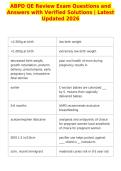
<2,500g at birth low birth weight
<1,000g at birth extremely low birth weight
decreased birth weight, poor oral health of mom during
growth retardation, preterm pregnancy results in
delivery, preeclampsia, early
pregnancy loss, intrauterine
fetal demise
earlier C-section babies are colonized ___
by S. mutans than vaginally
delivered babies
0-6 months AAPD recommends exclusive
breastfeeding
acetaminophen lidocaine analgesia and antipyretic of choice
for pregnant women local anesthetic
of choice for pregnant women
SIDS 1.5 in/3.8cm pacifier use helps protect against
____ shield is __ inches/cm
schn, recent immigrant moderate caries risk in 0-5 year old
,schn, recent immigrant, moderate risk in 6+ years olf
hyposalivary medications,
intraoral appliance, defective
restoration
1. third molars hypodontia frequency
2. second mandibular
premolar
3. maxillary lateral incisor
4. second maxillary premolar
1. maxillary lateral incisors microdontia frequency
2. second premolars
3. third molars
-enamel organ-dental tooth bud components
papilla-dental sac
number deficient: anodontia, initiation (dental lamina) nature of
hypodontia, oligodontia anomaly
excessive: hyperdontia
number and structure proliferation (bud, cap, early and
deficient: hypodontia, advanced bell) nature of anomaly
oligodontia excessive:
hyperdontia, odontomam
epithelial cells
, enamel and dentin histodifferentiation (cap, early and
structure-AI type I and IV-DI advanced bell) nature of anomaly
size and shape deficiency: morphodifferentiation (bud, cap,
microdontia, peg laterals, early and advanced bell) nature of
Hutchinson's incisors, Mulberry anomaly
molars, absense of root or
cusp excessive: macrodontia,
tuberculated cusps, Cusp of
Carabelli, taurodontism, dens
in dente, dens evaginatus,
dilaceration, gemination,
fusion, concrescence
enamel, dentin, and apposition (deposition of enamel
cementum apposition and dentin matricies) nature of
deficiency: AI types II and IV, anomaly
enamel hypoplasia, dentin
dysplasia, regional
odontodysplasia excessive:
enamel pearls,
hypercementosis, odontoma
enamel and dentin mineralization (mineralization of
mineralization deficiency: AI enamel and dentin matricies) nature
types III, enamel of anomaly
hypomineralization, fluorosis,
interglobular dentin excessive:
sclerotic dentin
enamel and dentin maturation maturation (enamel and dentin
deficiency: AI type I and IV, maturation) nature of anomaly
dentinogenesis imperfecta
Answers with Verified Solutions | Latest
Updated 2026
<2,500g at birth low birth weight
<1,000g at birth extremely low birth weight
decreased birth weight, poor oral health of mom during
growth retardation, preterm pregnancy results in
delivery, preeclampsia, early
pregnancy loss, intrauterine
fetal demise
earlier C-section babies are colonized ___
by S. mutans than vaginally
delivered babies
0-6 months AAPD recommends exclusive
breastfeeding
acetaminophen lidocaine analgesia and antipyretic of choice
for pregnant women local anesthetic
of choice for pregnant women
SIDS 1.5 in/3.8cm pacifier use helps protect against
____ shield is __ inches/cm
schn, recent immigrant moderate caries risk in 0-5 year old
,schn, recent immigrant, moderate risk in 6+ years olf
hyposalivary medications,
intraoral appliance, defective
restoration
1. third molars hypodontia frequency
2. second mandibular
premolar
3. maxillary lateral incisor
4. second maxillary premolar
1. maxillary lateral incisors microdontia frequency
2. second premolars
3. third molars
-enamel organ-dental tooth bud components
papilla-dental sac
number deficient: anodontia, initiation (dental lamina) nature of
hypodontia, oligodontia anomaly
excessive: hyperdontia
number and structure proliferation (bud, cap, early and
deficient: hypodontia, advanced bell) nature of anomaly
oligodontia excessive:
hyperdontia, odontomam
epithelial cells
, enamel and dentin histodifferentiation (cap, early and
structure-AI type I and IV-DI advanced bell) nature of anomaly
size and shape deficiency: morphodifferentiation (bud, cap,
microdontia, peg laterals, early and advanced bell) nature of
Hutchinson's incisors, Mulberry anomaly
molars, absense of root or
cusp excessive: macrodontia,
tuberculated cusps, Cusp of
Carabelli, taurodontism, dens
in dente, dens evaginatus,
dilaceration, gemination,
fusion, concrescence
enamel, dentin, and apposition (deposition of enamel
cementum apposition and dentin matricies) nature of
deficiency: AI types II and IV, anomaly
enamel hypoplasia, dentin
dysplasia, regional
odontodysplasia excessive:
enamel pearls,
hypercementosis, odontoma
enamel and dentin mineralization (mineralization of
mineralization deficiency: AI enamel and dentin matricies) nature
types III, enamel of anomaly
hypomineralization, fluorosis,
interglobular dentin excessive:
sclerotic dentin
enamel and dentin maturation maturation (enamel and dentin
deficiency: AI type I and IV, maturation) nature of anomaly
dentinogenesis imperfecta


