

Written by students who passed Immediately available after payment Read online or as PDF Wrong document? Swap it for free 4.6 TrustPilot
logo-home
Document preview thumbnail
Preview 4 out of 51 pages
Exam (elaborations)

Final Exam SPHE 421 : Kinesiology, answered latest 2026/2027 - American Public University.

Document preview thumbnail
Preview 4 out of 51 pages

Final Exam SPHE 421 : Kinesiology, answered latest 2026/2027 - American Public University. Final Exam Attempt Score 98 / 100 - 98 % Overall Grade (Highest Attempt) 98 / 100 - 98 % Question 1 1 / 1 point Which of the following is a function of the skeletal system? Question options: All of the above Manufactures blood cells Protects vital organs Gives shape and support Question 2 1 / 1 point In anatomical position, the thumb is located where in relation to the fingers? Question options: Medial Lateral ProximalDistal Question 3 1 / 1 point Forearm pronation occurs in which plane and around which axis? Question options: Transverse plane through a transverse axis Transverse plane through a vertical axis Sagittal plane through a frontal axis Frontal plane through a sagittal axis Question 4 1 / 1 point The type of abnormal end feel characterized by the presence of soft tissue edema is which of the following? Question options: Boggy end feel Springy block Empty end feel Soft tissue approximation Question 5 1 / 1 point When a condition involves both of the legs, which of the following terms best describes this situation?Question options: Unilateral Ipsilateral Bilateral Contralateral Question 6 1 / 1 point A broad, flat tendinous sheet is called Question options: linea alba aponeurosis elastic cartilage labrum Question 7 1 / 1 point The type of joint end feel characterized by a leatherlike limitation with some give is Question options: bony soft tissue approximation capsularempty Question 8 1 / 1 point Sliding your foot under your chair to prepare to stand involves knee Question options: flexion extension inversion abduction Question 9 1 / 1 point The ulna is where in relation to the humerus? Question options: Medial Lateral Proximal Distal Question 10 1 / 1 point The two bones of a joint are held together and supported by which of the following structures? Question options:Tendon Bursa Ligament Fibrocartilage Question 11 1 / 1 point Shoulder abduction occurs in which plane and around which axis? Question options: Frontal plane through a sagittal axis Frontal plane through a frontal axis Transverse plane through a vertical axis Sagittal plane through a frontal axis Question 12 1 / 1 point A biaxial joint allows motion in how many directions? Question options: One Two ThreeNone of the above Question 13 1 / 1 point The scapula is an example of which type of bone? Question options: Short Flat Irregular Sesamoid Question 14 1 / 1 point Which of the following types of joints is NOT a fibrous joint? Question options: Gomphosis Synarthrosis Synovial joint Syndesmosis Question 15 1 / 1 point Hip medial rotation occurs in which plane and around which axis? Question options:Transverse plane through a vertical axis Sagittal plane through a frontal axis Frontal plane through a sagittal axis None of the above Question 16 1 / 1 point The white fatty substance present in the central nervous system (CNS) and peripheral nervous system (PNS) that serves to increase the speed of impulse conduction is called Question options: myelin the node of Ranvier a neuron a tract. Question 17 1 / 1 point A common pathology of the PNS characterized by weakness of the long thoracic nerve is which of the following? Question options: Scapular winging Thoracic outlet syndromeBell's palsy Carpal tunnel syndrome Question 18 1 / 1 point A person with "wrist drop" has damage to which of the following nerves? Question options: Radial nerve Median nerve Femoral nerve Common peroneal nerve Question 19 1 / 1 point The ability of a muscle to recoil or return to normal resting length after a stretching or shortening force is removed is called Question options: irritability contractility elasticity extensibility Question 20 1 / 1 pointWhat is the term for a muscle contraction in which the proximal end moves toward the distal end? Question options: Irritability Extensibility Reversal of muscle action Active insufficiency Question 21 1 / 1 point In order to decrease the challenge of a client working on balance, you would do which of the following? Question options: Raise the center of gravity and increase the base of support Raise the center of gravity and decrease the base of support Lower the center of gravity and increase the base of support Lower the center of gravity and decrease the base of support Question 22 1 / 1 point The nerve plexus formed by the rami of C5 through T1 is called the Question options: cervical plexusbrachial plexus thoracic plexus lumbosacral plexus Question 23 1 / 1 point A person experiencing "foot drop" has damage to which of the following nerves? Question options: Radial nerve Median nerve Femoral nerve Common peroneal nerve Question 24 1 / 1 point Two forces acting in equal but opposite directions and resulting in a turning effect is called a Question options: stabilizing force dislocating force moment of force force couple Question 25 1 / 1 pointWhich of the following is a true statement regarding oblique muscle fibers? Question options: Oblique muscle fibers tend to be longer than parallel fibers, thus having more strength potential than parallel fibers. Oblique muscle fibers tend to be longer than parallel fibers, thus having less strength potential than parallel fibers. Oblique muscle fibers tend to be shorter than parallel fibers, thus having more strength potential than parallel fibers. Oblique muscle fibers tend to be shorter than parallel fibers, thus having less strength potential than parallel fibers. Question 26 1 / 1 point A contraction that causes no joint movement while producing muscle fiber tension is Question options: ISOKINETIC ISOTONIC ISOMETRIC ECCENTRIC Question 27 1 / 1 point If a PTA wishes to manually resist the knee extensors for an athlete and wishes to make the exercise as difficult as possible for the client, the best placement of her hand would be which of the following? Question options:Proximal to the knee joint Just distal to the tibial tuberosity Midpoint of the tibia Just proximal to the talus Question 28 1 / 1 point You can make a tighter fist with your wrist extended than with your wrist flexed because of Question options: active insufficiency of the finger flexors active insufficiency of the finger extensors passive insufficiency of the finger flexors passive insufficiency of the finger extensors Question 29 1 / 1 point If the distance of a force arm (FA) is 4 feet and the resistance arm (RA) is 2 feet, then the mechanical advantage would be Question options: 1/2 1/4 82 Question 30 1 / 1 point If a person threw a Frisbee and wanted wrist radial deviation, which muscle group would be the antagonist? Question options: Wrist radial deviators Wrist ulnar deviators Wrist flexors Wrist extensors Question 31 1 / 1 point Which muscle originates on the medial one-third of the clavicle and inserts on the lateral lip of the bicipital groove? Question options: Model Short Answer Anterior deltoid Supraspinatus Pectoralis major, clavicular portion Coracobrachialis Question 32 1 / 1 point The broad, flat membrane located longitudinally between the radius and the ulna is called theQuestion options: thoracolumbar fascia. joint capsule. interosseous membrane. annular ligament. Question 33 1 / 1 point Elbow extension occurs in which plane and through which axis? Question options: Transverse plane through a vertical axis Frontal plane through a sagittal axis Sagittal plane through a frontal axis Transverse plane through a transverse axis Question 34 1 / 1 point The upper trapezius, serratus anterior, and lower trapezius have which of the following actions in common? Question options: Retraction of the scapula Protraction of the scapulaDownward rotation of the scapula Upward rotation of the scapula Question 35 1 / 1 point Winging of the scapula is caused by weakness of which shoulder girdle muscle? Question options: Pectoralis minor Levator scapula Serratus anterior Middle trapezius Question 36 1 / 1 point The pectoralis major, latissimus dorsi, and teres major have which of the following shoulder motions in common? Question options: Horizontal abduction Adduction Lateral rotation Flexion Question 37 0 / 1 pointThe rotator cuff muscles serve to hold the humeral head against the glenoid fossa and best serve to facilitate which arthrokinematic motion of the shoulder joint? Question options: Roll Spin Glide Shear Question 38 1 / 1 point Which muscle originates on the anterior surface of the scapula and inserts on the lesser tubercle of the humerus? Question options: Teres major Teres minor Subscapularis Serratus anterior Question 39 1 / 1 point Which muscle originates on the distal half of the humerus (anterior surface) and inserts on the coronoid process and the ulnar tuberosity of the ulna? Question options:Coracobrachialis Short head of biceps brachii Brachialis Supinator Question 40 1 / 1 point Which muscle originates on the humeral lateral condyle and inserts on the radial styloid process? Question options: Brachioradialis Flexor carpi radialis Pronator teres Pronator quadratus Question 41 1 / 1 point An example of a muscle group that forms a force couple is which of the following? Question options: Upper trapezius, lower trapezius, levator scapula Levator scapula, rhomboids, pectoralis minor Rhomboids, upper trapezius, levator scapulaSerratus anterior and pectoralis minor Question 42 1 / 1 point Damage to which of the following nerves could result in weakness of the infraspinatus muscle? Question options: Radial nerve Musculocutaneous nerve Axillary nerve Suprascapular nerve Question 43 1 / 1 point A client who needs scapular depressor strengthening would need attention to which of the following muscles? Question options: Rhomboids and middle trapezius Serratus anterior and pectoralis minor Pectoralis minor and lower trapezius Pectoralis minor and pectoralis major Question 44 1 / 1 point Weakness of the triceps brachii muscle could indicate trauma to which of the following nerves?Question options: Musculocutaneous nerve Median nerve Ulnar nerve Radial nerve Question 45 1 / 1 point The acromioclavicular joint and the sternoclavicular joint contribute to scapular motions. Question options: True False Question 46 1 / 1 point The muscle of the cervical spine that is innervated by cranial nerve XI is the Question options: sternocleidomastoid. scalene. splenius capitis. splenius cervicis. Question 47 1 / 1 pointThe pelvic force couple that combine to pull the pelvis into an anterior tilt are the Question options: hip flexors and trunk flexors. hip flexors and trunk extensors. hip extensors and trunk flexors. hip extensors and trunk extensors. Question 48 1 / 1 point A normal finding for a lumbosacral angle would be which of the following? Question options: 10 degrees 30 degrees 45 degrees 60 degrees Question 49 1 / 1 point Which is the best instruction to most effectively stretch the left sternocleidomastoid muscle? Question options: Flex and laterally bend to the right; rotate to the left side Flex and laterally bend to the right; rotate to the right sideFlex and laterally bend to the left; rotate to the left side Flex and laterally bend to the left; rotate to the right side Question 50 1 / 1 point The quadratus lumborum is a prime mover in which of the following trunk motions? Question options: Trunk flexion Compression of abdominal contents Trunk extension Lateral bending Question 51 1 / 1 point Which cervical muscle, when contracted unilaterally, rotates the head to the opposite side? Question options: Splenius capitis Sternocleidomastoid Erector spinae Scalene Question 52 0 / 1 pointWhich muscle originates on the transverse process of a vertebra and inserts on the spinous process of the vertebra above? Question options: Interspinalis These muscles connect the spinous processes of adjacent vertebrae and assist in extension of the vertebral column. Analyze the specific origin and insertion described in the question. The muscle that originates on the transverse process of a vertebra and inserts on the spinous process of the vertebra above is the Interspinalis. Confirm that the Interspinalis muscle fits the criteria of originating from the transverse process and inserting onto the spinous process of the vertebra above Intertransversarii Transversospinalis Erector spinae Question 53 1 / 1 point The muscle groups activated when you have a patient do a supine posterior pelvic tilt are the Question options: hip flexors and trunk flexors. hip flexors and trunk extensors. hip extensors and trunk flexors. hip extensors and trunk rotators. Question 54 1 / 1 pointThe bony landmark of the vertebra that makes up the anterior portion of the neural arch is called the Question options: lamina. pedicle. vertebral foramen. spinous process. Question 55 1 / 1 point Which of the following is the best position to achieve eccentric strengthening of the trunk extensors? Question options: Supine, curl up with focus on the "up" part of the exercise Supine, curl up with focus on the "down" part of the exercise Prone, raise head and shoulders with focus on the "up" part of the exercise Prone, raise head and shoulders with focus on the "down" part of the exercise Question 56 1 / 1 point A person with tight hamstrings will likely adopt which of the following compensatory postures? Question options:Posterior tilt of pelvis and flattened lumbar curve Anterior tilt of pelvis and lumbar curve hyperextension Posterior tilt of pelvis and lumbar curve hyperextension Anterior tilt of pelvis and flattened lumbar curve Question 57 1 / 1 point The trunk muscle that originates on the pubis and inserts on the costal cartilages of the fifth, sixth, and seventh ribs is the Question options: external oblique. internal oblique. transverse abdominis. rectus abdominis. Question 58 1 / 1 point The bony landmark on the ischium that is posterior and located between the greater and lesser sciatic notches is the Question options: tuberosity. auricular . posterior inferior iliac spine. Question 59 1 / 1 point The posteriorly located muscles that primarily serve to extend, laterally bend, and rotate the head are called the Question options: erector spinae muscles. hyoid muscles. prevertebral muscles. suboccipital muscles. Question 60 1 / 1 point The pelvic force couple that combines to maintain a level pelvis when the left leg is unsupported during the gait cycle is which of the following? Question options: Left trunk lateral benders and right hip abductors Right trunk lateral benders and left hip abductors Left trunk lateral benders and left hip abductors Right trunk lateral benders and right hip abductors Question 61 1 / 1 pointWhich of the following will most effectively work the hip extensors in a closed chain manner? Question options: Prone, extend hip with knee flexed Prone, extend hip with knee extended Supine, flex hip Standing lunges Question 62 1 / 1 point Which muscle has its origin at the linea aspera, runs lateral at the thigh, and has its insertion at the tibial tuberosity via the patellar tendon? Question options: Vastus medialis Adductor magnus Tensor fascia latae Vastus lateralis Question 63 1 / 1 point If a patient lifts his left foot off the ground and the left hip drops, which hip abductors need strengthening? Question options:Left hip abductors Right hip abductors Right and left hip abductors There is not enough information given to make a choice. Question 64 1 / 1 point The bony landmark of the femur located medially and posteriorly on the proximal end is called the Question options: lesser trochanter. greater trochanter. medial condyle. linea aspera. Question 65 1 / 1 point Which of the following ligaments prevents excessive forward movement of the tibia on the femur? Question options: Lateral meniscus Medial collateral Anterior cruciate ligamentGenu labrum Question 66 1 / 1 point Most of the hip adductors are innervated by which of the following nerves? Question options: Sciatic nerve Deep peroneal nerve Obturator nerve Femoral nerve Question 67 1 / 1 point The ligament at the hip that lies within the capsule and contributes to the blood supply to the femoral head is called the Question options: inguinal ligament. acetabular ligament. ligamentum teres. pubofemoral ligament. Question 68 1 / 1 point The quadriceps muscles are all innervated by which of the following nerves?Question options: Tibial nerve Common peroneal nerve Sciatic nerve Femoral nerve Question 69 1 / 1 point The bony landmark of the tibia that comprises the proximal medial end is called the Question options: medial malleolus. medial condyle. medial tubercle. tibial tuberosity. Question 70 1 / 1 point Which of the following Q angle measurements would be considered an abnormal finding? Question options: 10 degrees 13 degrees 15 degrees18 degrees Question 71 1 / 1 point You are asked to instruct your client in eccentric strengthening of the quadriceps. The BEST instruction would be which of the following? Question options: Seated, extend the knee Seated with knee extended, slowly lower the foot, flexing the knee Supine with knee flexed over a bolster, extend the knee Prone with knee flexed, lower foot, extending the knee Question 72 1 / 1 point Which muscle is responsible for "unlocking" the knee? Question options: Popliteus Plantaris Soleus Posterior tibialis Question 73 1 / 1 point Which muscle has its origin at the linea aspera, runs medially, and inserts at the tibial tuberosity?Question options: Sartorius Rectus femoris Vastus intermedialis Vastus medialis Question 74 1 / 1 point Which muscle originates on the pubis and inserts on the medial proximal tibia? Question options: Adductor longus Rectus femoris Adductor brevis Gracilis Question 75 1 / 1 point During weight-bearing knee extension, in which direction does the femur rotate on the tibia? Question options: Medially Laterally AnteriorlyPosteriorly Question 76 1 / 1 point Your patient has suffered a sprain to the deltoid ligament, and you are asked to strengthen muscles on the same side of the ankle. Which of the following exercises would best achieve this? Question options: Seated with cuff weight around dorsum of foot, evert foot Seated with cuff weight around dorsum of foot, invert foot Seated with cuff weight around dorsum of foot, dorsiflex foot Seated with cuff weight around dorsum of foot, plantarflex foot Question 77 1 / 1 point Which muscle originates on the posterior tibia and fibula and inserts on the posterior calcaneus? Question options: Gastrocnemius Soleus Plantaris Flexor digitorum longus Question 78 1 / 1 point Which muscle originates from the posterior tibia and inserts on the distal phalanges of the four lesser toes?Question options: Tibialis posterior Flexor digitorum longus Flexor hallucis longus Dorsal interossei Question 79 1 / 1 point You are asked to strengthen the muscles that support the arch of the foot (stirrup muscles). You would choose exercises for which of the following pairs of muscles? Question options: Peroneus longus and anterior tibialis Anterior tibialis and posterior tibialis Peroneus longus and extensor hallucis longus Peroneus longus and peroneus brevis Question 80 1 / 1 point As you descend stairs leading with your right foot, describe what is happening at the left ankle. Question options: Concentric contraction of the left ankle dorsiflexors Eccentric contraction of the left ankle plantar flexorsAn open chain activity of the left ankle muscles The left ankle dorsiflexors are becoming actively insufficient. Question 81 1 / 1 point Leaning into the wall with the left foot behind and the left knee bent is isolating a stretch to which muscle of the lower leg? Question options: Soleus Gastrocnemius Plantaris Popliteus Question 82 1 / 1 point Ankle inversion is accomplished by the action of the Question options: peroneus brevis. anterior tibialis. posterior tibialis. B and C Question 83 1 / 1 pointWith an ankle sprain, the most common direction of the twist and the tissue damaged is which of the following? Question options: Rolling to an everted position and spraining the deltoid ligament Rolling to an everted position and spraining the lateral ligament Rolling to an inverted position and spraining the deltoid ligament Rolling to an inverted position and spraining the lateral ligament Question 84 1 / 1 point Walking on the lateral borders of your feet involves an isometric contraction of which group of muscles at the ankle? Question options: Ankle evertors Ankle plantar flexors Ankle dorsiflexors Ankle invertors Question 85 1 / 1 point Which muscle has its origin on the lateral tibia and interosseus membrane and inserts on the first cuneiform and first metatarsal? Question options:Anterior tibialis Posterior tibialis Extensor hallucis longus Extensor digitorum longus Question 86 1 / 1 point Pressure on the vertebral discs is greatest in which of the following positions? Question options: Supine Side-lying Seated Standing upright Question 87 1 / 1 point A gait pattern characterized by a wide base of support and unsteady movements is called Question options: Parkinsonian gait. scissors gait. ataxic gic gait. Question 88 1 / 1 point A normal width of walking base measured from the midpoint of each heel is Question options: 1/2 inch. 1 inch. 3 inches. 6 inches. Question 89 1 / 1 point You measure a person's leg lengths and note that there is a difference of 3/4 inch. You inform your patient that this is an atypical finding. What would be a typical range for leg length discrepancy? Question options: 1/8 inch or less 1/4 inch or less 1/2 inch or less Typical is the legs being exactly the same length Question 90 1 / 1 point Weakness of the gastrocnemius muscle group can cause a gait best described asQuestion options: rocking horse gait. sore foot limp. foot slap. ataxic gait. Question 91 1 / 1 point The term used to describe walking speed is Question options: cadence. stride length. gait cycle. period of nonsupport. Question 92 1 / 1 point A difficulty or slowness in initiating gait is characteristic of which of the following conditions? Question options: Rheumatoid arthritis Nonfunctioning gastrocnemius muscle ParkinsonismMuscular dystrophy Question 93 1 / 1 point You will be working with a patient who has had a stroke. You expect which of the following descriptions to best characterize the typical gait pattern that you will see? Question options: Excessive anterior pelvic tilt and lumbar lordosis with exaggerated arm swing A shift of the trunk to the affected side with weight-bearing Weight shift to the uninvolved side with circumduction of the involved leg A quick shift posteriorly of the trunk at the moment of heel strike Question 94 1 / 1 point Which muscle group slows down the knee motion in terminal swing and prevents the knee from "snapping" into extension just prior to initial contact? Question options: Hip flexors Knee flexors Hip extensors Knee extensors Question 95 1 / 1 pointIf your patient's treatment plan asks her to work on dynamic posture, which of the following activities would be appropriate to have your patient do? Question options: Seated stationary posture at a computer station Loading office supplies into a file cabinet Moving files from one shelf to another in a storeroom B and C Question 96 1 / 1 point During the loading response of the stance phase, which muscle group contracts eccentrically to keep the foot from slapping the ground as that extremity accepts the body's weight? Question options: Knee extensors Ankle dorsiflexors Ankle plantar flexors Toe flexors Question 97 1 / 1 point If you note a problem with gait that occurs when the non-weight-bearing limb is directly under the body, you are speaking of which part of the swing phase? Question options:Preswing Initial swing Midswing Terminal swing Question 98 1 / 1 point If you are describing a gait abnormality that occurs when the heel leaves the ground but the ball of the foot and toes remain in contact with the ground, you are speaking of which portion of the stance phase? Question options: Initial contact Midstance Terminal stance Terminal swing Question 99 1 / 1 point For optimal lateral view standing posture, a plumb line should be aligned with all of the following landmarks except Question options: through the gh the acromion process of the shoulder. the anterior to the greater trochanter. the posterior to the patella. Question 100 1 / 1 point Which of the following statements best describes the purpose of arm swing in gait? Question options: Serves to slow down the lower limbs to maintain balance and control Provides a counterrotation effect to the trunk Helps to propel the lower limbs forward in space None of the above—it is strictly a passive, extraneous activity. Question 1 All of the above The skeletal system provides the structural framework (shape and support), acts as a shield for the brain, heart, and lungs (protects vital organs), and the marrow within bones is where hematopoiesis occurs (manufactures blood cells). Question 2 Lateral In the standard anatomical position (palms facing forward), the thumb is situated further away from the midline of the body than the fingers. Question 3 Transverse plane through a vertical axis Rotational movements like pronation and supination occur in the transverse plane. Since the movement "rotates" around the length of the forearm, it occurs around a vertical (longitudinal) axis. Question 4 Boggy end feel A "boggy" end feel is typically associated with soft tissue edema (swelling), feeling much like pushing into a wet sponge.Question 5 Bilateral "Bi-" refers to two, and "lateral" refers to side. Bilateral means the condition is occurring on both sides of the body. Question 6 Aponeurosis An aponeurosis is a pearly-white, flat sheet of fibrous tissue that takes the place of a tendon in sheet-like muscles having a wide area of attachment. Question 7 Capsular A capsular end feel (also called firm end feel) is often described as having a "leatherlike" quality with a slight amount of give, typical of joint capsule or ligamentous stretching. Question 8 Flexion To pull your foot back under a chair, the angle of the knee joint decreases, which is the definition of flexion. Question 9 Distal Since the ulna is part of the forearm and is further away from the trunk/shoulder attachment than the humerus (upper arm), it is considered distal to the humerus. Question 10 Ligament Ligaments are the fibrous connective tissues that connect bone to bone, providing stability to the joint. (Conversely, tendons connect muscle to bone). Question 11: Frontal plane through a sagittal axis Abduction moves the limb away from the midline in the frontal plane. The axis of rotation is always perpendicular to the plane, which for the frontal plane is the sagittal axis. Question 12: Two A biaxial joint (like the wrist or MCP joints) allows movement in two planes around two axes. Question 13: Flat The scapula is categorized as a flat bone because of its broad, thin surface, which provides a large area for muscle attachment. Question 14: Synovial joint Gomphosis, synarthrosis, and syndesmosis are all types of fibrous joints. A synovial joint is a different category characterized by a fluid-filled joint cavity. Question 15: Transverse plane through a vertical axis Rotation (medial or lateral) occurs in the transverse plane, rotating around a longitudinal/vertical axis. Question 16: myelin Myelin is the fatty insulation that wraps around axons to accelerate nerve impulse conduction.Question 17: Scapular winging The long thoracic nerve innervates the serratus anterior; when it is weakened, the medial border of the scapula pulls away from the rib cage. Question 18: Radial nerve The radial nerve innervates the wrist extensors. Damage to this nerve results in the inability to extend the wrist, known as "wrist drop." Question 19: elasticity Elasticity is the specific property that allows a muscle to return to its original resting length after being stretched. Question 20: Reversal of muscle action Normally, the insertion (distal) moves toward the origin (proximal). When the origin moves toward the insertion, it is called a reversal of muscle action (e.g., a pull-up). Question 21: Lower the center of gravity and increase the base of support To increase stability (and thus decrease the challenge), you want a low center of gravity and a wide base. Question 22: brachial plexus The brachial plexus is the network of nerves originating from C5–T1 that supplies the upper extremity. Question 23: Common peroneal nerve Also known as the common fibular nerve, damage here weakens the dorsiflexors, leading to "foot drop." Question 24: force couple A force couple occurs when two forces act in opposite directions to create a rotation (like turning a steering wheel). Question 25: Oblique muscle fibers tend to be shorter than parallel fibers, thus having more strength potential than parallel fibers. Oblique (pennate) fibers allow for more fibers to be packed into a specific area, increasing the cross-sectional area and strength potential. Question 26: ISOMETRIC Isometric contractions produce tension without changing the length of the muscle or moving the joint. Question 27: Just proximal to the talus To make the exercise most difficult, the resistance should be placed at the longest possible lever arm (the furthest point from the axis of rotation, which is the knee).Question 28: active insufficiency of the finger flexors When the wrist is flexed, the finger flexors are already shortened and cannot contract far enough to make a tight fist. Question 29: 2 Mechanical Advantage ($MA$) = Force Arm / Resistance Arm. $4 / 2 = 2$. Question 30: Wrist ulnar deviators The antagonist is the muscle group that performs the opposite action. The opposite of radial deviation is ulnar deviation. Question 31: Pectoralis major, clavicular portion The clavicular head of the pec major originates on the medial clavicle and inserts on the lateral lip of the bicipital groove. Question 32: interosseous membrane This is the tough, fibrous sheet that connects the radius and ulna along their shafts. Question 33: Sagittal plane through a frontal axis Flexion and extension occur in the sagittal plane around a frontal (mediolateral) axis. Question 34: Upward rotation of the scapula These three muscles work together as a force couple to rotate the scapula upward during shoulder elevation. Question 35: Serratus anterior As noted in Question 17, the serratus anterior holds the scapula against the thoracic wall; its weakness causes winging. Question 36: Adduction All three of these muscles (often called the "swimmer's muscles") work together to adduct the humerus toward the midline. Question 37: Glide The rotator cuff (specifically the SITS muscles) provides a downward glide to the humeral head to counteract the upward pull of the deltoid, preventing impingement. Question 38: Subscapularis This is the only rotator cuff muscle that originates on the anterior (subscapular fossa) of the scapula. Question 39: Brachialis The brachialis is the "workhorse" of the elbow, originating on the distal humerus and inserting on the ulnar tuberosity.Question 40: Brachioradialis The brachioradialis originates on the lateral supracondylar ridge/condyle and inserts way down at the radial styloid process. Question 41: Levator scapula, rhomboids, pectoralis minor A force couple consists of muscles pulling in different directions to achieve a single motion. These three muscles work together to perform downward rotation of the scapula. Question 42: Suprascapular nerve The suprascapular nerve innervates both the supraspinatus and the infraspinatus muscles. Question 43: Pectoralis minor and lower trapezius The lower trapezius and pectoralis minor (along with the latissimus dorsi) are the primary muscles responsible for scapular depression. Question 44: Radial nerve The radial nerve innervates the entire posterior compartment of the arm, including all heads of the triceps brachii. Question 45: True The acromioclavicular (AC) and sternoclavicular (SC) joints are the only skeletal attachments of the shoulder girdle to the trunk; movement at these joints is required for any scapular motion. Question 46: sternocleidomastoid. The sternocleidomastoid (SCM) and the trapezius are the two primary muscles innervated by the Spinal Accessory Nerve (Cranial Nerve XI). Question 47: hip flexors and trunk extensors. To tilt the pelvis anteriorly (tipping the front down), the hip flexors pull down on the anterior pelvis while the back extensors pull up on the posterior pelvis. Question 48: 30 degrees A lumbosacral angle of approximately 30 degrees is considered the clinical norm for a person in a standing position. Question 49: Flex and laterally bend to the right; rotate to the left side To stretch a muscle, you perform the opposite of its actions. The left SCM performs left lateral flexion and right rotation; therefore, you stretch it by laterally bending to the right and rotating back to the left. (Note: While SCM also extends the head, terminal neck flexion is often used in clinical stretching protocols to isolate the muscle). Question 50: Lateral bending The quadratus lumborum (QL) is a prime mover for lateral flexion (side-bending) of the trunk and "hiking" the hip.Question 51: Sternocleidomastoid The SCM is a contralateral rotator; when the left SCM contracts, the head rotates to the right. Question 52: Transversospinalis This group (which includes the rotatores and multifidus) is defined by fibers that run from a transverse process to a spinous process above. Question 53: hip extensors and trunk flexors. To perform a posterior pelvic tilt, the abdominal muscles (trunk flexors) pull the pubis upward while the gluteus maximus and hamstrings (hip extensors) pull the posterior pelvis downward. Question 54: pedicle. The pedicles are the two short, thick processes that project posteriorly from the vertebral body to form the sides of the vertebral arch. Question 55: Prone, raise head and shoulders with focus on the "down" part of the exercise Eccentric contraction occurs when a muscle is lengthening under tension. In this case, the trunk extensors work eccentrically to slowly lower the body back down toward the floor against gravity. Question 56: Posterior tilt of pelvis and flattened lumbar curve Because the hamstrings attach to the ischial tuberosity, tightness pulls the bottom of the pelvis forward/down, creating a posterior tilt and reducing the natural inward curve (lordosis) of the lower back. Question 57: rectus abdominis. The "six-pack" muscle runs vertically from the pubic crest up to the lower rib cage and xiphoid process. Question 58: spine. The ischial spine is the pointed bony projection located between the greater and lesser sciatic notches. Question 59: suboccipital muscles. This group (including the rectus capitis and obliquus capitis muscles) is located at the base of the skull and is responsible for fine-tuning head movements. Question 60: Right trunk lateral benders and right hip abductors To keep the pelvis level when the left leg is lifted, the right hip abductors (Gluteus Medius) contract to prevent the left side from dropping, while the right lateral benders (like the QL) stabilize the trunk. Question 61: Standing lunges In a closed-chain exercise, the distal segment (foot) is fixed to the ground. Lunges require the hip extensors to move the body's weight, unlike the other options which are open-chain.Question 62: Vastus lateralis The vastus lateralis originates at the linea aspera and greater trochanter, runs along the lateral thigh, and inserts into the tibial tuberosity. Question 63: Right hip abductors This is the Trendelenburg sign. The abductors on the weight-bearing side (right) must contract to keep the opposite (left) pelvis from dropping. Question 64: lesser trochanter. The lesser trochanter is a small, conical projection located on the posterior-medial aspect of the femur. Question 65: Anterior cruciate ligament The ACL prevents the tibia from sliding anteriorly (forward) relative to the femur. Question 66: Obturator nerve The obturator nerve innervates most of the adductor group, including the adductor longus, brevis, and gracilis. Question 67: ligamentum teres. Also known as the ligament of the head of the femur, it contains a small artery that supplies blood to the femoral head. Question 68: Femoral nerve The femoral nerve (L2-L4) innervates all four muscles of the quadriceps group. Question 69: medial condyle. The medial condyle of the tibia is the large, proximal medial expansion that articulates with the femur. Question 70: 18 degrees While "normal" varies slightly by sex (typically 13° for men and 18° for women), 18° is often used as the clinical threshold where tracking issues may begin; in many textbooks, anything significantly over 15° is flagged as abnormal. Question 71: Seated with knee extended, slowly lower the foot, flexing the knee Eccentric work involves the muscle lengthening under tension. Here, the quadriceps must "fire" to control the rate of knee flexion against gravity. Question 72: Popliteus The popliteus "unlocks" the knee by medially rotating the tibia (or laterally rotating the femur) to initiate flexion. Question 73: Vastus medialis The vastus medialis originates at the linea aspera and the distal half of the intertrochanteric line, running medially to the patella.Question 74: Gracilis The gracilis is the only adductor that crosses the knee, inserting on the medial proximal tibia (part of the Pes Anserinus). Question 75: Medially According to the "Screw-Home Mechanism," during weight-bearing extension, the femur rotates medially on the tibia to lock the joint. Question 76: Seated with cuff weight around dorsum of foot, invert foot The deltoid ligament is on the medial side of the ankle. Strengthening the inverters (which are also on the medial side) provides dynamic stability to that area. Question 77: Soleus The soleus originates on the posterior tibia/fibula. Unlike the gastrocnemius, it does not cross the knee. Question 78: Flexor digitorum longus This muscle runs from the posterior tibia to the distal phalanges of the four lesser toes. Question 79: Peroneus longus and anterior tibialis These two muscles are known as the "stirrup" because they insert from opposite sides to support the arches of the foot. Question 80: Eccentric contraction of the left ankle plantar flexors When descending, the left ankle (trailing leg) undergoes controlled dorsiflexion. The plantar flexors must contract eccentrically to control that descent. Question 81: Soleus Bending the knee puts the gastrocnemius (a two-joint muscle) on slack, allowing the stretch to isolate the onejoint soleus. Question 82: B and C Both the anterior tibialis and posterior tibialis contribute to inversion, though they have opposite actions regarding dorsi/plantarflexion. Question 83: Rolling to an inverted position and spraining the lateral ligament The most common ankle injury is an inversion sprain, affecting the lateral ligaments (like the ATF). Question 84: Ankle invertors To stay on the lateral borders, you must keep the foot in an inverted position via isometric tension. Question 85: Anterior tibialis The anterior tibialis originates on the lateral tibia and inserts on the medial cuneiform and first metatarsal.Question 86: Seated Intradiscal pressure is higher when seated (especially leaning forward) than when standing or lying down. Question 87: ataxic gait. Ataxic gait is characterized by lack of coordination, staggering, and a wide base, often due to cerebellar involvement. Question 88: 3 inches. A normal walking base (width of support) is typically between 2 to 4 inches. Question 89: 1/4 inch or less Discrepancies of up to 1/4 inch (about 0.6 cm) are considered within the normal, typical range and usually don't require correction. Question 90: sore foot limp. Weakness in the "push-off" muscles (gastrocnemius/soleus) results in a flat-footed gait often called a "calcaneus gait" or "sore foot limp." Question 91: cadence. Cadence refers to the number of steps taken per minute. Question 92: Parkinsonism "Festinating gait" and difficulty initiating movement (akinesia) are hallmarks of Parkinson’s disease. Question 93: Weight shift to the uninvolved side with circumduction of the involved leg Due to extensor spasticity or the inability to clear the foot, a stroke patient will often swing the leg out to the side (circumduction). Question 94: Knee flexors The hamstrings (knee flexors) act eccentrically at the end of the swing phase to decelerate the lower leg. Question 95: B and C Dynamic posture refers to maintaining alignment while the body is in motion (loading or moving files), whereas stationary seated posture is static. Question 96: Ankle dorsiflexors The anterior tibialis works eccentrically during the loading response to lower the foot to the ground in a controlled manner. Question 97: Midswing Midswing is the point where the swing limb passes directly under the body. Question 98: Terminal stance Terminal stance begins when the heel rises and continues until the other foot touches the ground.Question 99: the anterior to the greater trochanter. In optimal posture, the plumb line should pass through the greater trochanter, not anterior to it. Question 100: Provides a counterrotation effect to the trunk Arm swing occurs in opposition to the legs to balance the rotational forces generated by the lower body.

Content preview

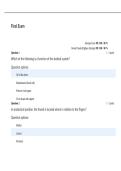
Final Exam


Attempt Score - 98 %
Overall Grade (Highest Attempt) - 98 %
Question 1 point
Which of the following is a function of the skeletal system?

Question options:
All of the above

Manufactures blood cells

Protects vital organs

Gives shape and support
Question 2 point
In anatomical position, the thumb is located where in relation to the fingers?

Question options:
Medial

Lateral

Proximal

, Distal
Question 3 point
Forearm pronation occurs in which plane and around which axis?

Question options:
Transverse plane through a transverse axis

Transverse plane through a vertical axis

Sagittal plane through a frontal axis

Frontal plane through a sagittal axis
Question 4 point
The type of abnormal end feel characterized by the presence of soft tissue edema is which of the
following?

Question options:
Boggy end feel

Springy block

Empty end feel

Soft tissue approximation
Question 5 point
When a condition involves both of the legs, which of the following terms best describes this
situation?

,Question options:
Unilateral

Ipsilateral

Bilateral

Contralateral
Question 6 point
A broad, flat tendinous sheet is called

Question options:
linea alba

aponeurosis

elastic cartilage

labrum
Question 7 point
The type of joint end feel characterized by a leatherlike limitation with some give is

Question options:
bony

soft tissue approximation

capsular

, empty
Question 8 point
Sliding your foot under your chair to prepare to stand involves knee

Question options:
flexion

extension

inversion

abduction
Question 9 point
The ulna is where in relation to the humerus?

Question options:
Medial

Lateral

Proximal

Distal
Question 10 point
The two bones of a joint are held together and supported by which of the following structures?

Question options:

Document information

Uploaded on
June 22, 2026
Number of pages
51
Written in
2024/2025
Type
Exam (elaborations)
Contains
Questions & answers
$22.39

Wrong document? Swap it for free Within 14 days of purchase and before downloading, you can choose a different document. You can simply spend the amount again.
Written by students who passed
Immediately available after payment
Read online or as PDF

Seller avatar
Reputation scores are based on the amount of documents a seller has sold for a fee and the reviews they have received for those documents. There are three levels: Bronze, Silver and Gold. The better the reputation, the more your can rely on the quality of the sellers work.
MindCraft
3.8
(47)
Sold
368
Followers
7
Items
2789
Last sold
12 hours ago


Why students choose Stuvia

Created by fellow students, verified by reviews

Quality you can trust: written by students who passed their tests and reviewed by others who've used these notes.

Didn't get what you expected? Choose another document

No worries! You can instantly pick a different document that better fits what you're looking for.

Pay as you like, start learning right away

No subscription, no commitments. Pay the way you're used to via credit card and download your PDF document instantly.

Student with book image

“Bought, downloaded, and aced it. It really can be that simple.”

Alisha Student

Working on your references?

Create accurate citations in APA, MLA and Harvard with our free citation generator.

Working on your references?

Frequently asked questions

