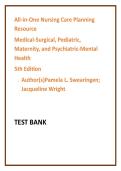
All-in-One Nursing Care Planning
Resource
Medical-Surgical, Pediatric,
Maternity, and Psychiatric-Mental
Health
5th Edition
• Author(s)Pamela L. Swearingen;
Jacqueline Wright
TEST BANK
,1) MCQ
Clinical Scenario:
A 62-year-old patient with colorectal cancer is receiving cycle 2
of chemotherapy. On assessment, the patient reports new
mouth soreness and poor appetite, and the white blood cell
count is decreased from baseline.
Question Stem:
Which nursing action is the priority to include in the plan of
care?
Answer Options:
A. Encourage the patient to increase oral intake with acidic
beverages
B. Teach the patient to report fever immediately and avoid sick
contacts
C. Restrict all visitors to reduce anxiety
D. Advise the patient to take over-the-counter antidiarrheals
routinely
Correct Answer:
B. Teach the patient to report fever immediately and avoid
sick contacts
Detailed Rationale:
Chemotherapy can suppress bone marrow function and
increase infection risk, so teaching the patient to report fever
promptly and limit exposure to infection is a high-priority safety
,intervention. Oral soreness also raises the need for vigilant
monitoring for mucosal injury, but the immediate life-
threatening concern is infection in the setting of leukopenia.
Incorrect Option Analysis:
A is incorrect because acidic beverages can worsen oral
mucositis and discomfort.
C is incorrect because limiting visitors is not the priority unless
they are ill; it does not address the main risk.
D is incorrect because routine antidiarrheal use without
assessment can mask complications and is not the first nursing
action.
Nursing Process Linkage: Implementation
NCJMM Competency: Recognize Cues; Take Action
Difficulty: Moderate
Bloom’s Level: Apply
NCLEX Client Needs Category: Physiological Adaptation
Nursing Diagnosis Integration:
• Priority Nursing Diagnosis: Risk for infection
• Risk Factors: Myelosuppression, chemotherapy exposure,
leukopenia
• Defining Characteristics: N/A for risk diagnosis
Expected Outcome: Patient will verbalize two infection
precautions and report fever promptly.
, Key Learning Objective: Apply oncology safety teaching to
reduce treatment-related infection risk.
2) SATA
Clinical Scenario:
A patient receiving pelvic radiation says, “I feel exhausted all the
time, and my skin feels irritated in the treatment area.”
Question Stem:
Which nursing interventions are appropriate? Select all that
apply.
Answer Options:
A. Encourage rest periods and energy conservation
B. Advise the patient to apply heating pads directly to the skin
area
C. Teach gentle skin care using mild soap and avoiding friction
D. Encourage reporting of persistent fatigue to the oncology
team
E. Recommend vigorous exercise immediately after each
treatment session
Correct Answers:
A, C, D
Detailed Rationale:
Fatigue is a common effect of radiation therapy, and supportive
Resource
Medical-Surgical, Pediatric,
Maternity, and Psychiatric-Mental
Health
5th Edition
• Author(s)Pamela L. Swearingen;
Jacqueline Wright
TEST BANK
,1) MCQ
Clinical Scenario:
A 62-year-old patient with colorectal cancer is receiving cycle 2
of chemotherapy. On assessment, the patient reports new
mouth soreness and poor appetite, and the white blood cell
count is decreased from baseline.
Question Stem:
Which nursing action is the priority to include in the plan of
care?
Answer Options:
A. Encourage the patient to increase oral intake with acidic
beverages
B. Teach the patient to report fever immediately and avoid sick
contacts
C. Restrict all visitors to reduce anxiety
D. Advise the patient to take over-the-counter antidiarrheals
routinely
Correct Answer:
B. Teach the patient to report fever immediately and avoid
sick contacts
Detailed Rationale:
Chemotherapy can suppress bone marrow function and
increase infection risk, so teaching the patient to report fever
promptly and limit exposure to infection is a high-priority safety
,intervention. Oral soreness also raises the need for vigilant
monitoring for mucosal injury, but the immediate life-
threatening concern is infection in the setting of leukopenia.
Incorrect Option Analysis:
A is incorrect because acidic beverages can worsen oral
mucositis and discomfort.
C is incorrect because limiting visitors is not the priority unless
they are ill; it does not address the main risk.
D is incorrect because routine antidiarrheal use without
assessment can mask complications and is not the first nursing
action.
Nursing Process Linkage: Implementation
NCJMM Competency: Recognize Cues; Take Action
Difficulty: Moderate
Bloom’s Level: Apply
NCLEX Client Needs Category: Physiological Adaptation
Nursing Diagnosis Integration:
• Priority Nursing Diagnosis: Risk for infection
• Risk Factors: Myelosuppression, chemotherapy exposure,
leukopenia
• Defining Characteristics: N/A for risk diagnosis
Expected Outcome: Patient will verbalize two infection
precautions and report fever promptly.
, Key Learning Objective: Apply oncology safety teaching to
reduce treatment-related infection risk.
2) SATA
Clinical Scenario:
A patient receiving pelvic radiation says, “I feel exhausted all the
time, and my skin feels irritated in the treatment area.”
Question Stem:
Which nursing interventions are appropriate? Select all that
apply.
Answer Options:
A. Encourage rest periods and energy conservation
B. Advise the patient to apply heating pads directly to the skin
area
C. Teach gentle skin care using mild soap and avoiding friction
D. Encourage reporting of persistent fatigue to the oncology
team
E. Recommend vigorous exercise immediately after each
treatment session
Correct Answers:
A, C, D
Detailed Rationale:
Fatigue is a common effect of radiation therapy, and supportive