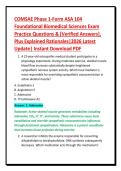
COMSAE Phase 1Form ASA 109
Foundational Biomedical Sciences Exam
Practice Questions & [Verified Answers],
Plus Explained Rationales|2026 Latest
Update| Instant Download PDF
1. A 6-year-old boy presents with recurrent respiratory infections,
steatorrhea, and failure to thrive. Genetic testing reveals a
mutation causing defective chloride transport across epithelial
membranes. Which cellular process is directly impaired?
A. Receptor-mediated endocytosis
B. ATP-dependent ion transport
C. Passive diffusion through aquaporins
D. Sodium-glucose cotransport
Answer: B. ATP-dependent ion transport
Rationale: Cystic fibrosis results from mutations in the CFTR gene,
which encodes an ATP-gated chloride channel. Defective ATP-dependent
chloride transport leads to thick mucus secretions, recurrent pulmonary
infections, pancreatic insufficiency, and malabsorption.
2. A researcher inhibits dihydrofolate reductase in rapidly dividing
cells. Which process is most directly affected?
A. Protein translation
B. Purine and thymidylate synthesis
C. Glycolysis
D. Fatty acid oxidation
,Answer: B. Purine and thymidylate synthesis
Rationale: Dihydrofolate reductase regenerates tetrahydrofolate, which
is required for one-carbon transfer reactions in nucleotide synthesis.
Inhibition decreases DNA replication and cellular proliferation.
3. A patient develops nephrotic syndrome characterized by selective
albuminuria. Which glomerular structure is most likely damaged?
A. Mesangial cells
B. Fenestrated endothelium
C. Podocyte foot processes
D. Proximal convoluted tubule
Answer: C. Podocyte foot processes
Rationale: Effacement of podocyte foot processes disrupts the slit
diaphragm, increasing permeability to albumin and causing selective
proteinuria.
4. A newborn develops severe hypocalcemia due to accidental
removal of the parathyroid glands during surgery. Which change
is expected?
A. Increased osteoclast activity
B. Increased renal calcium reabsorption
C. Decreased activation of vitamin D
D. Increased intestinal calcium absorption
Answer: C. Decreased activation of vitamin D
Rationale: Parathyroid hormone stimulates renal 1α-hydroxylase,
producing active vitamin D. Loss of PTH reduces calcitriol formation,
decreasing calcium absorption.
, 5. A patient with chronic alcoholism develops confusion,
ophthalmoplegia, and ataxia. Deficiency of which vitamin is
responsible?
A. Riboflavin
B. Niacin
C. Thiamine
D. Pyridoxine
Answer: C. Thiamine
Rationale: Thiamine deficiency causes Wernicke encephalopathy.
Thiamine serves as a cofactor for pyruvate dehydrogenase, α-
ketoglutarate dehydrogenase, branched-chain ketoacid dehydrogenase,
and transketolase.
6. A woman with systemic lupus erythematosus develops immune
complex-mediated glomerulonephritis. Which hypersensitivity
mechanism is involved?
A. Type I
B. Type II
C. Type III
D. Type IV
Answer: C. Type III
Rationale: Type III hypersensitivity involves deposition of antigen-
antibody complexes that activate complement and recruit inflammatory
cells.
7. A patient develops severe hypotension following bacterial sepsis.
Which cytokine is primarily responsible for septic shock?
A. IL-4
B. IL-10
, C. TNF-α
D. IFN-γ
Answer: C. TNF-α
Rationale: TNF-α released by activated macrophages induces fever,
vascular permeability, hypotension, and septic shock.
8. Which embryologic structure gives rise to the adrenal medulla?
A. Surface ectoderm
B. Neural crest cells
C. Intermediate mesoderm
D. Endoderm
Answer: B. Neural crest cells
Rationale: The adrenal medulla originates from neural crest cells and
functions as a modified sympathetic ganglion.
9. A patient has a mutation causing absence of dystrophin. Which
cellular component is destabilized?
A. Intermediate filaments
B. Cell membrane-cytoskeleton linkage
C. Golgi apparatus
D. Lysosomal membrane
Answer: B. Cell membrane-cytoskeleton linkage
Rationale: Dystrophin anchors intracellular actin to the extracellular
matrix through the dystrophin-associated glycoprotein complex. Loss
results in Duchenne muscular dystrophy.
10. During strenuous exercise, skeletal muscle increases ATP
production primarily through which pathway?
Foundational Biomedical Sciences Exam
Practice Questions & [Verified Answers],
Plus Explained Rationales|2026 Latest
Update| Instant Download PDF
1. A 6-year-old boy presents with recurrent respiratory infections,
steatorrhea, and failure to thrive. Genetic testing reveals a
mutation causing defective chloride transport across epithelial
membranes. Which cellular process is directly impaired?
A. Receptor-mediated endocytosis
B. ATP-dependent ion transport
C. Passive diffusion through aquaporins
D. Sodium-glucose cotransport
Answer: B. ATP-dependent ion transport
Rationale: Cystic fibrosis results from mutations in the CFTR gene,
which encodes an ATP-gated chloride channel. Defective ATP-dependent
chloride transport leads to thick mucus secretions, recurrent pulmonary
infections, pancreatic insufficiency, and malabsorption.
2. A researcher inhibits dihydrofolate reductase in rapidly dividing
cells. Which process is most directly affected?
A. Protein translation
B. Purine and thymidylate synthesis
C. Glycolysis
D. Fatty acid oxidation
,Answer: B. Purine and thymidylate synthesis
Rationale: Dihydrofolate reductase regenerates tetrahydrofolate, which
is required for one-carbon transfer reactions in nucleotide synthesis.
Inhibition decreases DNA replication and cellular proliferation.
3. A patient develops nephrotic syndrome characterized by selective
albuminuria. Which glomerular structure is most likely damaged?
A. Mesangial cells
B. Fenestrated endothelium
C. Podocyte foot processes
D. Proximal convoluted tubule
Answer: C. Podocyte foot processes
Rationale: Effacement of podocyte foot processes disrupts the slit
diaphragm, increasing permeability to albumin and causing selective
proteinuria.
4. A newborn develops severe hypocalcemia due to accidental
removal of the parathyroid glands during surgery. Which change
is expected?
A. Increased osteoclast activity
B. Increased renal calcium reabsorption
C. Decreased activation of vitamin D
D. Increased intestinal calcium absorption
Answer: C. Decreased activation of vitamin D
Rationale: Parathyroid hormone stimulates renal 1α-hydroxylase,
producing active vitamin D. Loss of PTH reduces calcitriol formation,
decreasing calcium absorption.
, 5. A patient with chronic alcoholism develops confusion,
ophthalmoplegia, and ataxia. Deficiency of which vitamin is
responsible?
A. Riboflavin
B. Niacin
C. Thiamine
D. Pyridoxine
Answer: C. Thiamine
Rationale: Thiamine deficiency causes Wernicke encephalopathy.
Thiamine serves as a cofactor for pyruvate dehydrogenase, α-
ketoglutarate dehydrogenase, branched-chain ketoacid dehydrogenase,
and transketolase.
6. A woman with systemic lupus erythematosus develops immune
complex-mediated glomerulonephritis. Which hypersensitivity
mechanism is involved?
A. Type I
B. Type II
C. Type III
D. Type IV
Answer: C. Type III
Rationale: Type III hypersensitivity involves deposition of antigen-
antibody complexes that activate complement and recruit inflammatory
cells.
7. A patient develops severe hypotension following bacterial sepsis.
Which cytokine is primarily responsible for septic shock?
A. IL-4
B. IL-10
, C. TNF-α
D. IFN-γ
Answer: C. TNF-α
Rationale: TNF-α released by activated macrophages induces fever,
vascular permeability, hypotension, and septic shock.
8. Which embryologic structure gives rise to the adrenal medulla?
A. Surface ectoderm
B. Neural crest cells
C. Intermediate mesoderm
D. Endoderm
Answer: B. Neural crest cells
Rationale: The adrenal medulla originates from neural crest cells and
functions as a modified sympathetic ganglion.
9. A patient has a mutation causing absence of dystrophin. Which
cellular component is destabilized?
A. Intermediate filaments
B. Cell membrane-cytoskeleton linkage
C. Golgi apparatus
D. Lysosomal membrane
Answer: B. Cell membrane-cytoskeleton linkage
Rationale: Dystrophin anchors intracellular actin to the extracellular
matrix through the dystrophin-associated glycoprotein complex. Loss
results in Duchenne muscular dystrophy.
10. During strenuous exercise, skeletal muscle increases ATP
production primarily through which pathway?