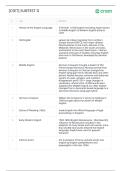
[CSET] SUBTEST II
# Term Definition
1 History of the English Language 3 Periods: 1) Old English (including Anglo-Saxon)
2) Middle English 3) Modern English (Early &
Late)
2 Old English spoken by tribes migrating from northern
Europe around 500 CE; four major dialects
(Northumbrian in the north, Mercian in the
Midlands, West Saxon in the south and west,
and Kentish in the east); West Saxon = literary
standard and basis of studies; everyday English
had roots in Old Norse; developed by German
dialects
3 Middle English Norman Conquest brought a dialect of Old
French (Anglo-Norman); 300-year period from
Norman Conquest to Chaucer changed the
English language more radically than any other
period; Modals became common and elaborate
system of cases, genders, and numbers
disappeared; post-1250 = large changes in
vocabulary, where some 10,000 words were
adopted into Middle English; by 1400, English
changed from a Germanic-based language to a
Germanic-Romance language hybrid
4 Norman Conquest William the Conqueror's victory at Hastings in
1066 brought about the advent of Middle
English
5 Statue of Pleading (1362) made English the official language of legal
proceedings in England
6 Early Modern English 1500-1800 (English Renaissance - Wordsworth);
influence of Renaissance resulted in the
adoption of many Greek and Latin words; more
than 26,000 new words entered the English
language; English was used for popular
literature
7 inkhorn terms the translation of fancy Latinate words into
english by English pamphleteers and
playwrights in the late 1500s
, [CSET] SUBTEST II
# Term Definition
8 Great Vowel Shift started in late Middle English and continued
into the Renaissance; shortening of long vowel
sounds where long vowels began to be
pronounced with the tongue higher in the
mouth and the letter "e" at the end of words
became silent
9 1476 William Caxton invented the movable printing
press that helped promote a standard uniform
language, with the dominance of the London
dialect as a result of London serving as the
center for many printers and printing houses
10 Late Modern English 1800-present; the Industrial Revolution and the
rise of new technologies introduced many
scientific words into English, most of which were
adapted from Greek and Latin roots; English
naval dominance and the rise of global trade
brought an influx of foreign words (e.g, pundit
(Hindi), tycoon (Japanese))
11 American English From the 17th century, American English
diverted from British English in pronunciation,
spelling, and vocabulary; many words were
borrowed from Native American languages
(e.g., canoe, barbeque) and Spanish (e.g,
stampede, canyon)
12 dialect a variation of a language that is spoken by
inhabitants of a particular geographic area; a
dialect can have its own grammar and
vocabulary and even have their own subdialects
(e.g., Southern American English, African
American English, Spanglish)
13 pidgin a contact language made up of two or more
languages; helped bridge the gap between
people with no common language;
characterized by a small vocabulary and simple
grammatical structures
# Term Definition
1 History of the English Language 3 Periods: 1) Old English (including Anglo-Saxon)
2) Middle English 3) Modern English (Early &
Late)
2 Old English spoken by tribes migrating from northern
Europe around 500 CE; four major dialects
(Northumbrian in the north, Mercian in the
Midlands, West Saxon in the south and west,
and Kentish in the east); West Saxon = literary
standard and basis of studies; everyday English
had roots in Old Norse; developed by German
dialects
3 Middle English Norman Conquest brought a dialect of Old
French (Anglo-Norman); 300-year period from
Norman Conquest to Chaucer changed the
English language more radically than any other
period; Modals became common and elaborate
system of cases, genders, and numbers
disappeared; post-1250 = large changes in
vocabulary, where some 10,000 words were
adopted into Middle English; by 1400, English
changed from a Germanic-based language to a
Germanic-Romance language hybrid
4 Norman Conquest William the Conqueror's victory at Hastings in
1066 brought about the advent of Middle
English
5 Statue of Pleading (1362) made English the official language of legal
proceedings in England
6 Early Modern English 1500-1800 (English Renaissance - Wordsworth);
influence of Renaissance resulted in the
adoption of many Greek and Latin words; more
than 26,000 new words entered the English
language; English was used for popular
literature
7 inkhorn terms the translation of fancy Latinate words into
english by English pamphleteers and
playwrights in the late 1500s
, [CSET] SUBTEST II
# Term Definition
8 Great Vowel Shift started in late Middle English and continued
into the Renaissance; shortening of long vowel
sounds where long vowels began to be
pronounced with the tongue higher in the
mouth and the letter "e" at the end of words
became silent
9 1476 William Caxton invented the movable printing
press that helped promote a standard uniform
language, with the dominance of the London
dialect as a result of London serving as the
center for many printers and printing houses
10 Late Modern English 1800-present; the Industrial Revolution and the
rise of new technologies introduced many
scientific words into English, most of which were
adapted from Greek and Latin roots; English
naval dominance and the rise of global trade
brought an influx of foreign words (e.g, pundit
(Hindi), tycoon (Japanese))
11 American English From the 17th century, American English
diverted from British English in pronunciation,
spelling, and vocabulary; many words were
borrowed from Native American languages
(e.g., canoe, barbeque) and Spanish (e.g,
stampede, canyon)
12 dialect a variation of a language that is spoken by
inhabitants of a particular geographic area; a
dialect can have its own grammar and
vocabulary and even have their own subdialects
(e.g., Southern American English, African
American English, Spanglish)
13 pidgin a contact language made up of two or more
languages; helped bridge the gap between
people with no common language;
characterized by a small vocabulary and simple
grammatical structures