

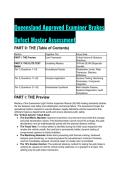
Queensland Approved Examiner Brakes
Defect Master Assessment
PART 0: THE (Table of Contents)
Section Cognitive Tier Focus Area
PART I: THE Preview Core Framework Critical Axioms & Statutory
Directives
PART II: THE ELITE TEST Escalating Mastery 30-Point QLVIM Diagnostic
BANK Gauntlet
Tier 1 (Questions 1–10) Foundational Syntax Deceleration Limits, Wear
Tolerances, Statutory
Definitions
Tier 2 (Questions 11–20) Complex Application Dynamic Testing, Machining
Parameters, Component
Integration
Tier 3 (Questions 21–30) Grandmaster Synthesis Multi-Variable Failures,
Systemic Diagnostics, Audit
Compliance
PART I: THE Preview
Mastery of the Queensland Light Vehicle Inspection Manual (QLVIM) braking standards dictates
the line between road safety and catastrophic mechanical failure. This assessment forges the
operational intuition required to execute flawless, legally defensible vehicle inspections that
withstand rigorous departmental audits and ensure absolute public safety.
The "Critical Axioms" Cheat Sheet
● The Dual-Metric Mandate: Approved examiners must test and record both the average
and peak deceleration values; if the decelerometer cannot record the average, the peak
deceleration must be mathematically paired with the physical distance method.
● The Visual Veto: If a critical defect is identified during the initial visual inspection that
renders the vehicle unsafe, the road test is permanently halted; dynamic testing of
compromised systems is strictly forbidden.
● The Machining Absolute: Brake discs presenting with thermal cracking, hardened
hotspots post-machining, or measuring below the manufacturer's minimum thickness
must be immediately replaced; structural repair of a brake rotor is prohibited.
● The 12% Gradient Anchor: The preferred statutory method for testing the park brake is
verifying its capacity to hold the vehicle strictly stationary on a gradient of at least 12%,
utilizing only the park brake mechanism.
,PART II: THE ELITE TEST BANK
Tier 1 - Foundational Syntax & Application
Q1: An approved examiner is testing the service brakes of a standard modern light vehicle with
a Gross Vehicle Mass (GVM) of 2.2 tonnes from a speed of 35 km/h. Based on the principles of
the QLVIM Section 8, which minimum deceleration threshold is the MOST ACCURATE statutory
requirement for a passing result? A) An average deceleration of 5.9m/s² and a peak
deceleration of 3.8m/s². B) A peak deceleration of 4.4m/s² and an average deceleration of
2.8m/s². C) A peak deceleration of 5.9m/s² (60%g) and an average deceleration of 3.8m/s²
(39%g). D) A peak deceleration of 4.6m/s² and a left-to-right brake force imbalance of less than
30%.
● The Answer: C (A peak deceleration of 5.9m/s² (60%g) and an average deceleration of
3.8m/s² (39%g).)
● Distractor Analysis:
○ A is incorrect: This option erroneously reverses the fundamental physics of braking
data. Peak deceleration represents the highest transient spike of stopping force,
which mathematically must always be higher than the sustained average
deceleration recorded over the entire braking event.
○ B is incorrect: These figures represent the heavily relaxed performance
requirements for a pre-ADR (post-1930) vintage vehicle over 2.5 tonnes, a standard
that is legally inapplicable to a modern hydraulic braking system.
○ D is incorrect: This specific combination of metrics represents the New South Wales
e-Safety Check criteria, representing a jurisdictional hallucination that possesses
zero legal authority under Queensland Transport legislation.
The Mentor's Analysis: The fundamental baseline for light vehicle stopping power rests firmly
on the 5.9/3.8 metric. When evaluating deceleration, the immediate priority is confirming that the
vehicle's kinetic energy can be dispersed safely over time without relying exclusively on
momentary friction spikes that could induce a skid. By utilizing the dual-metric minimums, the
examiner bypasses the common trap of passing a vehicle equipped with an aggressive initial
brake bite but suffering from dangerous, fading sustained stopping power.
Professional/Academic Intuition: The peak proves the hydraulic caliper functions; the average
proves the chassis stops safely.
Q2: During the visual inspection of a light vehicle's braking system, the examiner notes the
bonded brake linings are significantly worn, but the original manufacturer's wear specifications
cannot be located in any technical database. Based on the principles of the QLVIM, what is the
IMMEDIATE statutory rejection threshold for bonded lining thickness? A) The lining thickness
measures less than 1.5mm across the full width of the pad. B) The lining thickness measures
less than 3.0mm at the thinnest measurable point. C) The lining thickness measures less than
0.8mm at any point on the pad or 0.8mm above the head of a rivet. D) The friction material is
entirely depleted, allowing the metal backing plate to contact the rotor.
● The Answer: C (The lining thickness measures less than 0.8mm at any point on the pad
or 0.8mm above the head of a rivet.)
● Distractor Analysis:
○ A is incorrect: The 1.5mm specification is the absolute minimum legal tread depth
for pneumatic tyres across their principal grooves, an entirely unrelated metric often
, confused by novices with brake pad limits.
○ B is incorrect: While 3.0mm is universally taught as a standard preventative
maintenance recommendation by commercial mechanics to upsell repairs, it is not
the statutory legislative failure limit established by the QLVIM.
○ D is incorrect: Permitting a vehicle to reach metal-to-metal contact allows
catastrophic rotor scoring and heat displacement failure, completely invalidating the
pre-emptive safety mandate of the inspection manual.
The Mentor's Analysis: Friction material operates under extreme thermal stress, and without a
specified manufacturer baseline to guarantee adequate thermal mass, a universal hard deck is
required to prevent component fusion. When facing missing manufacturer data, the immediate
priority is applying the statutory 0.8mm floor to guarantee a minimal thermal buffer. By utilizing
the 0.8mm bonded lining rule, the examiner bypasses the common trap of relying on highly
subjective visual estimations of "adequate material" that fail to hold up in a court of law.
Professional/Academic Intuition: In the absolute absence of an OEM manual, 0.8mm is the
strict legal boundary distinguishing safe friction from structural disintegration.
Q3: A light vehicle arrives for a Safety Certificate inspection. Upon placing the vehicle on the
hoist for the initial visual assessment, the examiner discovers a ruptured flexible brake hose
leaking hydraulic fluid directly onto the suspension components. Based on the principles of
QLVIM inspection protocols, which action is the FIRST requirement? A) Clean the fluid, top up
the master cylinder reservoir, and proceed to the dynamic road test to assess the quantitative
severity of the pressure loss. B) Conduct the dynamic road test utilizing only the mechanical
park brake to evaluate the vehicle's secondary braking redundancy. C) Instantly fail the
component and strictly prohibit the road test, as the vehicle is structurally unsafe to operate. D)
Pass the vehicle with a minor defect warning, provided the peak deceleration still registers
safely above 5.9m/s² during testing.
● The Answer: C (Instantly fail the component and strictly prohibit the road test, as the
vehicle is structurally unsafe to operate.)
● Distractor Analysis:
○ A is incorrect: Cleaning the leak and topping up fluid artificially masks a critical
catastrophic failure; initiating dynamic testing of a ruptured hydraulic system risks
total, sudden brake failure on a public road, recklessly endangering the examiner
and the public.
○ B is incorrect: The road test requires a holistic operational assessment of all
systems; attempting to substitute the primary service brake with an emergency/park
brake to circumvent a hydraulic defect is highly illegal and physically dangerous.
○ D is incorrect: A pressurized fluid leak is a severe critical safety defect that
mandates an immediate rejection code; there is no "minor defect" or advisory
allowance for hydraulic ruptures under Queensland law.
The Mentor's Analysis: The absolute integrity of the hydraulic closed-loop system is the
singular lifeline of the service brake mechanism. When facing a visual hydraulic rupture, the
immediate priority is permanently grounding the vehicle and halting all further dynamic
evaluations. By utilizing the Visual Veto mandate, the examiner bypasses the common trap of
prioritizing digital data collection over fundamental, indisputable physical safety.
Professional/Academic Intuition: Visual failure permanently negates dynamic testing; never
road-test a compromised hydraulic system.
Q4: An approved examiner is evaluating a light vehicle's park brake using the preferred
stationary methodology. Based on the precise principles of QLVIM Section 8, which testing
condition establishes the MOST ACCURATE baseline standard for a passing result? A) The
Defect Master Assessment
PART 0: THE (Table of Contents)
Section Cognitive Tier Focus Area
PART I: THE Preview Core Framework Critical Axioms & Statutory
Directives
PART II: THE ELITE TEST Escalating Mastery 30-Point QLVIM Diagnostic
BANK Gauntlet
Tier 1 (Questions 1–10) Foundational Syntax Deceleration Limits, Wear
Tolerances, Statutory
Definitions
Tier 2 (Questions 11–20) Complex Application Dynamic Testing, Machining
Parameters, Component
Integration
Tier 3 (Questions 21–30) Grandmaster Synthesis Multi-Variable Failures,
Systemic Diagnostics, Audit
Compliance
PART I: THE Preview
Mastery of the Queensland Light Vehicle Inspection Manual (QLVIM) braking standards dictates
the line between road safety and catastrophic mechanical failure. This assessment forges the
operational intuition required to execute flawless, legally defensible vehicle inspections that
withstand rigorous departmental audits and ensure absolute public safety.
The "Critical Axioms" Cheat Sheet
● The Dual-Metric Mandate: Approved examiners must test and record both the average
and peak deceleration values; if the decelerometer cannot record the average, the peak
deceleration must be mathematically paired with the physical distance method.
● The Visual Veto: If a critical defect is identified during the initial visual inspection that
renders the vehicle unsafe, the road test is permanently halted; dynamic testing of
compromised systems is strictly forbidden.
● The Machining Absolute: Brake discs presenting with thermal cracking, hardened
hotspots post-machining, or measuring below the manufacturer's minimum thickness
must be immediately replaced; structural repair of a brake rotor is prohibited.
● The 12% Gradient Anchor: The preferred statutory method for testing the park brake is
verifying its capacity to hold the vehicle strictly stationary on a gradient of at least 12%,
utilizing only the park brake mechanism.
,PART II: THE ELITE TEST BANK
Tier 1 - Foundational Syntax & Application
Q1: An approved examiner is testing the service brakes of a standard modern light vehicle with
a Gross Vehicle Mass (GVM) of 2.2 tonnes from a speed of 35 km/h. Based on the principles of
the QLVIM Section 8, which minimum deceleration threshold is the MOST ACCURATE statutory
requirement for a passing result? A) An average deceleration of 5.9m/s² and a peak
deceleration of 3.8m/s². B) A peak deceleration of 4.4m/s² and an average deceleration of
2.8m/s². C) A peak deceleration of 5.9m/s² (60%g) and an average deceleration of 3.8m/s²
(39%g). D) A peak deceleration of 4.6m/s² and a left-to-right brake force imbalance of less than
30%.
● The Answer: C (A peak deceleration of 5.9m/s² (60%g) and an average deceleration of
3.8m/s² (39%g).)
● Distractor Analysis:
○ A is incorrect: This option erroneously reverses the fundamental physics of braking
data. Peak deceleration represents the highest transient spike of stopping force,
which mathematically must always be higher than the sustained average
deceleration recorded over the entire braking event.
○ B is incorrect: These figures represent the heavily relaxed performance
requirements for a pre-ADR (post-1930) vintage vehicle over 2.5 tonnes, a standard
that is legally inapplicable to a modern hydraulic braking system.
○ D is incorrect: This specific combination of metrics represents the New South Wales
e-Safety Check criteria, representing a jurisdictional hallucination that possesses
zero legal authority under Queensland Transport legislation.
The Mentor's Analysis: The fundamental baseline for light vehicle stopping power rests firmly
on the 5.9/3.8 metric. When evaluating deceleration, the immediate priority is confirming that the
vehicle's kinetic energy can be dispersed safely over time without relying exclusively on
momentary friction spikes that could induce a skid. By utilizing the dual-metric minimums, the
examiner bypasses the common trap of passing a vehicle equipped with an aggressive initial
brake bite but suffering from dangerous, fading sustained stopping power.
Professional/Academic Intuition: The peak proves the hydraulic caliper functions; the average
proves the chassis stops safely.
Q2: During the visual inspection of a light vehicle's braking system, the examiner notes the
bonded brake linings are significantly worn, but the original manufacturer's wear specifications
cannot be located in any technical database. Based on the principles of the QLVIM, what is the
IMMEDIATE statutory rejection threshold for bonded lining thickness? A) The lining thickness
measures less than 1.5mm across the full width of the pad. B) The lining thickness measures
less than 3.0mm at the thinnest measurable point. C) The lining thickness measures less than
0.8mm at any point on the pad or 0.8mm above the head of a rivet. D) The friction material is
entirely depleted, allowing the metal backing plate to contact the rotor.
● The Answer: C (The lining thickness measures less than 0.8mm at any point on the pad
or 0.8mm above the head of a rivet.)
● Distractor Analysis:
○ A is incorrect: The 1.5mm specification is the absolute minimum legal tread depth
for pneumatic tyres across their principal grooves, an entirely unrelated metric often
, confused by novices with brake pad limits.
○ B is incorrect: While 3.0mm is universally taught as a standard preventative
maintenance recommendation by commercial mechanics to upsell repairs, it is not
the statutory legislative failure limit established by the QLVIM.
○ D is incorrect: Permitting a vehicle to reach metal-to-metal contact allows
catastrophic rotor scoring and heat displacement failure, completely invalidating the
pre-emptive safety mandate of the inspection manual.
The Mentor's Analysis: Friction material operates under extreme thermal stress, and without a
specified manufacturer baseline to guarantee adequate thermal mass, a universal hard deck is
required to prevent component fusion. When facing missing manufacturer data, the immediate
priority is applying the statutory 0.8mm floor to guarantee a minimal thermal buffer. By utilizing
the 0.8mm bonded lining rule, the examiner bypasses the common trap of relying on highly
subjective visual estimations of "adequate material" that fail to hold up in a court of law.
Professional/Academic Intuition: In the absolute absence of an OEM manual, 0.8mm is the
strict legal boundary distinguishing safe friction from structural disintegration.
Q3: A light vehicle arrives for a Safety Certificate inspection. Upon placing the vehicle on the
hoist for the initial visual assessment, the examiner discovers a ruptured flexible brake hose
leaking hydraulic fluid directly onto the suspension components. Based on the principles of
QLVIM inspection protocols, which action is the FIRST requirement? A) Clean the fluid, top up
the master cylinder reservoir, and proceed to the dynamic road test to assess the quantitative
severity of the pressure loss. B) Conduct the dynamic road test utilizing only the mechanical
park brake to evaluate the vehicle's secondary braking redundancy. C) Instantly fail the
component and strictly prohibit the road test, as the vehicle is structurally unsafe to operate. D)
Pass the vehicle with a minor defect warning, provided the peak deceleration still registers
safely above 5.9m/s² during testing.
● The Answer: C (Instantly fail the component and strictly prohibit the road test, as the
vehicle is structurally unsafe to operate.)
● Distractor Analysis:
○ A is incorrect: Cleaning the leak and topping up fluid artificially masks a critical
catastrophic failure; initiating dynamic testing of a ruptured hydraulic system risks
total, sudden brake failure on a public road, recklessly endangering the examiner
and the public.
○ B is incorrect: The road test requires a holistic operational assessment of all
systems; attempting to substitute the primary service brake with an emergency/park
brake to circumvent a hydraulic defect is highly illegal and physically dangerous.
○ D is incorrect: A pressurized fluid leak is a severe critical safety defect that
mandates an immediate rejection code; there is no "minor defect" or advisory
allowance for hydraulic ruptures under Queensland law.
The Mentor's Analysis: The absolute integrity of the hydraulic closed-loop system is the
singular lifeline of the service brake mechanism. When facing a visual hydraulic rupture, the
immediate priority is permanently grounding the vehicle and halting all further dynamic
evaluations. By utilizing the Visual Veto mandate, the examiner bypasses the common trap of
prioritizing digital data collection over fundamental, indisputable physical safety.
Professional/Academic Intuition: Visual failure permanently negates dynamic testing; never
road-test a compromised hydraulic system.
Q4: An approved examiner is evaluating a light vehicle's park brake using the preferred
stationary methodology. Based on the precise principles of QLVIM Section 8, which testing
condition establishes the MOST ACCURATE baseline standard for a passing result? A) The


