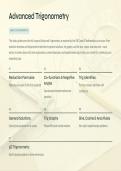
Advanced Trigonometry
GRADE 11 IEB MATHEMATICS
This study guide covers the full scope of Advanced Trigonometry as required by the IEB Grade 11 Mathematics curriculum. From
reduction formulae and trigonometric identities to general solutions, trig graphs, and the sine, cosine, and area rules — each
section is broken down with clear explanations, worked examples, and targeted exam tips to help you master this challenging but
rewarding topic.
01 02 03
Reduction Formulae Co-functions & Negative Trig Identities
Reducing any angle to the first quadrant Angles Proving complex identities with
Special angle transformations and confidence
identities
04 05 06
General Solutions Trig Graphs Sine, Cosine & Area Rules
Solving trig equations for all values Phase shifts and transformations Non-right-angled triangle problems
07
3D Trigonometry
Multi-triangle problems in three dimensions
, CHAPTER 1
Reduction Formulae — The Big Picture
Reduction formulae allow us to rewrite trigonometric ratios of any angle in terms of an acute angle (an angle between 0° and
90°). The core idea is that the magnitude of a trig ratio depends only on the reference angle, while the sign depends on which
quadrant the terminal arm lies in. Mastering this concept is one of the most powerful tools in your trigonometry toolkit.
The CAST diagram (also called the unit circle quadrant rule) tells you which ratios are positive in each quadrant. All ratios are
positive in the first quadrant (0° to 90°), only Sine is positive in the second quadrant (90° to 180°), only Tangent in the third (180°
to 270°), and only Cosine in the fourth (270° to 360°). Remember: All Students Take Calculus.
The key principle: when reducing an angle, if the co-function changes (i.e., you are working with 90° ± θ), the trig ratio swaps
between sin and cos (and tan becomes cot, etc.). When using 180° ± θ or 360° ± θ, the ratio stays the same, and only the sign
changes based on the quadrant. This distinction is critical and is a very common source of errors in exams.
© E-Loné Scheepers 2026
,Reduction Formulae — Reference Tables
The table below summarises all the standard reduction formulae you are expected to know and apply. Study these carefully and
practise deriving them from the CAST diagram rather than simply memorising them — understanding the logic will help you
reconstruct them under pressure.
Angle Form sin cos tan
90° − θ cos θ sin θ cot θ (= 1/tan θ)
90° + θ cos θ −sin θ −cot θ
180° − θ sin θ −cos θ −tan θ
180° + θ −sin θ −cos θ tan θ
360° − θ −sin θ cos θ −tan θ
360° + θ sin θ cos θ tan θ
−θ (negative angle) −sin θ cos θ −tan θ
For 90° ± θ: the ratio NAME changes (sin ↔ cos). For 180° ± θ and 360° ± θ: the ratio NAME stays the same. The sign is
always determined by the quadrant of the original angle.
For angles greater than 360°, simply subtract multiples of 360° until the angle falls within 0° to 360°. For example, sin 450° =
sin(450° − 360°) = sin 90° = 1. For negative angles, use the identity: sin(−θ) = −sin θ and cos(−θ) = cos θ. This is equivalent to a
360° − θ reflection.
© E-Loné Scheepers 2026
, Reduction Formulae — Worked Examples
Let us work through a variety of reduction problems, from straightforward to multi-step, so that you can see exactly how to apply
the formulae systematically. The golden rule is always to identify the quadrant first, determine the sign second, and apply the
ratio change (if any) third.
Example 1: sin 150° Example 2: cos 240°
Write as 180° − 30°. This is in the second quadrant, Write as 180° + 60°. This is in the third quadrant, where
where sine is positive. The ratio stays as sine (180° rule). cosine is negative. The ratio stays as cosine (180° rule).
Therefore: sin 150° = sin 30° = ½ Therefore: cos 240° = −cos 60° = −½
Example 3: tan(−45°) Example 4: sin 750°
Use tan(−θ) = −tan θ. Therefore: tan(−45°) = −tan 45° = Subtract 360° twice: 750° − 720° = 30°. Therefore: sin
−1 750° = sin 30° = ½
Exam Tip: Never skip writing out the quadrant determination step. Examiners award method marks for this, and it
protects you from sign errors — the most common mistake in reduction formulae questions.
© E-Loné Scheepers 2026
GRADE 11 IEB MATHEMATICS
This study guide covers the full scope of Advanced Trigonometry as required by the IEB Grade 11 Mathematics curriculum. From
reduction formulae and trigonometric identities to general solutions, trig graphs, and the sine, cosine, and area rules — each
section is broken down with clear explanations, worked examples, and targeted exam tips to help you master this challenging but
rewarding topic.
01 02 03
Reduction Formulae Co-functions & Negative Trig Identities
Reducing any angle to the first quadrant Angles Proving complex identities with
Special angle transformations and confidence
identities
04 05 06
General Solutions Trig Graphs Sine, Cosine & Area Rules
Solving trig equations for all values Phase shifts and transformations Non-right-angled triangle problems
07
3D Trigonometry
Multi-triangle problems in three dimensions
, CHAPTER 1
Reduction Formulae — The Big Picture
Reduction formulae allow us to rewrite trigonometric ratios of any angle in terms of an acute angle (an angle between 0° and
90°). The core idea is that the magnitude of a trig ratio depends only on the reference angle, while the sign depends on which
quadrant the terminal arm lies in. Mastering this concept is one of the most powerful tools in your trigonometry toolkit.
The CAST diagram (also called the unit circle quadrant rule) tells you which ratios are positive in each quadrant. All ratios are
positive in the first quadrant (0° to 90°), only Sine is positive in the second quadrant (90° to 180°), only Tangent in the third (180°
to 270°), and only Cosine in the fourth (270° to 360°). Remember: All Students Take Calculus.
The key principle: when reducing an angle, if the co-function changes (i.e., you are working with 90° ± θ), the trig ratio swaps
between sin and cos (and tan becomes cot, etc.). When using 180° ± θ or 360° ± θ, the ratio stays the same, and only the sign
changes based on the quadrant. This distinction is critical and is a very common source of errors in exams.
© E-Loné Scheepers 2026
,Reduction Formulae — Reference Tables
The table below summarises all the standard reduction formulae you are expected to know and apply. Study these carefully and
practise deriving them from the CAST diagram rather than simply memorising them — understanding the logic will help you
reconstruct them under pressure.
Angle Form sin cos tan
90° − θ cos θ sin θ cot θ (= 1/tan θ)
90° + θ cos θ −sin θ −cot θ
180° − θ sin θ −cos θ −tan θ
180° + θ −sin θ −cos θ tan θ
360° − θ −sin θ cos θ −tan θ
360° + θ sin θ cos θ tan θ
−θ (negative angle) −sin θ cos θ −tan θ
For 90° ± θ: the ratio NAME changes (sin ↔ cos). For 180° ± θ and 360° ± θ: the ratio NAME stays the same. The sign is
always determined by the quadrant of the original angle.
For angles greater than 360°, simply subtract multiples of 360° until the angle falls within 0° to 360°. For example, sin 450° =
sin(450° − 360°) = sin 90° = 1. For negative angles, use the identity: sin(−θ) = −sin θ and cos(−θ) = cos θ. This is equivalent to a
360° − θ reflection.
© E-Loné Scheepers 2026
, Reduction Formulae — Worked Examples
Let us work through a variety of reduction problems, from straightforward to multi-step, so that you can see exactly how to apply
the formulae systematically. The golden rule is always to identify the quadrant first, determine the sign second, and apply the
ratio change (if any) third.
Example 1: sin 150° Example 2: cos 240°
Write as 180° − 30°. This is in the second quadrant, Write as 180° + 60°. This is in the third quadrant, where
where sine is positive. The ratio stays as sine (180° rule). cosine is negative. The ratio stays as cosine (180° rule).
Therefore: sin 150° = sin 30° = ½ Therefore: cos 240° = −cos 60° = −½
Example 3: tan(−45°) Example 4: sin 750°
Use tan(−θ) = −tan θ. Therefore: tan(−45°) = −tan 45° = Subtract 360° twice: 750° − 720° = 30°. Therefore: sin
−1 750° = sin 30° = ½
Exam Tip: Never skip writing out the quadrant determination step. Examiners award method marks for this, and it
protects you from sign errors — the most common mistake in reduction formulae questions.
© E-Loné Scheepers 2026