
19/9/25
An introduction to fields
When we are describing forces that act at a distance, we are usually
referring to some kind of field.
Examples of fields included: magnetic, electric and gravitational.
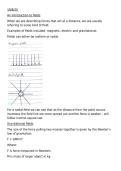
Fields can either be uniform or radial.
For a radial field we can see that as the distance from the point source
increases the field line are more spread out and the force is weaker – will
follow inverse square law.
Gravitational fields
The size of the force pulling two masses together is given by the Newton’s
law of gravitation.
F = GMm/r2
Where:
F is force measured in Newtons
M is mass of larger object in kg
, m is mass of smaller object in kg
r is the separation of the centre of masses of the two objects measured in
m.
G is the universal gravitational constant which is 6.67x10 -11 Nm2kg-2
Gravitational force always attracts. Although it is the weakest force, because
it is cumulative it has the biggest influence over huge (astronomical)
distances.
To see what direction the field is acting, place a test mass in the field and
see which direction the force acts, which way it moves.
Although not really possible to obtain a uniform gravitational field, we can
get a close application when considering the surface of the Earth on a small
scale.
Gravitational field strength is given by the symbol g and is defined by the
force acting per unit mass.
g = F/m and has unit Nkg-1
F = mg
25/9/25
An introduction to fields
When we are describing forces that act at a distance, we are usually
referring to some kind of field.
Examples of fields included: magnetic, electric and gravitational.
Fields can either be uniform or radial.
For a radial field we can see that as the distance from the point source
increases the field line are more spread out and the force is weaker – will
follow inverse square law.
Gravitational fields
The size of the force pulling two masses together is given by the Newton’s
law of gravitation.
F = GMm/r2
Where:
F is force measured in Newtons
M is mass of larger object in kg
, m is mass of smaller object in kg
r is the separation of the centre of masses of the two objects measured in
m.
G is the universal gravitational constant which is 6.67x10 -11 Nm2kg-2
Gravitational force always attracts. Although it is the weakest force, because
it is cumulative it has the biggest influence over huge (astronomical)
distances.
To see what direction the field is acting, place a test mass in the field and
see which direction the force acts, which way it moves.
Although not really possible to obtain a uniform gravitational field, we can
get a close application when considering the surface of the Earth on a small
scale.
Gravitational field strength is given by the symbol g and is defined by the
force acting per unit mass.
g = F/m and has unit Nkg-1
F = mg
25/9/25


