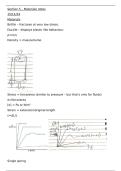
Section 5 – Materials notes
15/11/24
Materials
Brittle – fractures at very low stress.
Ductile – displays plastic like behaviour.
ρ=m/v
Density = mass/volume
Stress = force/area (similar to pressure – but that’s only for fluids)
σ=force/area
[σ] = Pa or N/m2
Strain = extension/original length
ε=ΔL/L
Single spring
,Mass / g Force / N Length / m Change in length /
m
0 0 0.560 0.000
100 0.98 0.525 0.035
200 1.96 0.475 0.085
300 2.94 0.438 0.122
400 3.92 0.390 0.170
500 4.90 0.352 0.208
Springs in parallel
Mass / g Force / N Length / m Change in length /
m
0 0 0.565 0.000
100 0.98 0.546 0.019
200 1.96 0.527 0.038
300 2.94 0.507 0.058
400 3.92 0.486 0.079
500 4.90 0.463 0.102
Springs in series
Mass / g Force / N Length / m Change in length /
m
0 0 0.513 0.000
100 0.98 0.425 0.088
200 1.96 0.343 0.170
300 2.94 0.257 0.256
400 3.92 0.174 0.339
500 4.90 0.086 0.427
Gradient of single spring = 2.34 N/cm
5/2.14
Gradient of parallel = 4.76 N/cm
5/1.05
Gradient of series = 1.15 N/cm
3/2.60
, 21/11/24
Springs and Hooke’s law
1. Stress is defined as force per unit area in Pascals, strain is defined as
extension/original length.
2. Spring constant is the gradient of force extension graph.
3. When the spring constant of a single spring is 200 N/m, springs in
series have 100 N/m spring constant, and springs in parallel have a
spring constant of 400 N/m.
15/11/24
Materials
Brittle – fractures at very low stress.
Ductile – displays plastic like behaviour.
ρ=m/v
Density = mass/volume
Stress = force/area (similar to pressure – but that’s only for fluids)
σ=force/area
[σ] = Pa or N/m2
Strain = extension/original length
ε=ΔL/L
Single spring
,Mass / g Force / N Length / m Change in length /
m
0 0 0.560 0.000
100 0.98 0.525 0.035
200 1.96 0.475 0.085
300 2.94 0.438 0.122
400 3.92 0.390 0.170
500 4.90 0.352 0.208
Springs in parallel
Mass / g Force / N Length / m Change in length /
m
0 0 0.565 0.000
100 0.98 0.546 0.019
200 1.96 0.527 0.038
300 2.94 0.507 0.058
400 3.92 0.486 0.079
500 4.90 0.463 0.102
Springs in series
Mass / g Force / N Length / m Change in length /
m
0 0 0.513 0.000
100 0.98 0.425 0.088
200 1.96 0.343 0.170
300 2.94 0.257 0.256
400 3.92 0.174 0.339
500 4.90 0.086 0.427
Gradient of single spring = 2.34 N/cm
5/2.14
Gradient of parallel = 4.76 N/cm
5/1.05
Gradient of series = 1.15 N/cm
3/2.60
, 21/11/24
Springs and Hooke’s law
1. Stress is defined as force per unit area in Pascals, strain is defined as
extension/original length.
2. Spring constant is the gradient of force extension graph.
3. When the spring constant of a single spring is 200 N/m, springs in
series have 100 N/m spring constant, and springs in parallel have a
spring constant of 400 N/m.