Economic Growth
The distinction between actual and potential growth
Actual growth is the percentage annual increase in national output or GDP (gross domestic
product).
Potential growth is the percentage annual increase in the capacity of the economy to produce.
Potential output is the output that could be produced in the economy if all firms were
operating at their normal level of capacity utilisation.
The difference between actual and potential output is known as the output gap. Thus if actual
output exceeds potential output, the output gap is positive. If the opposite, then the output
gap is negative.
If the actual growth rate is less than the potential growth rate, there will be an increase in
spare capacity and an increase in unemployment (the output gap will also worsen).
In the long-run, the actual growth rate will be limited to the potential growth rate.
Actual economic growth and the business cycle
Growth in potential output tends to be much steadier than the growth in actual output. Actual
growth tends to fluctuate. In some years there is a high rate of economic growth (boom). In
other years, economic growth is low or even negative (recession).
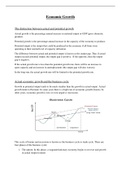
This cycle of booms and recessions is known as the business cycle or trade cycle. There are
four phases of the business cycle:
1. The upturn. In this phase, a stagnant/stationary economy begins to recover and growth
in actual output resumes
, 2. The rapid expansion. In this phase, there is rapid economic growth. The economy, at
this stage, is booming and the gap between actual and full/potential output narrows
3. The peaking out. In this phase, growth slows down or even ceases
4. The slowdown, recession or slump. In this phase, there is little or no growth or even a
decline in output. Increasing slack develops in the economy
The long-term national trend is represented by a line showing the trend of national output
over time.
The business cycle in practice
In practice business cycles are highly irregular, due to:
• The magnitude of the phases
• The length of phases
Causes of fluctuations in actual growth
Economists typically focus on variations in the growth of aggregate demand (the total
spending on goods and services made within the country) in explaining variations in the rate
of actual growth in the short run. A rapid rise in aggregate demand will create shortages. This
will tend to stimulate firms to increase output, thereby reducing slack in the economy.
Similarly, a reduction in aggregate demand will leave firms with increased stocks of unsold
goods. They will therefore tend to reduce output. Aggregate demand and actual output
therefore tend to fluctuate together in the short run.
Shifts in aggregate supply (the total amount of goods and services supplied by firms within
the country) can also lead to fluctuations in the rate of economic growth. Sudden sharp
changes to input prices could affect firms out decisions.
When viewing economic growth over the long term, aggregate supply takes an increasing
importance. This is because a rapid rise in aggregate demand is not enough to ensure a
continuing high level of growth over a number of years. Without an expansion of potential
output too, rises in actual output must eventually come to an end as spare capacity is used up
(i.e. reach full capacity). Therefore, in the long-run there are two determinants of actual
growth:
• The growth in aggregate demand, which determines whether potential output will be
realised
• The growth in potential output
Potential economic growth
There are two main determinants of potential output:
• The amount of resources available, and
• Their productivity
The distinction between actual and potential growth
Actual growth is the percentage annual increase in national output or GDP (gross domestic
product).
Potential growth is the percentage annual increase in the capacity of the economy to produce.
Potential output is the output that could be produced in the economy if all firms were
operating at their normal level of capacity utilisation.
The difference between actual and potential output is known as the output gap. Thus if actual
output exceeds potential output, the output gap is positive. If the opposite, then the output
gap is negative.
If the actual growth rate is less than the potential growth rate, there will be an increase in
spare capacity and an increase in unemployment (the output gap will also worsen).
In the long-run, the actual growth rate will be limited to the potential growth rate.
Actual economic growth and the business cycle
Growth in potential output tends to be much steadier than the growth in actual output. Actual
growth tends to fluctuate. In some years there is a high rate of economic growth (boom). In
other years, economic growth is low or even negative (recession).
This cycle of booms and recessions is known as the business cycle or trade cycle. There are
four phases of the business cycle:
1. The upturn. In this phase, a stagnant/stationary economy begins to recover and growth
in actual output resumes
, 2. The rapid expansion. In this phase, there is rapid economic growth. The economy, at
this stage, is booming and the gap between actual and full/potential output narrows
3. The peaking out. In this phase, growth slows down or even ceases
4. The slowdown, recession or slump. In this phase, there is little or no growth or even a
decline in output. Increasing slack develops in the economy
The long-term national trend is represented by a line showing the trend of national output
over time.
The business cycle in practice
In practice business cycles are highly irregular, due to:
• The magnitude of the phases
• The length of phases
Causes of fluctuations in actual growth
Economists typically focus on variations in the growth of aggregate demand (the total
spending on goods and services made within the country) in explaining variations in the rate
of actual growth in the short run. A rapid rise in aggregate demand will create shortages. This
will tend to stimulate firms to increase output, thereby reducing slack in the economy.
Similarly, a reduction in aggregate demand will leave firms with increased stocks of unsold
goods. They will therefore tend to reduce output. Aggregate demand and actual output
therefore tend to fluctuate together in the short run.
Shifts in aggregate supply (the total amount of goods and services supplied by firms within
the country) can also lead to fluctuations in the rate of economic growth. Sudden sharp
changes to input prices could affect firms out decisions.
When viewing economic growth over the long term, aggregate supply takes an increasing
importance. This is because a rapid rise in aggregate demand is not enough to ensure a
continuing high level of growth over a number of years. Without an expansion of potential
output too, rises in actual output must eventually come to an end as spare capacity is used up
(i.e. reach full capacity). Therefore, in the long-run there are two determinants of actual
growth:
• The growth in aggregate demand, which determines whether potential output will be
realised
• The growth in potential output
Potential economic growth
There are two main determinants of potential output:
• The amount of resources available, and
• Their productivity