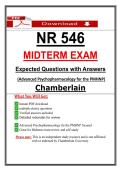
NR 546
MIDTERM EXAM
Expected Questions with Answers
(Advanced Psychopharmacology for the PMHNP)
Chamberlain
What You Will Get:
Instant PDF download
multiple-choice questions
Verified answers included
Detailed rationales for review
Advanced Psychopharmacology for the PMHNP focused
Great for Midterm exam review and self-study
Please note: This is an independent study resource and is not affiliated
with or endorsed by Chamberlain University.
,1. A 24-year-old male initially presents with acute auditory hallucinations and is
treated with medication. Four days later he arrives at your office for evaluation. You
observe that he is neatly dressed, avoids eye contact, and gives very short answers to
your initial questions. Which of the following questions would be most beneficial for
determining his degree of negative symptoms?
A. “How many hours did you sleep last night?”
B. “How often have you visited with friends in the past week?”
C. “Do you still hear voices when no one is around?”
D. “Can you describe your current mood in one word?”
Correct Answer: B
Rationale: Negative symptoms of schizophrenia include avolition, asociality, and flat
affect. Assessing recent social engagement directly targets social withdrawal and
avolition, whereas sleep, hallucinations, and mood items assess general medical,
positive, or affective domains.
2. A 21-year-old man who has just been diagnosed with schizophrenia presents with
his parents. He speaks with a reserved and simple language processing style; he is able
to understand and relate to simple questions, but seems to get lost when the pace of
the conversation between the clinician and parents accelerates. When reviewing the
patient's history, what pattern of cognitive functioning prior to psychosis onset would
you be most likely to find?
A. Superior cognitive functioning premorbidly with decline during the prodromal phase
B. Impaired cognitive functioning premorbidly with further decline during the prodromal
phase
C. Normal cognitive functioning premorbidly with sudden decline at psychosis onset
D. Gradually improving cognitive functioning throughout adolescence
Correct Answer: B
Rationale: Schizophrenia is a neurodevelopmental disorder; cognitive deficits in
processing speed, working memory, and executive function often predate illness onset
and worsen during the prodromal period.
,3. A 24-year-old woman is hospitalized after an altercation in which she screamed at
and attacked her neighbor when he knocked on her door. Her mother reports that she
has been increasingly erratic recently, with emotional outbursts and impulsive
behavior. Which of the following brain regions is most likely associated with these
symptoms?
A. Hippocampus
B. Dorsolateral prefrontal cortex
C. Orbital frontal cortex
D. Primary motor cortex
Correct Answer: C
Rationale: The orbital frontal cortex regulates impulse control, emotional responses,
and social behavior. Lesions or dysfunction here produce disinhibition, emotional lability,
and impulsive aggression.
4. A major current hypothesis for the cause of schizophrenia proposes that N-methyl-
d-aspartate (NMDA) receptors may be:
A. Hypofunctional
B. Hyperfunctional
C. Completely absent in the prefrontal cortex
D. Overexpressed in the substantia nigra
Correct Answer: A
Rationale: The NMDA receptor hypofunction hypothesis posits that reduced
glutamatergic neurotransmission via NMDA receptors contributes to schizophrenia
symptoms, supported by effects of NMDA antagonists like ketamine.
5. Tim is a 17-year-old patient with first-onset schizophrenia. He is currently taking the
antipsychotic fluphenazine but is not experiencing any relief from his positive
symptoms. Lab testing reveals that Tim’s fluphenazine plasma levels are low; thus,
there may not be sufficient blockade of dopamine D2 receptors. In order for an
, antipsychotic to exert therapeutic effects, what is the minimum hypothetical threshold
of D2 receptor occupancy?
A. >30%
B. >45%
C. >60%
D. >80%
Correct Answer: C
Rationale: PET imaging studies demonstrate that antipsychotic efficacy for positive
symptoms generally requires D2 receptor occupancy exceeding approximately 60%;
occupancy below this threshold is associated with inadequate response.
6. Based on thorough evaluation of a patient and his history, his care provider intends
to begin treatment with a conventional antipsychotic but has not selected a particular
agent yet. Which of the following is most true about conventional antipsychotics?
A. They are very similar in therapeutic profile but differ in side-effect profile
B. High-potency agents are significantly more effective for positive symptoms than low-
potency agents
C. Low-potency agents are preferred for treatment-resistant schizophrenia
D. They differ fundamentally in their mechanism of action at D2 receptors
Correct Answer: A
Rationale: Conventional (first-generation) antipsychotics are generally equivalent in
efficacy for positive symptoms; their primary distinction lies in side-effect profiles,
particularly differences in extrapyramidal symptoms and anticholinergic effects related
to potency.
7. A 34-year-old man is initiated on an atypical antipsychotic for the treatment of
schizophrenia. The majority of atypical antipsychotics:
A. Have higher affinity for dopamine D2 receptors than for serotonin 2A receptors
B. Have higher affinity for serotonin 2A receptors than for dopamine D2 receptors
MIDTERM EXAM
Expected Questions with Answers
(Advanced Psychopharmacology for the PMHNP)
Chamberlain
What You Will Get:
Instant PDF download
multiple-choice questions
Verified answers included
Detailed rationales for review
Advanced Psychopharmacology for the PMHNP focused
Great for Midterm exam review and self-study
Please note: This is an independent study resource and is not affiliated
with or endorsed by Chamberlain University.
,1. A 24-year-old male initially presents with acute auditory hallucinations and is
treated with medication. Four days later he arrives at your office for evaluation. You
observe that he is neatly dressed, avoids eye contact, and gives very short answers to
your initial questions. Which of the following questions would be most beneficial for
determining his degree of negative symptoms?
A. “How many hours did you sleep last night?”
B. “How often have you visited with friends in the past week?”
C. “Do you still hear voices when no one is around?”
D. “Can you describe your current mood in one word?”
Correct Answer: B
Rationale: Negative symptoms of schizophrenia include avolition, asociality, and flat
affect. Assessing recent social engagement directly targets social withdrawal and
avolition, whereas sleep, hallucinations, and mood items assess general medical,
positive, or affective domains.
2. A 21-year-old man who has just been diagnosed with schizophrenia presents with
his parents. He speaks with a reserved and simple language processing style; he is able
to understand and relate to simple questions, but seems to get lost when the pace of
the conversation between the clinician and parents accelerates. When reviewing the
patient's history, what pattern of cognitive functioning prior to psychosis onset would
you be most likely to find?
A. Superior cognitive functioning premorbidly with decline during the prodromal phase
B. Impaired cognitive functioning premorbidly with further decline during the prodromal
phase
C. Normal cognitive functioning premorbidly with sudden decline at psychosis onset
D. Gradually improving cognitive functioning throughout adolescence
Correct Answer: B
Rationale: Schizophrenia is a neurodevelopmental disorder; cognitive deficits in
processing speed, working memory, and executive function often predate illness onset
and worsen during the prodromal period.
,3. A 24-year-old woman is hospitalized after an altercation in which she screamed at
and attacked her neighbor when he knocked on her door. Her mother reports that she
has been increasingly erratic recently, with emotional outbursts and impulsive
behavior. Which of the following brain regions is most likely associated with these
symptoms?
A. Hippocampus
B. Dorsolateral prefrontal cortex
C. Orbital frontal cortex
D. Primary motor cortex
Correct Answer: C
Rationale: The orbital frontal cortex regulates impulse control, emotional responses,
and social behavior. Lesions or dysfunction here produce disinhibition, emotional lability,
and impulsive aggression.
4. A major current hypothesis for the cause of schizophrenia proposes that N-methyl-
d-aspartate (NMDA) receptors may be:
A. Hypofunctional
B. Hyperfunctional
C. Completely absent in the prefrontal cortex
D. Overexpressed in the substantia nigra
Correct Answer: A
Rationale: The NMDA receptor hypofunction hypothesis posits that reduced
glutamatergic neurotransmission via NMDA receptors contributes to schizophrenia
symptoms, supported by effects of NMDA antagonists like ketamine.
5. Tim is a 17-year-old patient with first-onset schizophrenia. He is currently taking the
antipsychotic fluphenazine but is not experiencing any relief from his positive
symptoms. Lab testing reveals that Tim’s fluphenazine plasma levels are low; thus,
there may not be sufficient blockade of dopamine D2 receptors. In order for an
, antipsychotic to exert therapeutic effects, what is the minimum hypothetical threshold
of D2 receptor occupancy?
A. >30%
B. >45%
C. >60%
D. >80%
Correct Answer: C
Rationale: PET imaging studies demonstrate that antipsychotic efficacy for positive
symptoms generally requires D2 receptor occupancy exceeding approximately 60%;
occupancy below this threshold is associated with inadequate response.
6. Based on thorough evaluation of a patient and his history, his care provider intends
to begin treatment with a conventional antipsychotic but has not selected a particular
agent yet. Which of the following is most true about conventional antipsychotics?
A. They are very similar in therapeutic profile but differ in side-effect profile
B. High-potency agents are significantly more effective for positive symptoms than low-
potency agents
C. Low-potency agents are preferred for treatment-resistant schizophrenia
D. They differ fundamentally in their mechanism of action at D2 receptors
Correct Answer: A
Rationale: Conventional (first-generation) antipsychotics are generally equivalent in
efficacy for positive symptoms; their primary distinction lies in side-effect profiles,
particularly differences in extrapyramidal symptoms and anticholinergic effects related
to potency.
7. A 34-year-old man is initiated on an atypical antipsychotic for the treatment of
schizophrenia. The majority of atypical antipsychotics:
A. Have higher affinity for dopamine D2 receptors than for serotonin 2A receptors
B. Have higher affinity for serotonin 2A receptors than for dopamine D2 receptors