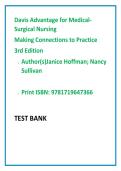
Davis Advantage for Medical-
Surgical Nursing
Making Connections to Practice
3rd Edition
• Author(s)Janice Hoffman; Nancy
Sullivan
• Print ISBN: 9781719647366
TEST BANK
,1) MCQ
Clinical Scenario:
A nurse on a medical-surgical unit receives report on four
patients. One patient is 2 hours post-op and reports incisional
pain rated 7/10. Another has a stable chronic wound. A third
patient has a new oxygen saturation of 88% and is more
confused than earlier in the shift. The fourth patient is waiting
for discharge teaching.
Question Stem:
Which patient should the nurse assess first?
Answer Options:
A. The patient reporting incisional pain rated 7/10
B. The patient with the stable chronic wound
C. The patient with oxygen saturation of 88% and new
confusion
D. The patient waiting for discharge teaching
Correct Answer:
C
Detailed Rationale:
This patient has new confusion and hypoxemia, which are cues
of possible deterioration requiring immediate assessment. In
the clinical judgment process, the nurse must recognize cues
indicating a threat to oxygenation and perfusion. New
confusion in an adult may reflect impaired oxygen delivery,
,infection, medication effect, or another acute problem. The
safest first action is to assess the unstable patient.
Incorrect Option Analysis:
• A: Pain is important, but this patient is not the highest
priority because the situation does not currently suggest
immediate physiologic instability.
Misconception: Thinking all severe pain outranks abnormal
vital signs.
Risk: Delayed response to hypoxemia and acute mental
status change.
• B: A stable chronic wound is lower priority.
Misconception: Chronic problems are always urgent.
Risk: Missed recognition of deterioration in another
patient.
• D: Discharge teaching is important but can wait until
unstable patients are addressed.
Misconception: Routine care can be done before urgent
assessment.
Risk: Unsafe delay in treating possible respiratory
compromise.
Nursing Process Linkage: Assessment
NCJMM Competencies: Recognize Cues; Prioritize Hypotheses
Difficulty: Moderate
Bloom’s Cognitive Level: Apply
NCLEX Client Needs Category: Physiological Adaptation
, Key Learning Objective: Prioritize assessment of a patient
showing signs of acute deterioration.
2) MCQ
Clinical Scenario:
A unit council is reviewing how to reduce medication errors on
a med-surg floor.
Question Stem:
Which action best reflects evidence-based nursing practice?
Answer Options:
A. Continue using the same fall-prevention process because
staff are familiar with it
B. Adopt a medication barcode process after reviewing current
research and unit error data
C. Follow the most experienced nurse’s preference for
medication administration
D. Use a practice change only after a physician requests it
Correct Answer:
B
Detailed Rationale:
Evidence-based practice combines the best current evidence,
clinical expertise, and patient values. Reviewing research and
local outcome data before changing a medication process is the
strongest example of EBP. Barcode verification reduces
administration errors and supports patient safety.
Surgical Nursing
Making Connections to Practice
3rd Edition
• Author(s)Janice Hoffman; Nancy
Sullivan
• Print ISBN: 9781719647366
TEST BANK
,1) MCQ
Clinical Scenario:
A nurse on a medical-surgical unit receives report on four
patients. One patient is 2 hours post-op and reports incisional
pain rated 7/10. Another has a stable chronic wound. A third
patient has a new oxygen saturation of 88% and is more
confused than earlier in the shift. The fourth patient is waiting
for discharge teaching.
Question Stem:
Which patient should the nurse assess first?
Answer Options:
A. The patient reporting incisional pain rated 7/10
B. The patient with the stable chronic wound
C. The patient with oxygen saturation of 88% and new
confusion
D. The patient waiting for discharge teaching
Correct Answer:
C
Detailed Rationale:
This patient has new confusion and hypoxemia, which are cues
of possible deterioration requiring immediate assessment. In
the clinical judgment process, the nurse must recognize cues
indicating a threat to oxygenation and perfusion. New
confusion in an adult may reflect impaired oxygen delivery,
,infection, medication effect, or another acute problem. The
safest first action is to assess the unstable patient.
Incorrect Option Analysis:
• A: Pain is important, but this patient is not the highest
priority because the situation does not currently suggest
immediate physiologic instability.
Misconception: Thinking all severe pain outranks abnormal
vital signs.
Risk: Delayed response to hypoxemia and acute mental
status change.
• B: A stable chronic wound is lower priority.
Misconception: Chronic problems are always urgent.
Risk: Missed recognition of deterioration in another
patient.
• D: Discharge teaching is important but can wait until
unstable patients are addressed.
Misconception: Routine care can be done before urgent
assessment.
Risk: Unsafe delay in treating possible respiratory
compromise.
Nursing Process Linkage: Assessment
NCJMM Competencies: Recognize Cues; Prioritize Hypotheses
Difficulty: Moderate
Bloom’s Cognitive Level: Apply
NCLEX Client Needs Category: Physiological Adaptation
, Key Learning Objective: Prioritize assessment of a patient
showing signs of acute deterioration.
2) MCQ
Clinical Scenario:
A unit council is reviewing how to reduce medication errors on
a med-surg floor.
Question Stem:
Which action best reflects evidence-based nursing practice?
Answer Options:
A. Continue using the same fall-prevention process because
staff are familiar with it
B. Adopt a medication barcode process after reviewing current
research and unit error data
C. Follow the most experienced nurse’s preference for
medication administration
D. Use a practice change only after a physician requests it
Correct Answer:
B
Detailed Rationale:
Evidence-based practice combines the best current evidence,
clinical expertise, and patient values. Reviewing research and
local outcome data before changing a medication process is the
strongest example of EBP. Barcode verification reduces
administration errors and supports patient safety.