

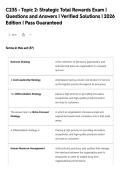
C235 - Topic 2: Strategic Total Rewards Exam |
Questions and Answers | Verified Solutions | 2026
Edition | Pass Guaranteed
Save
Terms in this set (37)
Business Strategy is the collection of decisions, approaches, and
activities that allow an organization to compete
and win
A Cost Leadership Strategy emphasizes having a lower cost product or service
as the highest priority throughout its processes.
The Differentiation Strategy places a high priority on providing innovative,
exceptional, and high-quality products and/or
services to customers.
The answer lies in a Niche-Focused in which an organization chooses a small and
Strategy segmented market and competes only in that small
arena.
A differentiation strategy is: Placing a high priority on providing innovative,
exceptional, and high-quality products and/or
services to customers.
Human Resource Management is the policies, practices, and systems that manage
the interface between the organization and its
employees in order to enable long-term
organizational performance.
, HR functions include workforce planning, recruiting, selection, training,
rewards, performance management, and career
management as well as the human resource
information systems and strategic functions that
integrate across those areas.
Strategic Human Resource Business Strategy
Management ensures that HR
practices are aligned with the
____________ _____________ in general and
critical success factors in particular.
Total rewards plays a ______________ role Vital
in the business strategy.
An organization's Total Rewards is the combination of pay forms, plans, policies,
Strategy and practices that enable long-term organizational
performance.
Reward Form Combinations reward forms offered (e.g., cash, benefits, etc.) and
Strategy the way in which they relate to each other. For
example, choosing to pay employees a salary is a
specific reward form strategy, as is the choice to
have a highly competitive work environment. The
Reward Form Combinations Strategy refers to the
way in which paying salary and the competitive
climate combine. Thus, when choosing to pay
either hourly, salary, based on performance, or any
other reward form, the decision should be made
with full consideration of business refers to the
strategy, reward strategy, and in relation to other
forms of rewards being used.
Reward Level Strategies define what Level of each reward will be offered.
Questions and Answers | Verified Solutions | 2026
Edition | Pass Guaranteed
Save
Terms in this set (37)
Business Strategy is the collection of decisions, approaches, and
activities that allow an organization to compete
and win
A Cost Leadership Strategy emphasizes having a lower cost product or service
as the highest priority throughout its processes.
The Differentiation Strategy places a high priority on providing innovative,
exceptional, and high-quality products and/or
services to customers.
The answer lies in a Niche-Focused in which an organization chooses a small and
Strategy segmented market and competes only in that small
arena.
A differentiation strategy is: Placing a high priority on providing innovative,
exceptional, and high-quality products and/or
services to customers.
Human Resource Management is the policies, practices, and systems that manage
the interface between the organization and its
employees in order to enable long-term
organizational performance.
, HR functions include workforce planning, recruiting, selection, training,
rewards, performance management, and career
management as well as the human resource
information systems and strategic functions that
integrate across those areas.
Strategic Human Resource Business Strategy
Management ensures that HR
practices are aligned with the
____________ _____________ in general and
critical success factors in particular.
Total rewards plays a ______________ role Vital
in the business strategy.
An organization's Total Rewards is the combination of pay forms, plans, policies,
Strategy and practices that enable long-term organizational
performance.
Reward Form Combinations reward forms offered (e.g., cash, benefits, etc.) and
Strategy the way in which they relate to each other. For
example, choosing to pay employees a salary is a
specific reward form strategy, as is the choice to
have a highly competitive work environment. The
Reward Form Combinations Strategy refers to the
way in which paying salary and the competitive
climate combine. Thus, when choosing to pay
either hourly, salary, based on performance, or any
other reward form, the decision should be made
with full consideration of business refers to the
strategy, reward strategy, and in relation to other
forms of rewards being used.
Reward Level Strategies define what Level of each reward will be offered.


