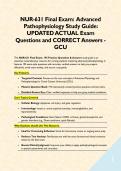
NUR-631 Final Exam: Advanced
Pathophysiology Study Guide:
UPDATED ACTUAL Exam
Questions and CORRECT Answers -
GCU
This NUR-631 Final Exam: 195 Practice Questions & Answers study guide is an
essential, comprehensive resource for nursing students mastering advanced pathophysiology. It
features 195 exam-style questions with accurate, verified answers to help you prepare
effectively, avoid exam anxiety, and secure a top grade.
Key Features
• Targeted Content: Focuses on the core concepts of Advanced Physiology and
Pathophysiology for Grand Canyon University (GCU).
• Massive Question Bank: 195 meticulously curated practice questions and test items.
• Detailed Answer Key: Clear, verified responses to help you grasp medical conditions.
Core Topics Covered
• Cellular Biology: Apoptosis, cell injury, and gene regulation.
• Immunology: Innate vs. active acquired immunity, immunoglobulins, and
hypersensitivity.
• Pathological Conditions: Heart failure, COPD, cirrhosis, glomerulonephritis, and
genetic disorders (e.g., Down syndrome, cystic fibrosis).
Why Students should Use This Resource
• Ideal for Cramming & Review: Great for last-minute review or ongoing exam prep.
• Reduces Test Anxiety: Familiarizes you with the exact formats and clinical scenarios
tested on the final exam.
• Boosts Clinical Judgment: Improves your ability to apply pathophysiological concepts
to patient assessments and care plans
1
,Q1. Explain why squatting is a spontaneous maneuver that relieves hypoxic
spells in children with tetralogy of Fallot. [Short Answer]
Answer: Squatting alleviates hypoxic spells because it increases systemic vascular
resistance and decreases venous return from the inferior vena cava, altering circulatory
dynamics in a way that reduces the severity of the spell.
Explanation: In tetralogy of Fallot, squatting is a compensatory action that changes
hemodynamics: raising systemic resistance and lowering venous return modifies the balance of
blood flow through the heart and lungs, which helps reduce the conditions that produce hypoxia.
These specific changes—higher systemic resistance and reduced venous return—are the
physiologic basis for why squatting relieves spells.
Q2. Which hormone is required for water reabsorption in the distal tubule and
collecting duct? [Multiple Choice]
A) Adrenocorticotropin hormone
B) Antidiuretic hormone
C) Cortisol
D) Aldosterone
Answer: Antidiuretic hormone
Explanation: Antidiuretic hormone (ADH) increases water permeability of the late distal tubule
and collecting duct, allowing water reabsorption and concentration of urine. Aldosterone
primarily promotes sodium reabsorption and potassium secretion, cortisol has broad metabolic
effects, and adrenocorticotropic hormone stimulates adrenal cortisol production—none directly
control water permeability in those nephron segments the way ADH does.
Q3. Pulmonary disease with elevated pulmonary vascular resistance most
directly predisposes to which form of heart failure? [Multiple Choice]
A) Right heart failure
B) Low-output failure
C) Left heart failure
D) High-output failure
Answer: Right heart failure
2
, Explanation: When pulmonary vascular resistance rises, the right ventricle must pump against a
higher afterload; over time this can cause failure of the right heart. Left heart failure originates
from problems in left ventricular function, not primary pulmonary vascular resistance. Low-
output and high-output failure describe global cardiac output states and are not the direct,
specific consequence of elevated pulmonary vascular resistance the way right heart failure is.
Q4. Which organism is the most common cause of uncomplicated urinary tract
infections? [Multiple Choice]
A) Klebsiella
B) Escherichia coli
C) Proteus
D) Staphylococcus
Answer: Escherichia coli
Explanation: Uropathogenic strains of Escherichia coli are responsible for the majority of
uncomplicated urinary tract infections, making E. coli the most common pathogen.
Staphylococcus, Klebsiella, and Proteus can cause UTIs but are less frequent causes of
uncomplicated infections.
Q5. Between which gestational weeks does surfactant secretion begin,
decreasing the risk of respiratory distress syndrome (RDS)? [Multiple Choice]
A) 16 and 24
B) 30 and 36
C) 24 and 30
D) 20 and 24
Answer: 30 and 36
Explanation: Surfactant production in the fetal lung starts in the period between 30 and 36
weeks of gestation; this increases alveolar stability and lowers the chance of RDS. Earlier
gestational windows listed are before significant surfactant secretion begins, so the risk of RDS
remains higher in those periods.
Q6. The presence of fluid in the pleural space is called what? [Multiple Choice]
A) Atelectasis
B) Pleural effusion
C) Ischemia
3
, D) Bronchiectasis
Answer: Pleural effusion
Explanation: Fluid collecting in the pleural space between the lung and chest wall is defined as a
pleural effusion. Atelectasis refers to collapsed or airless lung tissue, bronchiectasis to permanent
bronchial dilation, and ischemia refers to reduced blood flow — none describe fluid in the pleural
cavity.
Q7. What physical finding is produced by turbulent blood flow through a vessel?
[Multiple Choice]
A) Bounding pulse felt on palpation
B) Increased blood pressure during periods of stress
C) Murmur heard on auscultation
D) Cyanosis observed on excretion
Answer: Murmur heard on auscultation
Explanation: Turbulent flow creates whorls and eddy currents that generate audible noise—
clinically recognized as a murmur on auscultation. Increased blood pressure during stress is a
hemodynamic response, not a direct audible sign of turbulence. A bounding pulse is a palpation
finding related to stroke volume and arterial compliance, not specifically turbulence. 'Cyanosis
observed on excretion' is not a recognized clinical sign related to turbulent vascular flow.
Q8. In neonatal respiratory distress syndrome, what is the primary mechanical
problem in the lungs? [Multiple Choice]
A) Bronchiolar plugging
B) Pulmonary edema
C) Atelectasis
D) Consolidation
Answer: Atelectasis
Explanation: The main mechanical problem in neonatal RDS is atelectasis—alveolar collapse—
because lack of surfactant forces the infant to generate large negative inspiratory pressures to
open alveoli, causing severe hypoxemia. Consolidation (solidified lung from infection), pulmonary
edema (fluid in alveoli), and bronchiolar plugging are different pathological processes and are
not the primary issue in RDS.
4
Pathophysiology Study Guide:
UPDATED ACTUAL Exam
Questions and CORRECT Answers -
GCU
This NUR-631 Final Exam: 195 Practice Questions & Answers study guide is an
essential, comprehensive resource for nursing students mastering advanced pathophysiology. It
features 195 exam-style questions with accurate, verified answers to help you prepare
effectively, avoid exam anxiety, and secure a top grade.
Key Features
• Targeted Content: Focuses on the core concepts of Advanced Physiology and
Pathophysiology for Grand Canyon University (GCU).
• Massive Question Bank: 195 meticulously curated practice questions and test items.
• Detailed Answer Key: Clear, verified responses to help you grasp medical conditions.
Core Topics Covered
• Cellular Biology: Apoptosis, cell injury, and gene regulation.
• Immunology: Innate vs. active acquired immunity, immunoglobulins, and
hypersensitivity.
• Pathological Conditions: Heart failure, COPD, cirrhosis, glomerulonephritis, and
genetic disorders (e.g., Down syndrome, cystic fibrosis).
Why Students should Use This Resource
• Ideal for Cramming & Review: Great for last-minute review or ongoing exam prep.
• Reduces Test Anxiety: Familiarizes you with the exact formats and clinical scenarios
tested on the final exam.
• Boosts Clinical Judgment: Improves your ability to apply pathophysiological concepts
to patient assessments and care plans
1
,Q1. Explain why squatting is a spontaneous maneuver that relieves hypoxic
spells in children with tetralogy of Fallot. [Short Answer]
Answer: Squatting alleviates hypoxic spells because it increases systemic vascular
resistance and decreases venous return from the inferior vena cava, altering circulatory
dynamics in a way that reduces the severity of the spell.
Explanation: In tetralogy of Fallot, squatting is a compensatory action that changes
hemodynamics: raising systemic resistance and lowering venous return modifies the balance of
blood flow through the heart and lungs, which helps reduce the conditions that produce hypoxia.
These specific changes—higher systemic resistance and reduced venous return—are the
physiologic basis for why squatting relieves spells.
Q2. Which hormone is required for water reabsorption in the distal tubule and
collecting duct? [Multiple Choice]
A) Adrenocorticotropin hormone
B) Antidiuretic hormone
C) Cortisol
D) Aldosterone
Answer: Antidiuretic hormone
Explanation: Antidiuretic hormone (ADH) increases water permeability of the late distal tubule
and collecting duct, allowing water reabsorption and concentration of urine. Aldosterone
primarily promotes sodium reabsorption and potassium secretion, cortisol has broad metabolic
effects, and adrenocorticotropic hormone stimulates adrenal cortisol production—none directly
control water permeability in those nephron segments the way ADH does.
Q3. Pulmonary disease with elevated pulmonary vascular resistance most
directly predisposes to which form of heart failure? [Multiple Choice]
A) Right heart failure
B) Low-output failure
C) Left heart failure
D) High-output failure
Answer: Right heart failure
2
, Explanation: When pulmonary vascular resistance rises, the right ventricle must pump against a
higher afterload; over time this can cause failure of the right heart. Left heart failure originates
from problems in left ventricular function, not primary pulmonary vascular resistance. Low-
output and high-output failure describe global cardiac output states and are not the direct,
specific consequence of elevated pulmonary vascular resistance the way right heart failure is.
Q4. Which organism is the most common cause of uncomplicated urinary tract
infections? [Multiple Choice]
A) Klebsiella
B) Escherichia coli
C) Proteus
D) Staphylococcus
Answer: Escherichia coli
Explanation: Uropathogenic strains of Escherichia coli are responsible for the majority of
uncomplicated urinary tract infections, making E. coli the most common pathogen.
Staphylococcus, Klebsiella, and Proteus can cause UTIs but are less frequent causes of
uncomplicated infections.
Q5. Between which gestational weeks does surfactant secretion begin,
decreasing the risk of respiratory distress syndrome (RDS)? [Multiple Choice]
A) 16 and 24
B) 30 and 36
C) 24 and 30
D) 20 and 24
Answer: 30 and 36
Explanation: Surfactant production in the fetal lung starts in the period between 30 and 36
weeks of gestation; this increases alveolar stability and lowers the chance of RDS. Earlier
gestational windows listed are before significant surfactant secretion begins, so the risk of RDS
remains higher in those periods.
Q6. The presence of fluid in the pleural space is called what? [Multiple Choice]
A) Atelectasis
B) Pleural effusion
C) Ischemia
3
, D) Bronchiectasis
Answer: Pleural effusion
Explanation: Fluid collecting in the pleural space between the lung and chest wall is defined as a
pleural effusion. Atelectasis refers to collapsed or airless lung tissue, bronchiectasis to permanent
bronchial dilation, and ischemia refers to reduced blood flow — none describe fluid in the pleural
cavity.
Q7. What physical finding is produced by turbulent blood flow through a vessel?
[Multiple Choice]
A) Bounding pulse felt on palpation
B) Increased blood pressure during periods of stress
C) Murmur heard on auscultation
D) Cyanosis observed on excretion
Answer: Murmur heard on auscultation
Explanation: Turbulent flow creates whorls and eddy currents that generate audible noise—
clinically recognized as a murmur on auscultation. Increased blood pressure during stress is a
hemodynamic response, not a direct audible sign of turbulence. A bounding pulse is a palpation
finding related to stroke volume and arterial compliance, not specifically turbulence. 'Cyanosis
observed on excretion' is not a recognized clinical sign related to turbulent vascular flow.
Q8. In neonatal respiratory distress syndrome, what is the primary mechanical
problem in the lungs? [Multiple Choice]
A) Bronchiolar plugging
B) Pulmonary edema
C) Atelectasis
D) Consolidation
Answer: Atelectasis
Explanation: The main mechanical problem in neonatal RDS is atelectasis—alveolar collapse—
because lack of surfactant forces the infant to generate large negative inspiratory pressures to
open alveoli, causing severe hypoxemia. Consolidation (solidified lung from infection), pulmonary
edema (fluid in alveoli), and bronchiolar plugging are different pathological processes and are
not the primary issue in RDS.
4