Written by students who passed Immediately available after payment Read online or as PDF Wrong document? Swap it for free 4.6 TrustPilot
logo-home
Exam (elaborations)

COMM 287 Exam 2 2026 Questions and Answers (200+ Questions) | Advertising Theory, Consumer Culture, Marketing Psychology, Branding & Media Influence

Rating
-
Sold
-
Pages
9
Grade
A+
Uploaded on
17-06-2026
Written in
2025/2026

This comprehensive COMM 287 Exam 2 2026 Questions and Answers study guide contains more than 200 expertly compiled questions and verified answers covering the major theories, concepts, and critical perspectives examined in Sut Jhally’s Communication 287 course. The material provides extensive coverage of advertising theory, consumer psychology, branding strategies, semiotics, marketing communications, media influence, consumer culture, children's advertising, neuromarketing, food marketing, public health concerns, and the cultural impact of commercial media. Organized in a structured question-and-answer format, this resource enables students to strengthen conceptual understanding, reinforce key terminology, and prepare effectively for examinations focused on advertising, marketing, and media analysis. Key topics include product-based advertising, consumer-based advertising, hard-sell techniques, resonance theory of communication, semiology, symbolic meaning construction, transfer of meaning, audience participation in message creation, cultural codes, product symbolism, celebrity endorsements, lifestyle advertising, branding strategies, consumer identity formation, and the evolution of advertising techniques. Students will develop a thorough understanding of how advertisers create meaning, build emotional connections with audiences, and position products within broader cultural narratives. The guide also examines the progression from product-centered advertising toward sophisticated consumer-centered marketing approaches that emphasize identity, emotion, and lifestyle associations. The material further explores advanced advertising concepts including shock advertising, emotional appeals, self-referential advertising, humor strategies, self-transformation messaging, narrative-based campaigns, and the increasing use of unconventional marketing techniques to overcome advertising clutter. Significant emphasis is placed on understanding how marketing messages resonate with audiences through symbolism, cultural references, emotional triggers, and social expectations. Students will gain valuable insight into the psychological mechanisms that influence consumer behavior and shape purchasing decisions in modern media environments. Additional examination topics include direct-to-consumer pharmaceutical advertising, children's marketing, character licensing, consumer socialization, neuromarketing, micromarketing, brand loyalty development, the nag factor, age compression, materialistic culture, food industry marketing strategies, obesity and public health concerns, chronic disease, social isolation, consumer research methodologies, craving studies, food psychology, product segmentation, and environmental concerns associated with consumer culture. The guide also addresses neuroscience-based marketing concepts involving cortical, limbic, and reptilian brain responses, providing students with a deeper understanding of how advertising influences cognition, emotion, motivation, and behavior. The content aligns with scholarly research in communication studies, media studies, advertising, marketing psychology, consumer behavior, cultural studies, and critical media analysis. Supporting references include the works of Sut Jhally, Roland Barthes, Stuart Hall, Jean Baudrillard, George Gerbner, Naomi Klein, and academic literature examining advertising culture, branding, consumer identity, media influence, marketing ethics, and the commercialization of everyday life. Relevant Students: COMM 287 Students Communication Studies Students Advertising Students Marketing Students Media Studies Students Consumer Behavior Students Public Relations Students Digital Marketing Students Mass Communication Students Brand Management Students Journalism Students Psychology Students Sociology Students Cultural Studies Students Business Administration Students Marketing Research Students Media and Society Students Communication Research Students University of Massachusetts Amherst Students Consumer Culture Researchers Keywords: COMM 287 Exam 2 2026, Sut Jhally Exam Questions and Answers, Communication 287 Study Guide, Advertising Theory, Consumer Culture, Marketing Psychology, Branding Strategies, Consumer Behavior, Product Based Advertising, Consumer Based Advertising, Hard Sell Advertising, Resonance Theory, Semiology, Semiotics, Transfer of Meaning, Cultural Codes, Product Symbolism, Lifestyle Advertising, Celebrity Endorsements, Branding, Audience Participation, Advertising Clutter, Shock Advertising, Emotional Marketing, Self Referential Advertising, Marketing Communications, Direct to Consumer Advertising, Pharmaceutical Advertising, Children's Marketing, Character Licensing, Neuromarketing, Micromarketing, Consumer Socialization, Brand Loyalty, Nag Factor, Age Compression, Materialistic Culture, Food Marketing, Consumer Identity, Media Influence, Advertising Ethics, Marketing Research, Consumer Psychology, Cultural Studies, Brand Management, Media and Society, Marketing Strategy

Show more Read less
Institution
Sut Jhally
Course
Sut Jhally

Content preview

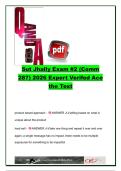
Sut Jhally Exam #2 (Comm
287) 2026 Expert Verifed Ace
the Text


product based approach - ANSWER ✔✔selling based on what is

unique about the product


hard sell - ANSWER ✔✔take one thing and repeat it over and over

again; a single message has no impact, there needs to be multiple

exposures for something to be impactful

, consumer based approach - ANSWER ✔✔less focus on the

uniqueness of the product, but rather a focus on the consumer in mind

when they construct the message; finding information about your target

audience


consumer based approach - ANSWER ✔✔attempts to transform the

audience and connect them and develop relationship with the product

you're selling


resonance theory of communication - ANSWER ✔✔focus on things

that resonate with people; the message should be familiar to people,

create stimuli that does this in an ad


semiology - ANSWER ✔✔how meaning is constructed and how it is

created


transfer of meaning - ANSWER ✔✔the meaning of one sign (i.e. a

celebrity) is transferred to another sign (i.e. a brand) and requires us to

make this


connection - ANSWER ✔✔without the audience an ad is nothing and

no meaning can be created, it requires active participation


codes - ANSWER ✔✔the makeup of advertising; understandings and

reference systems that exist outside of the ad; the interaction with the

Written for

Institution
Sut Jhally
Course
Sut Jhally

Document information

Uploaded on
June 17, 2026
Number of pages
9
Written in
2025/2026
Type
Exam (elaborations)
Contains
Questions & answers

Subjects

$18.99
Get access to the full document:

Wrong document? Swap it for free Within 14 days of purchase and before downloading, you can choose a different document. You can simply spend the amount again.
Written by students who passed
Immediately available after payment
Read online or as PDF


Also available in package deal

Thumbnail
Package deal
COMM 289 EXAM COMPLETE PACKAGE DEAL
-
3 2026
$ 26.28 More info

Get to know the seller

Seller avatar
Reputation scores are based on the amount of documents a seller has sold for a fee and the reviews they have received for those documents. There are three levels: Bronze, Silver and Gold. The better the reputation, the more your can rely on the quality of the sellers work.
JOSHCLAY West Governors University
View profile
Follow You need to be logged in order to follow users or courses
Sold
360
Member since
2 year
Number of followers
15
Documents
19912
Last sold
4 hours ago
JOSHCLAY

JOSHCLAY EXAM HUB, WELCOME ALL, HERE YOU WILL FIND ALL DOCUMENTS & PACKAGE DEAL YOU NEED FOR YOUR SCHOOL WORK OFFERED BY SELLER JOSHCLAY

3.5

80 reviews

5
31
4
12
3
16
2
8
1
13

Why students choose Stuvia

Created by fellow students, verified by reviews

Quality you can trust: written by students who passed their tests and reviewed by others who've used these notes.

Didn't get what you expected? Choose another document

No worries! You can instantly pick a different document that better fits what you're looking for.

Pay as you like, start learning right away

No subscription, no commitments. Pay the way you're used to via credit card and download your PDF document instantly.

Student with book image

“Bought, downloaded, and aced it. It really can be that simple.”

Alisha Student

Working on your references?

Create accurate citations in APA, MLA and Harvard with our free citation generator.

Working on your references?

Frequently asked questions