

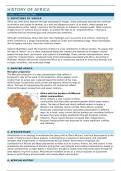
HISTORY OF AFRICA
CLASS 1: INTRODUCTION
1. DEPICTIONS OF ‘AFRICA’
Africa has often been depicted through stereotypical images. These portrayals describe the continent
as primitive and unable to develop, as a wild and dangerous place, or as exotic, where people are
represented as either naked, covered in fanciful designs, or dressed in strange outfits. Other common
images focus on violence and corruption, or present the idea of an “unspoiled Africa,” meaning a
continent that has remained pure and untouched by modernity.
Although contemporary Africa does face real challenges such as poverty and violence, reducing an
entire continent to a single characteristic creates an unfair and misleading image. These stereotypes
did not appear naturally; they have historical origins.
Valentin Mudimbe’s work The Invention of Africa is a key contribution to African studies. He argues that
the idea of “Africa” as it is often understood today was created and imposed by European colonial
powers through texts, documents, and systems of knowledge. These colonial representations, often
called the “colonial library,” produced many of the stereotypes associated with Africa. According to
Mudimbe, Western discourses constructed Africa as a concept and reduced its enormous diversity into
a single, monolithic, and exoticized image.
2. MAPPING AFRICA
Mercator projection:
The Mercator projection is a map representation that reflects a
Eurocentric view of the world. In this projection, Africa appears much
smaller than its actual size, is placed toward the bottom of the map,
while Europe is positioned at the center and appears almost as large as
Africa. This way of representing the world is not neutral but reflects
historical European perspectives and power relations.
Africa with the borders of different
ethnic communities:
Africa contains a vast number of ethnic
communities that were often grouped together within large modern
states. The idea of fixed and clearly defined borders is largely a
Western and relatively recent concept. Many African societies
historically understood territory and political boundaries in different
ways. As a result, many current African borders are considered artificial
because they were largely established through European colonial
influence. These colonial borders remained after independence
because changing them was expected to create significant conflicts
and instability.
3. AFROCENTRISM
Afrocentrism is an ideology or worldview that places Africa, Black Africans, and their descendants at the
center of historical and cultural analysis. It developed as a response to Eurocentric and orientalist
attitudes that marginalized or misrepresented African people. Afrocentrism recognizes the
contributions of African and Black populations to fields such as science, history, art, and culture. It also
emphasizes the importance of Africans writing their own histories and creating interpretations based on
African perspectives. A major figure in Afrocentric thought is Cheikh Anta Diop, particularly through his
work Nations n*gr*s et Culture. Afrocentrism therefore serves as a critical response to Eurocentric
biases in world history and promotes unity among Black communities.
4. AFRICAN HISTORY
,“Perhaps in the future there will be some African history to teach. But at the present there is none,
there is only the history of the Europeans in Africa. The rest is darkness... and darkness is not a subject
of history.” – Trevor Roper
This statement reflects a historical view in which only European colonial history in Africa was
considered worthy of academic study. During the colonial period, disciplines such as history and
anthropology were often used to justify colonial rule. African histories were frequently dismissed
because they relied heavily on oral sources, which many Western scholars considered unreliable. This
created the myth that Africa had no history because it lacked written records. However, oral sources
are not inherently less reliable than written sources. Like all historical sources, they contain biases and
must be critically analyzed.
CLASS 2: DEEP AFRICAN HISTORY
Deep African History refers to periods before the Common Era (BCE). Studying these earlier periods
requires different types of sources than later periods. The closer historians are to the present, the more
diverse their available sources become, while earlier periods rely more heavily on archaeological and
oral evidence.
1. PROBLEMATIC ASPECTS
The starting point of a historical narrative strongly influences how history is understood. The concept of
“precolonial Africa” is problematic because it covers an enormous timeframe, stretching from the
origins of humanity to the arrival of Europeans. This approach places European arrival at the center of
African history and ignores other forms of colonial influence that existed before European imperialism,
such as Byzantine, Roman, or Ottoman forms of expansion. Another issue is “presentism,” a tendency
in African historical studies to explain contemporary situations only through recent events, especially
European colonialism, without considering the longue durée and deeper historical developments of the
continent.
2. OUT OF AFRICA
2.1 OUT OF AFRICA I
Out of Africa I refers to the migration of early hominins from Africa to other parts of the world. This
process took place over millions of years and is not the focus of this course
2.2 OUT OF AFRICA II
Out of Africa II refers to the emergence of the ancestors
of modern humans in Africa and their later spread across
the globe.
Homo sapiens originated in Africa approximately 200,000
to 300,000 years ago. Their migration occurred through
different waves, routes, and groups, increasing their
chances of survival and adaptation. Research on this
topic is rapidly evolving due to advances in archaeology
and genetics. Environmental factors such as climate and
ecology also played an important role in determining the
timing and pathways of these migrations.
2.2.1 HOMINI VS. HOMO SAPIENS
Denisovans:
Denisovans were a group of hominins genetically distinct from both Homo sapiens and Neanderthals.
They mainly lived in Asia.
Neanderthals:
Neanderthals inhabited Eurasia and were first discovered in Germany. They disappeared from the
archaeological record around 40,000 BCE. Although they physically resembled modern humans, they
are often characterized by having less evidence of advanced tools, complex materials, and artistic
expression.
,Homo sapiens:
Some early Homo sapiens remains were initially mistaken for Neanderthals. Numerous archaeological
sites across Africa provide evidence of early Homo sapiens. Their emergence was associated with major
cultural developments, including the production of finer tools, greater use of diverse materials, and the
creation of art.
Archaeological research remains challenging in many parts of the world, including Africa, due to
preservation and accessibility issues.
3. BANTU EXPANSION
The Bantu expansion refers to the spread of Bantu languages and the communities that spoke them
approximately 4,000–5,000 years ago. It was one of the most significant demographic events in human
history due to its speed and geographical scale. Climate change played an important role in shaping
this process. Today, around one in three Africans speaks at least one Bantu language, making Bantu
the largest language family in Africa.
3.1 19TH CENTURY MYTHS
During the 19th century, scholars often portrayed the Bantu expansion as a rapid military conquest
carried out by technologically superior populations who conquered other communities. Modern
research has shown that this interpretation is inaccurate.
3.2 EVOLUTION
The spread of Bantu languages was a long and complex process rather than a single migration. It
involved the movement of communities, usually on a north–south continental axis, and the gradual
replacement and transformation of languages.
The first phase began with the separation from the Niger-Congo language family in present-day
southeastern Nigeria and western Cameroon. This stage involved slow fragmentation and expansion,
taking around 1,000 years to spread approximately 200 kilometers.
The second phase lasted around 2,500 years and involved a much more rapid dispersal toward the
Congo Basin, West Central Africa, and the Great Lakes region. By the beginning of the Common Era,
Bantu-speaking communities had expanded as far as Southern Africa. The continental axis theory
suggests that migration on continents with a north–south orientation is generally more difficult because
of the large distances and significant ecological changes that must be crossed.
3.3 THE LATE SPLIT
The late split refers to the division between western and eastern Bantu languages. This separation
occurred when ecological changes caused the Equatorial rainforest to become less dense, allowing
populations to move more easily through it. The western Bantu language group is more diverse than
the eastern group, indicating a longer and more complex history of differentiation.
3.4 NOT JUST LANGUAGE SPREAD
The Bantu expansion was not merely a linguistic event but also a major demographic transformation. It
demonstrates the ability of communities to adapt to new environments, climates, and cultural contexts.
The spread of iron metallurgy in Central Africa occurred around the same time as the expansion. Food
production and domestication also became more widespread, although the transition from hunting and
gathering to agriculture was a gradual process. The beginning of the Bantu expansion was not directly
caused by the domestication of food, although agricultural developments may have supported later
stages of the expansion.
3.5 TYPES OF EVIDENCE
Linguistic data:
Linguists compare related languages to reconstruct historical relationships. Languages that share many
words are generally assumed to have descended from a common ancestor. When related languages
have different words for a particular object or concept, it may suggest that the ancestral language did
, not have a term for it, and therefore that the object or concept did not exist in that society. However,
languages can also borrow words from one another. The current distribution of Bantu languages does
not necessarily represent the original migration patterns because some languages disappeared over
time.
Archaeological data:
Archaeological sites such as Shum Laka have been associated with the Bantu homeland. At this cave
site, tools related to everyday activities were discovered. The discovery of Urewe ceramics around Lake
Victoria and Lake Kivu provides evidence of population movements from Cameroon toward the lower
and central Congo regions, supporting theories about the early Bantu expansion. Archaeology also has
limitations because hard materials, such as stone tools used for hunting, are more likely to survive than
softer materials like baskets used for gathering.
Genetic data:
Genetic studies reveal differences between West African populations associated with Bantu-speaking
groups and populations in Central and Southern Africa. This evidence helps researchers identify
moments of biological contact and confirms that the spread of Bantu languages involved the
movement of people, not only the diffusion of language.
Historical research:
Historical research combines available written, oral, linguistic, archaeological, and genetic evidence to
create a broader understanding of the Bantu expansion.
3.6 ABUSE OF BANTU EXPANSION MYTHS
The “Empty Land Myth” of South Africa:
The “Empty Land Myth” claimed that South Africa was uninhabited before the arrival of European
settlers, suggesting that white settlers had a legitimate right to occupy the land. Supporters of this
myth argued that Bantu-speaking communities arrived at the same time as European settlers. This
interpretation was used by the Apartheid government to justify the creation of “homelands,” small
territories where approximately 70% of the population was forced to live under the argument that
these were the only areas where Bantu populations had historically settled.
Racializing the Bantu in the Great Lakes: The Hamitic Hypothesis:
During the 19th and 20th centuries, the term “Bantu” was transformed from a linguistic category into a
supposed racial category. It was contrasted with groups considered more “advanced,” such as the so-
called Hamites. This racist Hamitic hypothesis had serious consequences in Rwanda and Burundi under
Belgian colonial rule, where Hutu populations were classified as “Bantu” and Tutsi populations were
classified as “Hamites.”
Racist and right-wing replacement theories:
Some modern racist “replacement theories” misuse the Bantu expansion to support the idea that white
populations are being replaced through migration. These theories are not free speech but hate speech.
CLASS 3: AFRICA AND WORLD RELIGIONS
1.CHRISTIANITY
A common misconception is that Christianity only arrived in Africa recently through European
colonialism. This idea is connected to the colonial image of Africans as “heathens” who needed to be
saved and the perception of Christianity as a purely Western religion. This view often focuses too
heavily on Catholic and Protestant traditions while ignoring older African Christian traditions, such as
the Coptic Church. In reality, populations in North Africa, the Nile Valley, and the Horn of Africa were
among the earliest communities to adopt Christianity.
1.1 INFLUENCES OF AFRICANS ON CHRISTIANITY
Africans played a crucial role in the development of early Christianity. Many important thinkers of the
early Church came from Africa, and several early theological disputes about the nature and teachings
of Christianity originated on the continent. Furthermore, one of the first catechetical schools of
CLASS 1: INTRODUCTION
1. DEPICTIONS OF ‘AFRICA’
Africa has often been depicted through stereotypical images. These portrayals describe the continent
as primitive and unable to develop, as a wild and dangerous place, or as exotic, where people are
represented as either naked, covered in fanciful designs, or dressed in strange outfits. Other common
images focus on violence and corruption, or present the idea of an “unspoiled Africa,” meaning a
continent that has remained pure and untouched by modernity.
Although contemporary Africa does face real challenges such as poverty and violence, reducing an
entire continent to a single characteristic creates an unfair and misleading image. These stereotypes
did not appear naturally; they have historical origins.
Valentin Mudimbe’s work The Invention of Africa is a key contribution to African studies. He argues that
the idea of “Africa” as it is often understood today was created and imposed by European colonial
powers through texts, documents, and systems of knowledge. These colonial representations, often
called the “colonial library,” produced many of the stereotypes associated with Africa. According to
Mudimbe, Western discourses constructed Africa as a concept and reduced its enormous diversity into
a single, monolithic, and exoticized image.
2. MAPPING AFRICA
Mercator projection:
The Mercator projection is a map representation that reflects a
Eurocentric view of the world. In this projection, Africa appears much
smaller than its actual size, is placed toward the bottom of the map,
while Europe is positioned at the center and appears almost as large as
Africa. This way of representing the world is not neutral but reflects
historical European perspectives and power relations.
Africa with the borders of different
ethnic communities:
Africa contains a vast number of ethnic
communities that were often grouped together within large modern
states. The idea of fixed and clearly defined borders is largely a
Western and relatively recent concept. Many African societies
historically understood territory and political boundaries in different
ways. As a result, many current African borders are considered artificial
because they were largely established through European colonial
influence. These colonial borders remained after independence
because changing them was expected to create significant conflicts
and instability.
3. AFROCENTRISM
Afrocentrism is an ideology or worldview that places Africa, Black Africans, and their descendants at the
center of historical and cultural analysis. It developed as a response to Eurocentric and orientalist
attitudes that marginalized or misrepresented African people. Afrocentrism recognizes the
contributions of African and Black populations to fields such as science, history, art, and culture. It also
emphasizes the importance of Africans writing their own histories and creating interpretations based on
African perspectives. A major figure in Afrocentric thought is Cheikh Anta Diop, particularly through his
work Nations n*gr*s et Culture. Afrocentrism therefore serves as a critical response to Eurocentric
biases in world history and promotes unity among Black communities.
4. AFRICAN HISTORY
,“Perhaps in the future there will be some African history to teach. But at the present there is none,
there is only the history of the Europeans in Africa. The rest is darkness... and darkness is not a subject
of history.” – Trevor Roper
This statement reflects a historical view in which only European colonial history in Africa was
considered worthy of academic study. During the colonial period, disciplines such as history and
anthropology were often used to justify colonial rule. African histories were frequently dismissed
because they relied heavily on oral sources, which many Western scholars considered unreliable. This
created the myth that Africa had no history because it lacked written records. However, oral sources
are not inherently less reliable than written sources. Like all historical sources, they contain biases and
must be critically analyzed.
CLASS 2: DEEP AFRICAN HISTORY
Deep African History refers to periods before the Common Era (BCE). Studying these earlier periods
requires different types of sources than later periods. The closer historians are to the present, the more
diverse their available sources become, while earlier periods rely more heavily on archaeological and
oral evidence.
1. PROBLEMATIC ASPECTS
The starting point of a historical narrative strongly influences how history is understood. The concept of
“precolonial Africa” is problematic because it covers an enormous timeframe, stretching from the
origins of humanity to the arrival of Europeans. This approach places European arrival at the center of
African history and ignores other forms of colonial influence that existed before European imperialism,
such as Byzantine, Roman, or Ottoman forms of expansion. Another issue is “presentism,” a tendency
in African historical studies to explain contemporary situations only through recent events, especially
European colonialism, without considering the longue durée and deeper historical developments of the
continent.
2. OUT OF AFRICA
2.1 OUT OF AFRICA I
Out of Africa I refers to the migration of early hominins from Africa to other parts of the world. This
process took place over millions of years and is not the focus of this course
2.2 OUT OF AFRICA II
Out of Africa II refers to the emergence of the ancestors
of modern humans in Africa and their later spread across
the globe.
Homo sapiens originated in Africa approximately 200,000
to 300,000 years ago. Their migration occurred through
different waves, routes, and groups, increasing their
chances of survival and adaptation. Research on this
topic is rapidly evolving due to advances in archaeology
and genetics. Environmental factors such as climate and
ecology also played an important role in determining the
timing and pathways of these migrations.
2.2.1 HOMINI VS. HOMO SAPIENS
Denisovans:
Denisovans were a group of hominins genetically distinct from both Homo sapiens and Neanderthals.
They mainly lived in Asia.
Neanderthals:
Neanderthals inhabited Eurasia and were first discovered in Germany. They disappeared from the
archaeological record around 40,000 BCE. Although they physically resembled modern humans, they
are often characterized by having less evidence of advanced tools, complex materials, and artistic
expression.
,Homo sapiens:
Some early Homo sapiens remains were initially mistaken for Neanderthals. Numerous archaeological
sites across Africa provide evidence of early Homo sapiens. Their emergence was associated with major
cultural developments, including the production of finer tools, greater use of diverse materials, and the
creation of art.
Archaeological research remains challenging in many parts of the world, including Africa, due to
preservation and accessibility issues.
3. BANTU EXPANSION
The Bantu expansion refers to the spread of Bantu languages and the communities that spoke them
approximately 4,000–5,000 years ago. It was one of the most significant demographic events in human
history due to its speed and geographical scale. Climate change played an important role in shaping
this process. Today, around one in three Africans speaks at least one Bantu language, making Bantu
the largest language family in Africa.
3.1 19TH CENTURY MYTHS
During the 19th century, scholars often portrayed the Bantu expansion as a rapid military conquest
carried out by technologically superior populations who conquered other communities. Modern
research has shown that this interpretation is inaccurate.
3.2 EVOLUTION
The spread of Bantu languages was a long and complex process rather than a single migration. It
involved the movement of communities, usually on a north–south continental axis, and the gradual
replacement and transformation of languages.
The first phase began with the separation from the Niger-Congo language family in present-day
southeastern Nigeria and western Cameroon. This stage involved slow fragmentation and expansion,
taking around 1,000 years to spread approximately 200 kilometers.
The second phase lasted around 2,500 years and involved a much more rapid dispersal toward the
Congo Basin, West Central Africa, and the Great Lakes region. By the beginning of the Common Era,
Bantu-speaking communities had expanded as far as Southern Africa. The continental axis theory
suggests that migration on continents with a north–south orientation is generally more difficult because
of the large distances and significant ecological changes that must be crossed.
3.3 THE LATE SPLIT
The late split refers to the division between western and eastern Bantu languages. This separation
occurred when ecological changes caused the Equatorial rainforest to become less dense, allowing
populations to move more easily through it. The western Bantu language group is more diverse than
the eastern group, indicating a longer and more complex history of differentiation.
3.4 NOT JUST LANGUAGE SPREAD
The Bantu expansion was not merely a linguistic event but also a major demographic transformation. It
demonstrates the ability of communities to adapt to new environments, climates, and cultural contexts.
The spread of iron metallurgy in Central Africa occurred around the same time as the expansion. Food
production and domestication also became more widespread, although the transition from hunting and
gathering to agriculture was a gradual process. The beginning of the Bantu expansion was not directly
caused by the domestication of food, although agricultural developments may have supported later
stages of the expansion.
3.5 TYPES OF EVIDENCE
Linguistic data:
Linguists compare related languages to reconstruct historical relationships. Languages that share many
words are generally assumed to have descended from a common ancestor. When related languages
have different words for a particular object or concept, it may suggest that the ancestral language did
, not have a term for it, and therefore that the object or concept did not exist in that society. However,
languages can also borrow words from one another. The current distribution of Bantu languages does
not necessarily represent the original migration patterns because some languages disappeared over
time.
Archaeological data:
Archaeological sites such as Shum Laka have been associated with the Bantu homeland. At this cave
site, tools related to everyday activities were discovered. The discovery of Urewe ceramics around Lake
Victoria and Lake Kivu provides evidence of population movements from Cameroon toward the lower
and central Congo regions, supporting theories about the early Bantu expansion. Archaeology also has
limitations because hard materials, such as stone tools used for hunting, are more likely to survive than
softer materials like baskets used for gathering.
Genetic data:
Genetic studies reveal differences between West African populations associated with Bantu-speaking
groups and populations in Central and Southern Africa. This evidence helps researchers identify
moments of biological contact and confirms that the spread of Bantu languages involved the
movement of people, not only the diffusion of language.
Historical research:
Historical research combines available written, oral, linguistic, archaeological, and genetic evidence to
create a broader understanding of the Bantu expansion.
3.6 ABUSE OF BANTU EXPANSION MYTHS
The “Empty Land Myth” of South Africa:
The “Empty Land Myth” claimed that South Africa was uninhabited before the arrival of European
settlers, suggesting that white settlers had a legitimate right to occupy the land. Supporters of this
myth argued that Bantu-speaking communities arrived at the same time as European settlers. This
interpretation was used by the Apartheid government to justify the creation of “homelands,” small
territories where approximately 70% of the population was forced to live under the argument that
these were the only areas where Bantu populations had historically settled.
Racializing the Bantu in the Great Lakes: The Hamitic Hypothesis:
During the 19th and 20th centuries, the term “Bantu” was transformed from a linguistic category into a
supposed racial category. It was contrasted with groups considered more “advanced,” such as the so-
called Hamites. This racist Hamitic hypothesis had serious consequences in Rwanda and Burundi under
Belgian colonial rule, where Hutu populations were classified as “Bantu” and Tutsi populations were
classified as “Hamites.”
Racist and right-wing replacement theories:
Some modern racist “replacement theories” misuse the Bantu expansion to support the idea that white
populations are being replaced through migration. These theories are not free speech but hate speech.
CLASS 3: AFRICA AND WORLD RELIGIONS
1.CHRISTIANITY
A common misconception is that Christianity only arrived in Africa recently through European
colonialism. This idea is connected to the colonial image of Africans as “heathens” who needed to be
saved and the perception of Christianity as a purely Western religion. This view often focuses too
heavily on Catholic and Protestant traditions while ignoring older African Christian traditions, such as
the Coptic Church. In reality, populations in North Africa, the Nile Valley, and the Horn of Africa were
among the earliest communities to adopt Christianity.
1.1 INFLUENCES OF AFRICANS ON CHRISTIANITY
Africans played a crucial role in the development of early Christianity. Many important thinkers of the
early Church came from Africa, and several early theological disputes about the nature and teachings
of Christianity originated on the continent. Furthermore, one of the first catechetical schools of


