Focused Exam-NR-509 Advanced Physical Assessment-Chest PainObjective.pdf.pdf
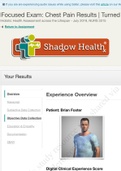
This score measures your performance on the Student Performance Index in relation to other students in comparable academic programs. Your instructor has chosen to scale your Student Performance Index score so that the average score on the index is a 80.0%. This score may not be your final grade if your instructor chooses to include additional components, such as documentation or time spent.Appearance (1/1 point) No visible abnormal findings Rash or lesion Cyanosis Pallor Redness or flushing Evidence of trauma (scar, laceration, or bruising) Inspected for jugular venous distension 1 of 1 point Height Of Venous Pressure (1/1 point) 4 cm or less above the sternal angle More than 4 cm above the sternal angle Inspected chest 1 of 1 point Symmetry (1/2 point) Symmetric Asymmetric Appearance (1/2 point) No visible abnormal findings Rash or lesion AP diameter abnormal Intercostal retraction while breathing Excessive use of accessory muscles while breathing Pectus excavatum Skin growths (freckles or moles) Evidence of skin trauma (scar, laceration, or bruising)This score measures your performance on the Student Performance Index in relation to other students in comparable academic programs. Your instructor has chosen to scale your Student Performance Index score so that the average score on the index is a 80.0%. This score may not be your final grade if your instructor chooses to include additional components, such as documentation or time spent.Appearance (1/1 point) No visible abnormal findings Rash or lesion Cyanosis Pallor Redness or flushing Evidence of trauma (scar, laceration, or bruising) Inspected for jugular venous distension 1 of 1 point Height Of Venous Pressure (1/1 point) 4 cm or less above the sternal angle More than 4 cm above the sternal angle Inspected chest 1 of 1 point Symmetry (1/2 point) Symmetric Asymmetric Appearance (1/2 point) No visible abnormal findings Rash or lesion AP diameter abnormal Intercostal retraction while breathing Excessive use of accessory muscles while breathing Pectus excavatum Skin growths (freckles or moles) Evidence of skin trauma (scar, laceration, or bruising)
Written for
Document information
- Uploaded on
- June 5, 2021
- Number of pages
- 8
- Written in
- 2020/2021
- Type
- Exam (elaborations)
- Contains
- Questions & answers
Subjects
-
this score measures your performance on the student performance index in relation to other students in comparable academic programs your instructor has chosen to scale your student performance index

Also available in package deal