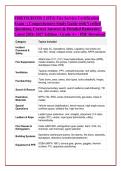
FIREFIGHTER 2 (FF2) Fire Service Certification
Exam –| Comprehensive Study Guide with Verified
Questions, Correct Answers & Detailed Rationales |
Latest 2026–2027 Edition | Grade A+ | PDF Download
Category Topics Included
Incident
ICS roles (IC, Operations, Safety, Logistics), two-in/two-out
Command &
rule, RIC, rehab, collapse zones, scene safety, NFPA standards
Safety
Attack lines (1¾", 2½"), hose loads/rollouts, water flow (GPM),
Fire Suppression master streams, fire pumps, hydrants (wet/dry barrel),
standpipes (Class I/II/III)
Tactical ventilation, PPV, vertical/horizontal, roof safety, window
Ventilation
breaking, smoke indicators, flashover/backdraft
Tools (irons, axes, saws), door types, locks (deadbolt), hinges,
Forcible Entry
fencing, roof access
Primary/secondary search, search patterns (wall-following), TIC
Search & Rescue
use, victim location, rehab
Hazardous NFPA 704, ERG, zones (hot/warm/cold), gas leaks, Class D
Materials metals
Special Vehicle rescue (stabilization), trench rescue, high-angle rescue,
Operations confined space, wildland fire, high-rise fires
Ladder types (extension, roof, straight), placement (1:4 ratio),
Ladders & Rope angles (75°), carries, rope types (kernmantle, utility),
harness/belay
Fire Classes & Class A/B/C/D/K, extinguisher types (water, foam, CO2, dry
Extinguizers chemical, wet chemical), agent selection
Sprinklers (wet/dry/pre-action), fire alarms, fire doors, stairwells,
Building Systems
standpipes, detectors (ionization/photoelectric)
SCBA (NFPA 1981), turnout gear, gloves, goggles, thermal
Equipment & PPE
curtains, TIC, apparatus positioning
, Category Topics Included
Professional NFPA standards (1001, 1500, 1710, 1901, 1981), professional
Development development (NFPA 1041)
Flashover, backdraft, traveling fire, smoke reading, heat
Fire Behavior
radiation, combustion types
Residential, commercial, high-rise, hospitals, wildland, vehicle
Occupancy Types
fires
Question 1
As a Firefighter 2 acting as the company officer at a structure fire, you arrive and
find a two-story residential building with heavy smoke showing from the second
floor. What is your FIRST priority action?
A. Begin immediate interior attack
B. Establish incident command and conduct size-up
C. Call for additional resources immediately
D. Evacuate neighboring houses
Correct Answer: B
Rationale: Establishing incident command and conducting size-up is the
FIRST priority because you must assess the situation before committing resources.
Size-up includes evaluating building construction, fire location, occupancy, life
safety concerns, and resources needed. Beginning interior attack without
assessment is dangerous. Calling for resources comes after size-up determines
needs. Evacuating neighbors is part of life safety but command/size-up is priority.
NFPA 1710 and incident command principles require proper assessment before
action.
Question 2
Which classification of hazardous material is represented by a blue placard with
the number 4?
,A. Flammable liquid
B. Explosive
C. Radioactive material
D. Health hazard (toxic material)
Correct Answer: D
Rationale: A blue placard with number 4 represents health hazard (toxic
material) according to NFPA 704 standard. Blue = health hazard, red =
flammability, yellow = reactivity, white = special hazards. Flammable liquid is
red. Explosive is in orange diamond (DOT). Radioactive is yellow/white with
trefoil symbol. Understanding NFPA 704 is critical for FF2 to identify hazards
quickly at incidents.
Question 3
During a multi-story building fire, which ventillation strategy is MOST appropriate
when the fire is on the 3rd floor and you are on the 2nd floor?
A. Positive pressure ventilation (PPV) from exterior
B. Vertical ventilation through roof
C. Tactical ventilation from the floor above the fire
D. Negative pressure ventilation
Correct Answer: C
Rationale: Tactical ventilation from the floor above the fire is MOST
appropriate because it releases heat and smoke upward without pushing fire toward
occupants or firefighters on lower floors. This prevents horizontal fire spread. PPV
from exterior can push fire inward. Vertical ventilation is for roof access but
may not be safe if structure is compromised. Negative pressure is less effective.
FF2 must understand ventilation timing and placement to support rescue and
suppression.
Question 4
A Firefighter 2 is assigned as the backup firefighter during an interior attack. What
is the primary responsibility of the backup position?
, A. Lead the hose line into the structure
B. Assist the nozzle firefighter and protect the hose line
C. Take radio communications
D. Perform search and rescue independently
Correct Answer: B
Rationale: The backup firefighter's primary responsibility is to assist the
nozzle firefighter and protect the hose line, ensuring it doesn't kink, get
damaged, or become disconnected. The backup supports the nozzle person, helps
advance the line, and can take over if needed. Leading the hose line is the nozzle
firefighter's role. Taking radio is usually the officer. Independent search is not
the backup's primary role. Teamwork and hose line management are critical for
FF2.
Question 5
Which type of fire extinguisher is Class A and what material does it extinguish?
A. Class B - flammable gases
B. Class A - ordinary combustibles (wood, paper, cloth)
C. Class C - electrical equipment
D. Class K - cooking oils
Correct Answer: B
Rationale: Class A extinguishers extinguish ordinary combustibles (wood,
paper, cloth, trash). These are the most common fires. Class A is marked with
green triangle. Class B is flammable liquids/gases. Class C is electrical. Class K is
kitchen/cooking oils. FF2 must know classification to select proper extinguisher.
Water, foam, and dry chemical are common Class A agents.
Question 6
In the Incident Command System (ICS), what is the role of the Safety Officer?
A. Direct fire suppression operations
B. Monitor safety conditions and advise the Incident Commander
C. Manage logistics and resources
D. Handle public information
Exam –| Comprehensive Study Guide with Verified
Questions, Correct Answers & Detailed Rationales |
Latest 2026–2027 Edition | Grade A+ | PDF Download
Category Topics Included
Incident
ICS roles (IC, Operations, Safety, Logistics), two-in/two-out
Command &
rule, RIC, rehab, collapse zones, scene safety, NFPA standards
Safety
Attack lines (1¾", 2½"), hose loads/rollouts, water flow (GPM),
Fire Suppression master streams, fire pumps, hydrants (wet/dry barrel),
standpipes (Class I/II/III)
Tactical ventilation, PPV, vertical/horizontal, roof safety, window
Ventilation
breaking, smoke indicators, flashover/backdraft
Tools (irons, axes, saws), door types, locks (deadbolt), hinges,
Forcible Entry
fencing, roof access
Primary/secondary search, search patterns (wall-following), TIC
Search & Rescue
use, victim location, rehab
Hazardous NFPA 704, ERG, zones (hot/warm/cold), gas leaks, Class D
Materials metals
Special Vehicle rescue (stabilization), trench rescue, high-angle rescue,
Operations confined space, wildland fire, high-rise fires
Ladder types (extension, roof, straight), placement (1:4 ratio),
Ladders & Rope angles (75°), carries, rope types (kernmantle, utility),
harness/belay
Fire Classes & Class A/B/C/D/K, extinguisher types (water, foam, CO2, dry
Extinguizers chemical, wet chemical), agent selection
Sprinklers (wet/dry/pre-action), fire alarms, fire doors, stairwells,
Building Systems
standpipes, detectors (ionization/photoelectric)
SCBA (NFPA 1981), turnout gear, gloves, goggles, thermal
Equipment & PPE
curtains, TIC, apparatus positioning
, Category Topics Included
Professional NFPA standards (1001, 1500, 1710, 1901, 1981), professional
Development development (NFPA 1041)
Flashover, backdraft, traveling fire, smoke reading, heat
Fire Behavior
radiation, combustion types
Residential, commercial, high-rise, hospitals, wildland, vehicle
Occupancy Types
fires
Question 1
As a Firefighter 2 acting as the company officer at a structure fire, you arrive and
find a two-story residential building with heavy smoke showing from the second
floor. What is your FIRST priority action?
A. Begin immediate interior attack
B. Establish incident command and conduct size-up
C. Call for additional resources immediately
D. Evacuate neighboring houses
Correct Answer: B
Rationale: Establishing incident command and conducting size-up is the
FIRST priority because you must assess the situation before committing resources.
Size-up includes evaluating building construction, fire location, occupancy, life
safety concerns, and resources needed. Beginning interior attack without
assessment is dangerous. Calling for resources comes after size-up determines
needs. Evacuating neighbors is part of life safety but command/size-up is priority.
NFPA 1710 and incident command principles require proper assessment before
action.
Question 2
Which classification of hazardous material is represented by a blue placard with
the number 4?
,A. Flammable liquid
B. Explosive
C. Radioactive material
D. Health hazard (toxic material)
Correct Answer: D
Rationale: A blue placard with number 4 represents health hazard (toxic
material) according to NFPA 704 standard. Blue = health hazard, red =
flammability, yellow = reactivity, white = special hazards. Flammable liquid is
red. Explosive is in orange diamond (DOT). Radioactive is yellow/white with
trefoil symbol. Understanding NFPA 704 is critical for FF2 to identify hazards
quickly at incidents.
Question 3
During a multi-story building fire, which ventillation strategy is MOST appropriate
when the fire is on the 3rd floor and you are on the 2nd floor?
A. Positive pressure ventilation (PPV) from exterior
B. Vertical ventilation through roof
C. Tactical ventilation from the floor above the fire
D. Negative pressure ventilation
Correct Answer: C
Rationale: Tactical ventilation from the floor above the fire is MOST
appropriate because it releases heat and smoke upward without pushing fire toward
occupants or firefighters on lower floors. This prevents horizontal fire spread. PPV
from exterior can push fire inward. Vertical ventilation is for roof access but
may not be safe if structure is compromised. Negative pressure is less effective.
FF2 must understand ventilation timing and placement to support rescue and
suppression.
Question 4
A Firefighter 2 is assigned as the backup firefighter during an interior attack. What
is the primary responsibility of the backup position?
, A. Lead the hose line into the structure
B. Assist the nozzle firefighter and protect the hose line
C. Take radio communications
D. Perform search and rescue independently
Correct Answer: B
Rationale: The backup firefighter's primary responsibility is to assist the
nozzle firefighter and protect the hose line, ensuring it doesn't kink, get
damaged, or become disconnected. The backup supports the nozzle person, helps
advance the line, and can take over if needed. Leading the hose line is the nozzle
firefighter's role. Taking radio is usually the officer. Independent search is not
the backup's primary role. Teamwork and hose line management are critical for
FF2.
Question 5
Which type of fire extinguisher is Class A and what material does it extinguish?
A. Class B - flammable gases
B. Class A - ordinary combustibles (wood, paper, cloth)
C. Class C - electrical equipment
D. Class K - cooking oils
Correct Answer: B
Rationale: Class A extinguishers extinguish ordinary combustibles (wood,
paper, cloth, trash). These are the most common fires. Class A is marked with
green triangle. Class B is flammable liquids/gases. Class C is electrical. Class K is
kitchen/cooking oils. FF2 must know classification to select proper extinguisher.
Water, foam, and dry chemical are common Class A agents.
Question 6
In the Incident Command System (ICS), what is the role of the Safety Officer?
A. Direct fire suppression operations
B. Monitor safety conditions and advise the Incident Commander
C. Manage logistics and resources
D. Handle public information