

z
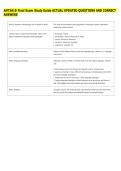
ANT3610 Final Exam Study Guide ACTUAL UPDATED QUESTIONS AND CORRECT
ANSWERS
What is linguistic Anthropology and its object of study? The study of the semantics and pragmatics of language to better understand
social and cultural issues
List the 5 basic components of language. Which have 1. phonology: sound
been of interest to linguistic anthropologists? 2. morphology: internal structures of words
3. syntax: structure of sentences
4. semantics: meaning in language
5. pragmatics: language use
Define multifunctionality Refers to all the different kinds of work that language does. (Ahearn 21). Language
is dynamic.
Define language ideologies "attitudes, opinions, beliefs, or theories that we all have about language." (Ahearn
23).
1. almost always serve the interests of a specific social or cultural group.
2. people can belong to many different social groups simultaneously and therefor
can have multiple ideologies
3. People may be more or less aware f their language ideologies
4. Peoples language ideologies mediate between social structures and forms of
talk. This bridges micro-level speech and macro-level social structures.
Define practice language, culture, and society all have a pre-existing reality but at the same time
are very much the products of individual humans' words and actions
, Define indexicality Identifying the precise way in which language and social relations intersect
emerges from Pierce's idea of semiotics
Explain Chompsky's approach to language and how its Competence, the abstract and usually unconscious knowledge of a language, and
contrasts to linguistic anthropologist's. performance, the putting into practice of a language.
DeSaussure Similar ideology to Chompsky. Makes a connection between langue, the language
system in abstract, and parole, everyday speech.
Semiotics the study of signs and symbols
- Icon: refers to object by means of similarity
- Index: refers to its object in a dynamic connection between the object and
person
- Symbol: Refers to its object by virtue of convention or habit
multimodality indexicality occurs across various overlapping channels or modes, including
speech, gestures sign language, whistles, song, illustrations, and writing
Gestures and sign languages they're different!!!
gestures compliment verbal communication
Sign languages are fully developed languages with their own phonetics,
morphology, syntax, semantics, and pragmatics
typology of gestures 1. Iconics: resemble that which is being described verbally
2. Metaphorics: gestural representations of more abstract concepts. Often
grouped with iconics in a field called representational.
3. Dietics: pointing gestures
4. Beats:no discernible meaning
Kuster's argument in "Deaf on the Lifeline of Mumbai" creating a typology misses the point of multimodality. Thinking about interactions
as complex ensembles in which the combination of modes adds up to more than
the sum of their parts.
Deaf men create communities on Mumbai's train system through an elaborate use
of space.
Goffman's concept of "footing" The role of speaker can be broken down into three roles:
1. Animator: animates the words, regardless of who wrote them
2. Author: composed the words
3. Principle: Believes the words, their opinions are the ones being expressed
Whistled Speech Usually found in mountainous regions. Based directly on spoken language.
examples include Sochiapan Chinantec of Oaxaca and Sylbo Gomero of the
Canary Islands
ANT3610 Final Exam Study Guide ACTUAL UPDATED QUESTIONS AND CORRECT
ANSWERS
What is linguistic Anthropology and its object of study? The study of the semantics and pragmatics of language to better understand
social and cultural issues
List the 5 basic components of language. Which have 1. phonology: sound
been of interest to linguistic anthropologists? 2. morphology: internal structures of words
3. syntax: structure of sentences
4. semantics: meaning in language
5. pragmatics: language use
Define multifunctionality Refers to all the different kinds of work that language does. (Ahearn 21). Language
is dynamic.
Define language ideologies "attitudes, opinions, beliefs, or theories that we all have about language." (Ahearn
23).
1. almost always serve the interests of a specific social or cultural group.
2. people can belong to many different social groups simultaneously and therefor
can have multiple ideologies
3. People may be more or less aware f their language ideologies
4. Peoples language ideologies mediate between social structures and forms of
talk. This bridges micro-level speech and macro-level social structures.
Define practice language, culture, and society all have a pre-existing reality but at the same time
are very much the products of individual humans' words and actions
, Define indexicality Identifying the precise way in which language and social relations intersect
emerges from Pierce's idea of semiotics
Explain Chompsky's approach to language and how its Competence, the abstract and usually unconscious knowledge of a language, and
contrasts to linguistic anthropologist's. performance, the putting into practice of a language.
DeSaussure Similar ideology to Chompsky. Makes a connection between langue, the language
system in abstract, and parole, everyday speech.
Semiotics the study of signs and symbols
- Icon: refers to object by means of similarity
- Index: refers to its object in a dynamic connection between the object and
person
- Symbol: Refers to its object by virtue of convention or habit
multimodality indexicality occurs across various overlapping channels or modes, including
speech, gestures sign language, whistles, song, illustrations, and writing
Gestures and sign languages they're different!!!
gestures compliment verbal communication
Sign languages are fully developed languages with their own phonetics,
morphology, syntax, semantics, and pragmatics
typology of gestures 1. Iconics: resemble that which is being described verbally
2. Metaphorics: gestural representations of more abstract concepts. Often
grouped with iconics in a field called representational.
3. Dietics: pointing gestures
4. Beats:no discernible meaning
Kuster's argument in "Deaf on the Lifeline of Mumbai" creating a typology misses the point of multimodality. Thinking about interactions
as complex ensembles in which the combination of modes adds up to more than
the sum of their parts.
Deaf men create communities on Mumbai's train system through an elaborate use
of space.
Goffman's concept of "footing" The role of speaker can be broken down into three roles:
1. Animator: animates the words, regardless of who wrote them
2. Author: composed the words
3. Principle: Believes the words, their opinions are the ones being expressed
Whistled Speech Usually found in mountainous regions. Based directly on spoken language.
examples include Sochiapan Chinantec of Oaxaca and Sylbo Gomero of the
Canary Islands


