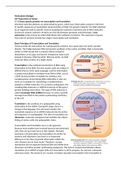
Moleculaire Biologie
H17 Expression of Genes
17.1 Genes specify proteins via transcription and translation
Inherited traits like albinism are determined by genes, which have information content in the form
of specific sequences of nucleotides along stretches of DNA, the genetic material. The DNA inherited
by an organism leads to specific traits by dictating the synthesis of proteins and of RNA molecules
involved in protein synthesis. Proteins are the link between genotype and phenotype. Gene
expression is the process by which DNA directs the synthesis of proteins. The expression of genes
that code for proteins include two stages: transcription and translation.
Basic Principles of Transcription and Translation
Genes provide the instructions for making specific proteins, but a gene does not build a protein
directly. The bridge between DNA and protein synthesis is the nucleic acid RNA. RNA is chemically
similar to DNA except that it contains ribose instead of
deoxyribose as its sugar and has the nitrogenous base uracil
instead of thymine. DNA has ACGT. RNA has ACGU. An RNA
molecule often consists of a single strand.
Transcription is the synthesis (production) of RNA using
information in the DNA. The two nucleic acids are written in
different forms of the same language, and the information
is simply transcribed or rewritten from DNA to RNA. Just as
a DNA strand provides a template for making a new
complementary strand during RNA replication, it also can
serve as a template for assembling a complementary
sequence of RNA molecules. For a protein-coding gene, the
resulting RNA molecule is a faithful transcript of the gene’s
protein building instructions. This type of RNA molecule is
called messenger RNA (mRNA) because it carries a genetic
message from DNA to the protein-synthesizing machinery
of the cell.
Translation is the synthesis of a polypeptide using
information in the mRNA. During this stage, there is a
change in the language: The cell must translate the
nucleotide sequence of an mRNA molecule into the amino
acid sequence of a polypeptide. The sites of translation are
ribosomes, molecular complexes that facilitate the orderly
linking of amino acids into polypeptide chains.
Transcription and translation occur in all organisms.
Because most studies have involved bacteria and eukaryotic
cells, they are our main focus in this chapter. The basic
mechanics of transcription and translation are similar for
bacteria and eukaryotes, but there is an important
difference in the flow of genetic information within the
cells. Bacteria do not have nuclei. Therefore, nuclear
membranes do not separate bacterial DNA and mRNA from
ribosomes and other protein-synthesizing equipment. This lack of compartmentalization allows
translation of an mRNA to begin while its transcription is still in progress. By contrast, eukaryotic
cells have nuclei. The presence of a nuclear envelope separates transcription from translation in
,space and time. Transcription occurs in the nucleus but the mRNA must be transported to the
cytoplasm for translation. In eukaryotes, before RNA transcripts from protein-coding genes can leave
the nucleus, they are modified in various ways to produce the final, functional mRNA. The
transcription of a protein-encoding eukaryotic gene results in pre-mRNA, and further RNA
processing yields the finished mRNA. The initial RNA transcript from any gene, including those
specifying RNA that is not translated into protein, is more generally called a primary transcript.
To summarize: Genes program protein synthesis via genetic messages in the form of mRNA. Put
another way, cells are governed by a molecular chain of command with a directional flow of genetic
information. DNA – RNA – Protein.
The Genetic Code
Codons: Triplets of Nucleotides
If each kind of nucleotide base were translated into amino acid, only four amino acids could be
specified, one per nucleotide base. The two-nucleotide sequence AG, for example, could specify one
amino acid, and GT could specify another. Since there are four possible nucleotide bases in each
position, this would give us 16 possible arrangements – still not enough to code for all 20 amino
acids. Triplets of nucleotide bases are the smallest units of uniform length that can code for all
amino acids. If each arrangement of three consecutive nucleotide bases specifies for an amino acid,
there can be 64 possible code words. Experiments have verified that the flow of information from
gene to protein is based on a triplet code: The genetic instructions for a polypeptide chain are
written in the DNA as a series of nonoverlapping, three-nucleotide words. The series of words in a
gene is transcribed into a complementary series of nonoverlapping, three-nucleotide words in the
mRNA, which is then translated into a chain of amino acids.
During transcription, the gene determines the sequence
of nucleotide bases along the length of the mRNA
molecule that is being synthesized. For each gene, only
one of the two DNA strands is being transcribed. This
strand is called the template strand because it provides
the pattern, or template, for the sequence of
nucleotides in an RNA transcript. An mRNA molecule is
complementary rather than identical to its DNA
template because RNA nucleotides are assembled on
the template according to base-pairing rules. The pairs
are similar to those that form during DNA replication,
except that U pairs with A and the mRNA nucleotides
contain ribose instead of deoxyribose. Like a new strand
of DNA, the RNA molecule is synthesized in an
antiparallel direction to the template strand of DNA.
The mRNA nucleotide triplets are called , and they are
customarily written in the 5’ - > 3’ direction. The term
codon is also used for the DNA nucleotide triplets along
the nontemplate strand. These codons are
complementary to the template strand and thus
identical in sequence to the mRNA. For this reason, the
nontemplate DNA strand is often called the coding
strand; by convention, the sequence of the coding
strand is used when a gene’s sequence is reported.
, During translation, the sequence of codons along an mRNA molecule is decoded, or translated, into
a sequence of amino acids making up a polypeptide chain. The codons are read by the translation
machinery in 5’ -> 3’ direction along the mRNA. Each codon specifies which one of the 20 amino
acids will be incorporated at the corresponding position along a polypeptide.
Cracking the Code
H17 Expression of Genes
17.1 Genes specify proteins via transcription and translation
Inherited traits like albinism are determined by genes, which have information content in the form
of specific sequences of nucleotides along stretches of DNA, the genetic material. The DNA inherited
by an organism leads to specific traits by dictating the synthesis of proteins and of RNA molecules
involved in protein synthesis. Proteins are the link between genotype and phenotype. Gene
expression is the process by which DNA directs the synthesis of proteins. The expression of genes
that code for proteins include two stages: transcription and translation.
Basic Principles of Transcription and Translation
Genes provide the instructions for making specific proteins, but a gene does not build a protein
directly. The bridge between DNA and protein synthesis is the nucleic acid RNA. RNA is chemically
similar to DNA except that it contains ribose instead of
deoxyribose as its sugar and has the nitrogenous base uracil
instead of thymine. DNA has ACGT. RNA has ACGU. An RNA
molecule often consists of a single strand.
Transcription is the synthesis (production) of RNA using
information in the DNA. The two nucleic acids are written in
different forms of the same language, and the information
is simply transcribed or rewritten from DNA to RNA. Just as
a DNA strand provides a template for making a new
complementary strand during RNA replication, it also can
serve as a template for assembling a complementary
sequence of RNA molecules. For a protein-coding gene, the
resulting RNA molecule is a faithful transcript of the gene’s
protein building instructions. This type of RNA molecule is
called messenger RNA (mRNA) because it carries a genetic
message from DNA to the protein-synthesizing machinery
of the cell.
Translation is the synthesis of a polypeptide using
information in the mRNA. During this stage, there is a
change in the language: The cell must translate the
nucleotide sequence of an mRNA molecule into the amino
acid sequence of a polypeptide. The sites of translation are
ribosomes, molecular complexes that facilitate the orderly
linking of amino acids into polypeptide chains.
Transcription and translation occur in all organisms.
Because most studies have involved bacteria and eukaryotic
cells, they are our main focus in this chapter. The basic
mechanics of transcription and translation are similar for
bacteria and eukaryotes, but there is an important
difference in the flow of genetic information within the
cells. Bacteria do not have nuclei. Therefore, nuclear
membranes do not separate bacterial DNA and mRNA from
ribosomes and other protein-synthesizing equipment. This lack of compartmentalization allows
translation of an mRNA to begin while its transcription is still in progress. By contrast, eukaryotic
cells have nuclei. The presence of a nuclear envelope separates transcription from translation in
,space and time. Transcription occurs in the nucleus but the mRNA must be transported to the
cytoplasm for translation. In eukaryotes, before RNA transcripts from protein-coding genes can leave
the nucleus, they are modified in various ways to produce the final, functional mRNA. The
transcription of a protein-encoding eukaryotic gene results in pre-mRNA, and further RNA
processing yields the finished mRNA. The initial RNA transcript from any gene, including those
specifying RNA that is not translated into protein, is more generally called a primary transcript.
To summarize: Genes program protein synthesis via genetic messages in the form of mRNA. Put
another way, cells are governed by a molecular chain of command with a directional flow of genetic
information. DNA – RNA – Protein.
The Genetic Code
Codons: Triplets of Nucleotides
If each kind of nucleotide base were translated into amino acid, only four amino acids could be
specified, one per nucleotide base. The two-nucleotide sequence AG, for example, could specify one
amino acid, and GT could specify another. Since there are four possible nucleotide bases in each
position, this would give us 16 possible arrangements – still not enough to code for all 20 amino
acids. Triplets of nucleotide bases are the smallest units of uniform length that can code for all
amino acids. If each arrangement of three consecutive nucleotide bases specifies for an amino acid,
there can be 64 possible code words. Experiments have verified that the flow of information from
gene to protein is based on a triplet code: The genetic instructions for a polypeptide chain are
written in the DNA as a series of nonoverlapping, three-nucleotide words. The series of words in a
gene is transcribed into a complementary series of nonoverlapping, three-nucleotide words in the
mRNA, which is then translated into a chain of amino acids.
During transcription, the gene determines the sequence
of nucleotide bases along the length of the mRNA
molecule that is being synthesized. For each gene, only
one of the two DNA strands is being transcribed. This
strand is called the template strand because it provides
the pattern, or template, for the sequence of
nucleotides in an RNA transcript. An mRNA molecule is
complementary rather than identical to its DNA
template because RNA nucleotides are assembled on
the template according to base-pairing rules. The pairs
are similar to those that form during DNA replication,
except that U pairs with A and the mRNA nucleotides
contain ribose instead of deoxyribose. Like a new strand
of DNA, the RNA molecule is synthesized in an
antiparallel direction to the template strand of DNA.
The mRNA nucleotide triplets are called , and they are
customarily written in the 5’ - > 3’ direction. The term
codon is also used for the DNA nucleotide triplets along
the nontemplate strand. These codons are
complementary to the template strand and thus
identical in sequence to the mRNA. For this reason, the
nontemplate DNA strand is often called the coding
strand; by convention, the sequence of the coding
strand is used when a gene’s sequence is reported.
, During translation, the sequence of codons along an mRNA molecule is decoded, or translated, into
a sequence of amino acids making up a polypeptide chain. The codons are read by the translation
machinery in 5’ -> 3’ direction along the mRNA. Each codon specifies which one of the 20 amino
acids will be incorporated at the corresponding position along a polypeptide.
Cracking the Code