

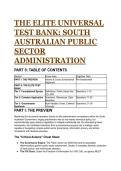
THE ELITE UNIVERSAL
TEST BANK: SOUTH
AUSTRALIAN PUBLIC
SECTOR
ADMINISTRATION
PART 0: TABLE OF CONTENTS
Section Focus Area Cognitive Tiers
PART I: THE PREVIEW Axioms & Cross-Jurisdictional Pre-Assessment
Alignment
PART II: THE ELITE TEST
BANK
Tier 1: Foundational Syntax Definitions, Public Sector Act, Questions 1–10
FOI, IPPI
Tier 2: Complex Application Scenarios, Grievances, Data Questions 11–20
Breaches
Tier 3: Grandmaster Multi-Variable Crises, External Questions 21–30
Synthesis Tribunals
PART I: THE PREVIEW
Mastering this document translates directly to elite administrative competence within the South
Australian Government, forging practitioners who do not merely memorize policy, but
mechanistically apply statutory legislation to mitigate institutional risk. By internalizing these
frameworks, the candidate transitions from a procedural processor into a strategic asset
capable of navigating complex public sector governance, information privacy, and ethical
compliance with absolute precision.
The "Critical Axioms" Cheat Sheet
● The Governance Engine: The Public Sector Act 2009 (SA) and its associated
determinations govern public sector employment. Section 5 mandates fairness, protection
of frank advice, and merit-based selection.
● The FOI Clock: Under the Freedom of Information Act 1991 (SA), an agency MUST
, determine an application within 30 days. Internal reviews are a mandatory prerequisite for
external review by the South Australian Civil and Administrative Tribunal (SACAT).
● The Privacy Matrix: South Australia relies on an administrative scheme (DPC Circular
PC012), not a legislative Privacy Act. Only the Privacy Committee of South Australia can
grant exemptions to the 10 Information Privacy Principles (IPPs).
● The Tribunal Divide: Employment grievances strictly follow the Public Sector Act internal
review mechanisms before escalating to the South Australian Employment Tribunal
(SAET). FOI and administrative appeals escalate to SACAT.
Cross-Jurisdictional Alignment: The ASO Structure To operate effectively, practitioners must
understand how South Australian Administrative Services Officer (ASO) classifications align with
federal and interstate equivalents.
South Australia (ASO) Federal (APS) NSW Government Victoria (VPS)
ASO 3 APS 3 Clerk Grade 3/4 VPS Grade 2
ASO 4 APS 4 Clerk Grade 3/4 VPS Grade 3
ASO 5 APS 5 Clerk Grade 5/6 VPS Grade 3/4
ASO 6 APS 6 Clerk Grade 7/8 VPS Grade 4/5
ASO 7 EL 1 Clerk Grade 9/10 VPS Grade 5/6
ASO 8 EL 2 Clerk Grade 11/12 VPS Grade 6
PART II: THE ELITE TEST BANK
Tier 1: Foundational Syntax & Application
Q1: A newly appointed chief executive is restructuring departmental reporting lines. According
to the foundational principles outlined in Section 5 of the Public Sector Act 2009 (SA), which of
the following mandates MUST drive their workforce management strategy? A) The immediate
conversion of all casual contracts to tenured executive positions to ensure stability. B) The
requirement that employees are permitted to provide frank advice without fear of reprisal. C)
The elimination of public sector representative organisations to streamline operational
command. D) The bypass of merit-based selection protocols for urgent administrative unit
appointments.
● The Answer: B (The requirement that employees are permitted to provide frank advice
without fear of reprisal.)
● Distractor Analysis:
○ A is incorrect: Tenure conversion is governed by strict procedural fairness and
classification rules, not the overarching Section 5 principles.
○ C is incorrect: Section 5 explicitly protects the right of employees to join and consult
with public sector representative organisations.
○ D is incorrect: Merit-based selection is a fundamental statutory requirement under
Section 46 of the Act and cannot be bypassed arbitrarily.
The Mentor's Analysis: The Public Sector Act 2009 establishes the ethical and operational
bedrock of the South Australian public sector. By legally protecting frank and fearless advice,
the legislation bypasses the trap of sycophantic cultures, ensuring executive decisions are
stress-tested by objective administrative feedback. When systemic failures occur in government,
they are frequently traced to a breakdown in this specific principle, where subordinates
suppress critical risk data out of fear. Professional/Academic Intuition: Statutory protection
of frank advice is the ultimate safeguard against administrative failure; never penalize
, operational truth.
Q2: Under the Freedom of Information Act 1991 (SA), a citizen submits a valid request for
access to state government documents. Excluding formal extensions for consultation, what is
the strict statutory timeframe within which the agency MUST deal with the application? A) 14
days B) 21 days C) 30 days D) 60 days
● The Answer: C (30 days)
● Distractor Analysis:
○ A is incorrect: 14 days is the standard statutory notice period for termination of
employment under the Public Sector Act 2009.
○ B is incorrect: 21 days is the strict time limit to make an unfair dismissal application
to the South Australian Employment Tribunal (SAET).
○ D is incorrect: 60 days applies to external reviews by the National Education and
Care Services FOI Commissioner, an entirely different jurisdiction.
The Mentor's Analysis: The machinery of government relies on predictable transparency. By
establishing a rigid 30-day mandate, the FOI Act prevents bureaucratic stalling. An agency's
failure to respond within 30 days legally constitutes a "deemed refusal." This mechanism is a
vital catalyst in administrative law; it structurally empowers the citizen, converting government
inaction into an actionable appellate trigger. Professional/Academic Intuition: In
administrative law, timeframes are jurisdictional, not merely aspirational. 30 days is the
absolute hard deck.
Q3: The Information Privacy Principles Instruction (IPPI) regulates how South Australian public
sector agencies handle personal data. What is the primary legal mechanism that enforces the
IPPI in South Australia? A) The Privacy Act 1988 (Commonwealth) B) A Cabinet Administrative
Instruction issued via DPC Circular PC012 C) The South Australian Privacy Act 2001 D) The
Freedom of Information Act 1991 (SA)
● The Answer: B (A Cabinet Administrative Instruction issued via DPC Circular PC012)
● Distractor Analysis:
○ A is incorrect: State Government agencies are generally exempt from the
Commonwealth Privacy Act, unless dealing directly with specific federal information
sharing.
○ C is incorrect: South Australia is one of the only Australian jurisdictions without
specific, standalone privacy legislation; it relies entirely on the administrative
scheme.
○ D is incorrect: The FOI Act governs access to documents and amendment of
personal records, not the systemic lifecycle and privacy protections of data
collection.
The Mentor's Analysis: South Australia's privacy framework is structurally unique because it
operates as an administrative directive rather than a parliamentary statute. By adhering to
Cabinet Administrative Instruction 1/89 (PC012), agencies ensure systemic compliance. This
administrative architecture requires agile, policy-driven compliance rather than rigid statutory
litigation, shifting the burden of enforcement to the Privacy Committee of South Australia.
Professional/Academic Intuition: Understand your jurisdictional boundaries. In South
Australia, public sector privacy is governed by Cabinet Instruction, not parliamentary
statute.
Q4: According to the Code of Ethics for the South Australian Public Sector, which of the
following represents the four "Strong Foundations" of public sector employment? A)
Transparency, Efficiency, Loyalty, and Economy B) Democracy, Impartiality, Accountability, and
Diversity C) Sustainability, Courage, Tenacity, and Trust D) Service, Professionalism, Respect,
TEST BANK: SOUTH
AUSTRALIAN PUBLIC
SECTOR
ADMINISTRATION
PART 0: TABLE OF CONTENTS
Section Focus Area Cognitive Tiers
PART I: THE PREVIEW Axioms & Cross-Jurisdictional Pre-Assessment
Alignment
PART II: THE ELITE TEST
BANK
Tier 1: Foundational Syntax Definitions, Public Sector Act, Questions 1–10
FOI, IPPI
Tier 2: Complex Application Scenarios, Grievances, Data Questions 11–20
Breaches
Tier 3: Grandmaster Multi-Variable Crises, External Questions 21–30
Synthesis Tribunals
PART I: THE PREVIEW
Mastering this document translates directly to elite administrative competence within the South
Australian Government, forging practitioners who do not merely memorize policy, but
mechanistically apply statutory legislation to mitigate institutional risk. By internalizing these
frameworks, the candidate transitions from a procedural processor into a strategic asset
capable of navigating complex public sector governance, information privacy, and ethical
compliance with absolute precision.
The "Critical Axioms" Cheat Sheet
● The Governance Engine: The Public Sector Act 2009 (SA) and its associated
determinations govern public sector employment. Section 5 mandates fairness, protection
of frank advice, and merit-based selection.
● The FOI Clock: Under the Freedom of Information Act 1991 (SA), an agency MUST
, determine an application within 30 days. Internal reviews are a mandatory prerequisite for
external review by the South Australian Civil and Administrative Tribunal (SACAT).
● The Privacy Matrix: South Australia relies on an administrative scheme (DPC Circular
PC012), not a legislative Privacy Act. Only the Privacy Committee of South Australia can
grant exemptions to the 10 Information Privacy Principles (IPPs).
● The Tribunal Divide: Employment grievances strictly follow the Public Sector Act internal
review mechanisms before escalating to the South Australian Employment Tribunal
(SAET). FOI and administrative appeals escalate to SACAT.
Cross-Jurisdictional Alignment: The ASO Structure To operate effectively, practitioners must
understand how South Australian Administrative Services Officer (ASO) classifications align with
federal and interstate equivalents.
South Australia (ASO) Federal (APS) NSW Government Victoria (VPS)
ASO 3 APS 3 Clerk Grade 3/4 VPS Grade 2
ASO 4 APS 4 Clerk Grade 3/4 VPS Grade 3
ASO 5 APS 5 Clerk Grade 5/6 VPS Grade 3/4
ASO 6 APS 6 Clerk Grade 7/8 VPS Grade 4/5
ASO 7 EL 1 Clerk Grade 9/10 VPS Grade 5/6
ASO 8 EL 2 Clerk Grade 11/12 VPS Grade 6
PART II: THE ELITE TEST BANK
Tier 1: Foundational Syntax & Application
Q1: A newly appointed chief executive is restructuring departmental reporting lines. According
to the foundational principles outlined in Section 5 of the Public Sector Act 2009 (SA), which of
the following mandates MUST drive their workforce management strategy? A) The immediate
conversion of all casual contracts to tenured executive positions to ensure stability. B) The
requirement that employees are permitted to provide frank advice without fear of reprisal. C)
The elimination of public sector representative organisations to streamline operational
command. D) The bypass of merit-based selection protocols for urgent administrative unit
appointments.
● The Answer: B (The requirement that employees are permitted to provide frank advice
without fear of reprisal.)
● Distractor Analysis:
○ A is incorrect: Tenure conversion is governed by strict procedural fairness and
classification rules, not the overarching Section 5 principles.
○ C is incorrect: Section 5 explicitly protects the right of employees to join and consult
with public sector representative organisations.
○ D is incorrect: Merit-based selection is a fundamental statutory requirement under
Section 46 of the Act and cannot be bypassed arbitrarily.
The Mentor's Analysis: The Public Sector Act 2009 establishes the ethical and operational
bedrock of the South Australian public sector. By legally protecting frank and fearless advice,
the legislation bypasses the trap of sycophantic cultures, ensuring executive decisions are
stress-tested by objective administrative feedback. When systemic failures occur in government,
they are frequently traced to a breakdown in this specific principle, where subordinates
suppress critical risk data out of fear. Professional/Academic Intuition: Statutory protection
of frank advice is the ultimate safeguard against administrative failure; never penalize
, operational truth.
Q2: Under the Freedom of Information Act 1991 (SA), a citizen submits a valid request for
access to state government documents. Excluding formal extensions for consultation, what is
the strict statutory timeframe within which the agency MUST deal with the application? A) 14
days B) 21 days C) 30 days D) 60 days
● The Answer: C (30 days)
● Distractor Analysis:
○ A is incorrect: 14 days is the standard statutory notice period for termination of
employment under the Public Sector Act 2009.
○ B is incorrect: 21 days is the strict time limit to make an unfair dismissal application
to the South Australian Employment Tribunal (SAET).
○ D is incorrect: 60 days applies to external reviews by the National Education and
Care Services FOI Commissioner, an entirely different jurisdiction.
The Mentor's Analysis: The machinery of government relies on predictable transparency. By
establishing a rigid 30-day mandate, the FOI Act prevents bureaucratic stalling. An agency's
failure to respond within 30 days legally constitutes a "deemed refusal." This mechanism is a
vital catalyst in administrative law; it structurally empowers the citizen, converting government
inaction into an actionable appellate trigger. Professional/Academic Intuition: In
administrative law, timeframes are jurisdictional, not merely aspirational. 30 days is the
absolute hard deck.
Q3: The Information Privacy Principles Instruction (IPPI) regulates how South Australian public
sector agencies handle personal data. What is the primary legal mechanism that enforces the
IPPI in South Australia? A) The Privacy Act 1988 (Commonwealth) B) A Cabinet Administrative
Instruction issued via DPC Circular PC012 C) The South Australian Privacy Act 2001 D) The
Freedom of Information Act 1991 (SA)
● The Answer: B (A Cabinet Administrative Instruction issued via DPC Circular PC012)
● Distractor Analysis:
○ A is incorrect: State Government agencies are generally exempt from the
Commonwealth Privacy Act, unless dealing directly with specific federal information
sharing.
○ C is incorrect: South Australia is one of the only Australian jurisdictions without
specific, standalone privacy legislation; it relies entirely on the administrative
scheme.
○ D is incorrect: The FOI Act governs access to documents and amendment of
personal records, not the systemic lifecycle and privacy protections of data
collection.
The Mentor's Analysis: South Australia's privacy framework is structurally unique because it
operates as an administrative directive rather than a parliamentary statute. By adhering to
Cabinet Administrative Instruction 1/89 (PC012), agencies ensure systemic compliance. This
administrative architecture requires agile, policy-driven compliance rather than rigid statutory
litigation, shifting the burden of enforcement to the Privacy Committee of South Australia.
Professional/Academic Intuition: Understand your jurisdictional boundaries. In South
Australia, public sector privacy is governed by Cabinet Instruction, not parliamentary
statute.
Q4: According to the Code of Ethics for the South Australian Public Sector, which of the
following represents the four "Strong Foundations" of public sector employment? A)
Transparency, Efficiency, Loyalty, and Economy B) Democracy, Impartiality, Accountability, and
Diversity C) Sustainability, Courage, Tenacity, and Trust D) Service, Professionalism, Respect,


