

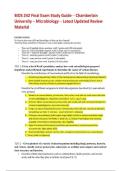
BIOS 242 Final Exam Study Guide – Chamberlain University Microbiology | Latest Updated Review Material
Prepare with confidence using the BIOS 242 Final Exam Study Guide for Chamberlain University Fundamentals of Microbiology with Lab. This comprehensive review resource is designed to help nursing and healthcare students master the essential microbiology concepts covered throughout the course. BIOS 242 focuses on medically important microorganisms, infectious diseases, microbial genetics, immunology, antimicrobial therapy, laboratory techniques, and host-pathogen interactions, making it one of the most important science courses for future healthcare professionals. This updated study guide brings together the most frequently tested concepts from lectures, laboratory exercises, assignments, and examinations into one organized and easy-to-follow resource. Whether you are preparing for a final exam, cumulative assessment, ATI-style testing, or simply reinforcing your microbiology knowledge, this guide provides a structured approach to review and retention. The material covers foundational microbiology topics including the history of microbiology, major microbiological discoveries, microscopy, microbial classification, bacterial anatomy, cellular structures, metabolism, genetics, growth requirements, and microbial reproduction. Students will gain a clear understanding of how microorganisms function, reproduce, adapt, and contribute to both health and disease. In addition, the guide includes detailed reviews of prokaryotic and eukaryotic microorganisms, viruses, fungi, protozoa, helminths, and prions. These concepts are essential for identifying pathogens, understanding disease transmission, and applying microbiological principles in clinical settings. One of the most valuable features of this study guide is its comprehensive coverage of microbial metabolism and growth. Students will review aerobic respiration, anaerobic respiration, fermentation, enzyme activity, ATP production, growth curves, environmental factors affecting microbial growth, and microbial nutritional requirements. These topics frequently appear on BIOS 242 exams and are crucial for understanding microbial physiology. The guide also emphasizes microbial genetics and biotechnology, including DNA replication, transcription, translation, mutations, horizontal gene transfer, plasmids, recombinant DNA technology, and antibiotic resistance mechanisms. These concepts are increasingly important in modern healthcare and microbiology practice. Another major section focuses on infection control and microbial control methods. Students will learn about sterilization, disinfection, antisepsis, pasteurization, physical and chemical control methods, healthcare-associated infections, and infection prevention strategies. Understanding these principles is essential for nursing practice and patient safety. Immunology is thoroughly reviewed, covering innate immunity, adaptive immunity, inflammatory responses, antibodies, antigens, immune cells, hypersensitivity reactions, vaccines, and immune system disorders. The study guide simplifies complex immunological processes into understandable explanations that support exam success. Host defenses and immune responses are central learning outcomes within BIOS 242. Students will also find extensive coverage of antimicrobial medications, including mechanisms of action, drug classifications, antimicrobial resistance, spectrum of activity, and appropriate clinical applications. These topics bridge microbiology and pharmacology, helping nursing students understand how medications combat infectious diseases. The laboratory review section is particularly useful for students preparing for practical examinations. It includes key microbiology lab concepts such as aseptic technique, culture methods, staining procedures, Gram staining, microscopy, bacterial identification, colony morphology, biosafety procedures, and pathogen identification. Laboratory skills are a critical component of the BIOS 242 curriculum and are often assessed during practical evaluations. To support active learning, the guide incorporates: Comprehensive chapter summaries High-yield microbiology facts Key vocabulary and definitions Practice review questions Memory aids and study tips Exam-focused concept reviews Pathogen identification charts Disease transmission summaries Laboratory procedure reviews Quick-reference study outlines This resource is ideal for: Chamberlain University nursing students Students enrolled in BIOS 242 Fundamentals of Microbiology with Lab Pre-nursing and healthcare students Final exam preparation Midterm and cumulative review NCLEX foundation building ATI preparation Healthcare science learners seeking microbiology mastery The study guide is organized to maximize efficiency, allowing students to focus on the most heavily tested material while strengthening weak areas. By consolidating complex microbiology content into a structured review format, students can improve comprehension, retention, and exam performance. Whether you are aiming for an A on your final exam or building a strong foundation for future nursing and healthcare courses, this BIOS 242 Final Exam Study Guide provides the tools necessary for success. Updated to reflect current microbiology concepts and course objectives, this review material serves as an essential companion for mastering Chamberlain University's microbiology curriculum.
Document information
- Uploaded on
- June 6, 2026
- Number of pages
- 18
- Written in
- 2025/2026
- Type
- Exam (elaborations)
- Contains
- Questions & answers


