

Written by students who passed Immediately available after payment Read online or as PDF Wrong document? Swap it for free 4.6 TrustPilot
logo-home
Document preview thumbnail
Preview 2 out of 9 pages
Exam (elaborations)

CATC Exam 2026 | 80+ Practice Questions and Verified Answers | Substance Abuse Counseling, Treatment Planning, Assessment, Case Management & Addiction Recovery Certification

Document preview thumbnail
Preview 2 out of 9 pages

This CATC (Certified Addiction Treatment Counselor) Exam 2026 study guide contains more than 80 carefully organized practice questions and verified answers covering the core competencies, counseling techniques, assessment procedures, treatment planning principles, and ethical standards required for addiction counseling certification examinations. The resource provides a comprehensive review of the eight primary domains of addiction counseling practice, including clinical evaluation, treatment planning, referral procedures, service coordination, counseling methodologies, client and community education, documentation standards, and professional and ethical responsibilities. The material offers in-depth coverage of substance use disorder assessment, screening instruments, biopsychosocial evaluation, motivational interviewing, case management, counseling theories, treatment goal development, client-centered interventions, relapse prevention concepts, and recovery support services. Key topics include the CAGE Questionnaire, Drug Abuse Screening Test (DAST), Michigan Alcoholism Screening Test (MAST), Substance Abuse Subtle Screening Inventory (SASSI), Addiction Severity Index (ASI), psychosocial assessment strategies, behavioral and cognitive counseling approaches, documentation requirements, counselor-client communication techniques, and evidence-based treatment planning practices. Students and professionals preparing for CATC certification examinations will benefit from practical examples demonstrating the development of measurable treatment objectives, clinical documentation procedures, case management responsibilities, family and community education strategies, and ethical decision-making processes. The content reinforces foundational knowledge necessary for effective substance abuse counseling, addiction treatment program participation, and professional practice within behavioral health and recovery services. The concepts reviewed align with recognized addiction counseling competencies and evidence-based practices presented in leading professional resources, including: Substance Abuse and Mental Health Services Administration (SAMHSA) Treatment Improvement Protocols (TIP Series) The Addiction Counseling Competencies: The Knowledge, Skills, and Attitudes of Professional Practice (TAP 21) American Society of Addiction Medicine (ASAM) Criteria Motivational Interviewing: Helping People Change by Miller & Rollnick DSM-5-TR Diagnostic and Statistical Manual of Mental Disorders Principles of Drug Addiction Treatment: A Research-Based Guide (National Institute on Drug Abuse) Ethical Standards for Addiction Professionals (NAADAC) This study resource is particularly beneficial for: CATC certification candidates Registered Alcohol and Drug Technician (RADT) candidates Substance Abuse Counselor trainees Addiction Studies students Behavioral Health students Chemical Dependency Counselor candidates Recovery Support Specialists Case Managers in addiction treatment programs Social Work students Psychology students Human Services students Mental Health Counseling students Rehabilitation Counseling students Behavioral Health professionals seeking certification renewal Keywords CATC Exam 2026, CATC Practice Questions, CATC Certification Exam, Certified Addiction Treatment Counselor, Addiction Counseling, Substance Abuse Counseling, Chemical Dependency Counseling, Addiction Treatment, Substance Use Disorder, Clinical Evaluation, Client Assessment, Screening and Assessment, Treatment Planning, Referral Services, Service Coordination, Case Management, Individual Counseling, Group Counseling, Family Counseling, Motivational Interviewing, Recovery Support Services, Addiction Recovery, Behavioral Health, Substance Abuse Treatment, Counseling Techniques, Client Centered Therapy, Cognitive Behavioral Approaches, Behavioral Therapy, Reality Therapy, Strategic Family Therapy, Transactional Analysis, Psychosocial Assessment, Biopsychosocial Model, Clinical Documentation, Progress Notes, Ethical Responsibilities, Professional Conduct, Counselor Competencies, Addiction Severity Index, ASI Assessment, CAGE Questionnaire, DAST, Drug Abuse Screening Test, MAST, Michigan Alcoholism Screening Test, SASSI, Substance Abuse Screening, DSM 5 Substance Use Disorders, Recovery Planning, Treatment Goals, Treatment Objectives, Evidence Based Practice, Relapse Prevention, Community Resources, Behavioral Health Certification, Addiction Studies, Counseling Certification Review

Content preview

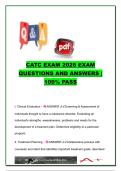
CATC EXAM 2026 EXAM
QUESTIONS AND ANSWERS |
100% PASS


I. Clinical Evaluation - ANSWER ✔✔Screening & Assessment of

individuals thought to have a substance disorder. Evaluating an

individual's strengths, wweaknesses, problems and needs for the

development of a treament plan. Determine eligibility to a particular

program.


II. Treatment Planning - ANSWER ✔✔Collaborative process with

counselor and client that identifies important treatment goals; described

, in behavioral and measureable, time-s ensitive action steps with

expected outcomes. Specific activity that links the problem with the goal.

Contract must be regularly reviewed and modified appropriately.


III. Referral - ANSWER ✔✔identifying needs of client that cannot be

met by the counselor or agency. Facilitating client's use of available

support systems and community resources to meet needs identified in

clinical evaluation or treatment planning.


IV. Service Coordination - ANSWER ✔✔Also known as Case

Management; activities that bring client, treatment services, community

agencies, and other resources together to focus on issues and needs

identified in treatment plan.


3 Definable elements of Service Coordination - ANSWER ✔✔1.

Implementing the treatment plan.

2. Counsulting and carrying on the process of ongoing assessment and

treatment planning

3. Counseling, of course, elements of individual, group, and family

counseling.


V. Counseling - ANSWER ✔✔a collaborative process that facilitates

the client's progress toward mutually determined treatment goal and

objectives through: exploration of a problem and it's ramifications

Document information

Uploaded on
June 6, 2026
Number of pages
9
Written in
2025/2026
Type
Exam (elaborations)
Contains
Questions & answers
$19.49

Wrong document? Swap it for free Within 14 days of purchase and before downloading, you can choose a different document. You can simply spend the amount again.
Written by students who passed
Immediately available after payment
Read online or as PDF

Seller avatar
Reputation scores are based on the amount of documents a seller has sold for a fee and the reviews they have received for those documents. There are three levels: Bronze, Silver and Gold. The better the reputation, the more your can rely on the quality of the sellers work.
JOSHCLAY
3.5
(82)
Sold
382
Followers
16
Items
20301
Last sold
1 day ago


Why students choose Stuvia

Created by fellow students, verified by reviews

Quality you can trust: written by students who passed their tests and reviewed by others who've used these notes.

Didn't get what you expected? Choose another document

No worries! You can instantly pick a different document that better fits what you're looking for.

Pay as you like, start learning right away

No subscription, no commitments. Pay the way you're used to via credit card and download your PDF document instantly.

Student with book image

“Bought, downloaded, and aced it. It really can be that simple.”

Alisha Student

Working on your references?

Create accurate citations in APA, MLA and Harvard with our free citation generator.

Working on your references?

Frequently asked questions

