

Written by students who passed Immediately available after payment Read online or as PDF Wrong document? Swap it for free 4.6 TrustPilot
logo-home
Document preview thumbnail
Preview 2 out of 13 pages
Exam (elaborations)

Older Adult Final Exam Study Guide (2026) | 120+ Key Concepts and Exam Answers | Gerontological Nursing, Dementia, Delirium, Falls, Polypharmacy, Hospice & Elder Abuse

Document preview thumbnail
Preview 2 out of 13 pages

This comprehensive Older Adult Final Exam Study Guide (2026) provides more than 120 high-yield nursing concepts, exam answers, and evidence-based review points covering the essential principles of gerontological nursing, healthy aging, age-related physiological changes, cognitive disorders, medication safety, elder abuse, discharge planning, palliative care, and end-of-life nursing. The study guide is specifically designed for nursing students preparing for final examinations, NCLEX-RN®, Medical-Surgical Nursing, Adult Health Nursing, Community Health Nursing, and Gerontological Nursing courses. Its concise question-and-answer format allows students to rapidly review critical concepts while strengthening clinical judgment and test-taking skills. A major focus of the guide is age-related physiological changes across body systems. Students review cardiovascular changes such as decreased cardiac output and vascular stiffness, respiratory changes including reduced lung elasticity, gastrointestinal alterations leading to constipation risk, genitourinary changes associated with urinary frequency, musculoskeletal decline resulting in bone loss and decreased muscle mass, and integumentary changes such as fragile skin, dryness, and increased susceptibility to skin tears. The material emphasizes assessment findings commonly encountered in older adults and highlights evidence-based nursing interventions designed to maintain function, prevent complications, and support healthy aging. The resource provides extensive coverage of frailty, fall prevention, mobility preservation, and safety promotion. Students examine frailty syndrome, orthostatic hypotension, intrinsic and extrinsic fall risk factors, balance assessment using the Romberg test, pressure injury prevention strategies, skin integrity management, and interventions that reduce hospitalization, disability, and mortality. Topics include assistive devices, environmental safety modifications, exercise promotion, nutritional support, and rehabilitation strategies that preserve independence and quality of life among older adults. A substantial portion of the guide focuses on pain management and mental health assessment in aging populations. Students review the PAINAD scale, acetaminophen as first-line therapy, nonpharmacological pain interventions, causes of agitation, depression risk factors, depression screening, suicide assessment, and evidence-based approaches to treating mood disorders in older adults. The material reinforces the important concept that both pain and depression are not normal consequences of aging and require appropriate nursing assessment and intervention. The study guide also provides in-depth review of cognitive disorders commonly tested on nursing examinations. Topics include normal cognitive aging, dementia, delirium, Alzheimer's disease, sundowning syndrome, confusion assessment, cognitive stimulation, safety precautions, and differentiation between acute and chronic cognitive impairment. Students learn to identify common causes of delirium such as urinary tract infections, dehydration, medication effects, and electrolyte imbalances while applying evidence-based nursing interventions that improve patient outcomes and safety. Additional chapters focus on sexuality in older adulthood, urinary tract infections, nutrition, hydration, polypharmacy, medication safety, elder abuse recognition, vision disorders, caregiver burden, respite care, discharge planning, aging in place, community resources, ethical principles, advance directives, informed consent, hospice care, palliative care, grief, aspiration prevention, sleep disorders, urinary incontinence, chronic venous insufficiency, skin disorders, and end-of-life care. Students develop a comprehensive understanding of the biological, psychosocial, ethical, and legal dimensions of caring for older adults across acute care, community, rehabilitation, and long-term care settings. The content aligns with major gerontological nursing curricula and reflects concepts presented in leading academic references including Miller's Nursing for Wellness in Older Adults, Eliopoulos' Gerontological Nursing, Touhy & Jett's Gerontological Nursing & Healthy Aging, Lewis's Medical-Surgical Nursing, Brunner & Suddarth's Textbook of Medical-Surgical Nursing, and Potter & Perry's Fundamentals of Nursing. The material also incorporates evidence-based recommendations from the American Geriatrics Society (AGS), National Institute on Aging (NIA), National Council on Aging (NCOA), Centers for Disease Control and Prevention (CDC), and World Health Organization (WHO) healthy aging initiatives. Relevant Students: NCLEX-RN Candidates, NCLEX-PN Candidates, Registered Nursing (RN) Students, Bachelor of Science in Nursing (BSN) Students, Associate Degree Nursing (ADN) Students, Licensed Practical Nursing (LPN/LVN) Students, Gerontological Nursing Students, Adult Health Nursing Students, Medical-Surgical Nursing Students, Community Health Nursing Students, Geriatric Care Students, Rehabilitation Nursing Students, Long-Term Care Nursing Students, Nurse Practitioner Students, Public Health Students, Occupational Therapy Students, Physical Therapy Students, Healthcare Administration Students, Social Work Students, Care Coordinators, Case Managers, and healthcare professionals involved in the care of older adults. Keywords: older adult final exam, gerontological nursing, geriatric nursing, nursing study guide, NCLEX gerontology, age related changes, cardiovascular aging, decreased cardiac output, respiratory aging, gastrointestinal aging, constipation, urinary frequency, musculoskeletal aging, frailty syndrome, frailty assessment, fall prevention, orthostatic hypotension, pressure injury prevention, skin integrity, skin tears, Romberg test, balance assessment, pain assessment, PAINAD scale, chronic pain management, acetaminophen, nonpharmacologic pain management, agitation, depression in older adults, suicide assessment, cognitive impairment, dementia, delirium, Alzheimer's disease, sundowning, confusion assessment, urinary tract infections, UTI in older adults, nutrition in aging, dehydration prevention, polypharmacy, medication safety, start low go slow, elder abuse, elder neglect, financial exploitation, presbyopia, glaucoma, cataracts, macular degeneration, vision care, driving safety, caregiver burden, respite care, discharge planning, aging in place, home health referrals, autonomy, beneficence, nonmaleficence, justice, fidelity, veracity, advance directives, living will, durable power of attorney, informed consent, hospice care, palliative care, end of life care, Kubler Ross stages of grief, aspiration prevention, xerostomia, oral candidiasis, sleep disorders, sleep apnea, stress incontinence, venous stasis, cellulitis, arterial insufficiency ulcers, bradycardia, pacemaker, quality of life care, HIPAA, nursing final exam review, evidence based geriatric care

Content preview

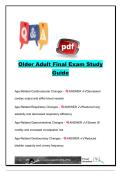
Older Adult Final Exam Study
Guide


Age-Related Cardiovascular Changes - ANSWER ✔✔Decreased

cardiac output and stiffer blood vessels


Age-Related Respiratory Changes - ANSWER ✔✔Reduced lung

elasticity and decreased respiratory efficiency


Age-Related Gastrointestinal Changes - ANSWER ✔✔Slower GI

motility and increased constipation risk


Age-Related Genitourinary Changes - ANSWER ✔✔Reduced

bladder capacity and urinary frequency

, Age-Related Musculoskeletal Changes - ANSWER ✔✔Bone loss and

decreased muscle mass


Normal Skin Changes in Older Adults - ANSWER ✔✔Thin fragile

skin, wrinkles, dryness, and easy bruising


Pressure Injury Prevention - ANSWER ✔✔Reposition every 2 hours,

moisturize skin, and use pressure relief devices


Frailty - ANSWER ✔✔Syndrome of decreased physiologic reserve

causing vulnerability to stressors


Signs of Frailty - ANSWER ✔✔Weakness, weight loss, fatigue, slow

gait, and decreased activity


Frailty Risks - ANSWER ✔✔Falls, hospitalization, disability, and

death


Frailty Nursing Interventions - ANSWER ✔✔Exercise, protein intake,

fall prevention, and monitor functional status


Orthostatic Hypotension - ANSWER ✔✔Drop in blood pressure when

standing causing dizziness and fall risk


Major Fall Risk Factors - ANSWER ✔✔Weakness, poor vision,

cognitive impairment, sedating medications, bradycardia

Document information

Uploaded on
June 6, 2026
Number of pages
13
Written in
2025/2026
Type
Exam (elaborations)
Contains
Questions & answers
$18.99

Wrong document? Swap it for free Within 14 days of purchase and before downloading, you can choose a different document. You can simply spend the amount again.
Written by students who passed
Immediately available after payment
Read online or as PDF

Seller avatar
Reputation scores are based on the amount of documents a seller has sold for a fee and the reviews they have received for those documents. There are three levels: Bronze, Silver and Gold. The better the reputation, the more your can rely on the quality of the sellers work.
NinjaNerd
3.4
(76)
Sold
397
Followers
6
Items
15334
Last sold
2 hours ago


Why students choose Stuvia

Created by fellow students, verified by reviews

Quality you can trust: written by students who passed their tests and reviewed by others who've used these notes.

Didn't get what you expected? Choose another document

No worries! You can instantly pick a different document that better fits what you're looking for.

Pay as you like, start learning right away

No subscription, no commitments. Pay the way you're used to via credit card and download your PDF document instantly.

Student with book image

“Bought, downloaded, and aced it. It really can be that simple.”

Alisha Student

Working on your references?

Create accurate citations in APA, MLA and Harvard with our free citation generator.

Working on your references?

Frequently asked questions

