

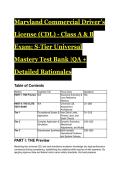
Maryland Commercial Driver’s
License (CDL) - Class A & B
Exam: S-Tier Universal
Mastery Test Bank |QA +
Detailed Rationales
Table of Contents
Section Cognitive Tier Focus Area Questions
PART I: THE Preview N/A Executive Summary & N/A
Core Reference
Matrices
PART II: THE ELITE N/A Universal CDL Q1–Q60
TEST BANK Assessment
Architecture
Tier 1 Foundational Syntax & Hard Deck Limits, Q1–Q15
Application Primary Laws, and
Static Checks
Tier 2 Complex Application & Dynamic Scenarios, Q16–Q35
Simulation Mechanical
Adjustments, and Rules
Tier 3 Grandmaster Synthesis Multi-Variable Q36–Q60
Operational Problems
and System Failures
PART I: THE Preview
Mastering this universal CDL test bank transforms academic knowledge into high-performance
commercial driving competency, establishing the analytical skills required of elite operators. By
applying rigorous state and federal motor carrier safety standards, this bank prepares
,candidates to navigate the legal and mechanical challenges of modern logistics.
Critical Reference Matrices
The following tables synthesize Maryland's commercial driving standards and provide
immediate, high-density access to key operational thresholds.
Table 1: Maryland CDL Weights & Classifications
License Class Configuration Combined/Gross Towed Unit Weight Key
Weight Rating (GVWR) Exclusions/Notes
Class A Combination \ge 26,001 \text{ > 10,000 \text{ lbs} Authorizes
lbs} operating Class B
and C vehicles.
Class B Single Unit \ge 26,001 \text{ \le 10,000 \text{ Common for
lbs} lbs} straight trucks,
large buses, dump
trucks.
Class C Single/Combo < 26,001 \text{ lbs} \le 10,000 \text{ Required ONLY if
lbs} carrying \ge 16
passengers or
placarded hazmat.
Table 2: In-Cab Air Brake Test Steps and Pressure Limits
Test Phase Engine State Valve Maximum Key Operational
Configuration Allowable Air Loss Thresholds
Static Leak Test Off Pushed In (Brakes Single: 2 \text{ Monitor gauges for
Released) psi/min} Combo: 3 a full 60 \text{
\text{ psi/min} seconds}.
Applied Pressure Off Pushed In / Brake Single: 3 \text{ Apply and hold
Test Pedal Held psi/min} Combo: 4 service brake
\text{ psi/min} pedal firmly.
Low-Air Warning Off (Key On) Pushed In / Fan N/A Optical/acoustic
Check Service Brake alarms must
activate \ge 60
\text{ psi}.
Spring Brake Off (Key On) Pushed In / Fan N/A Parking and
Pop-Out Service Brake emergency valves
must pop out
between
20\text{--}45 \text{
psi}.
Compressor On (1500 \text{ N/A N/A Rise from 85 \text{
Build Rate RPM}) to } 100 \text{ psi}
within 45 \text{
seconds}.
Governor On N/A N/A Compressor
,Test Phase Engine State Valve Maximum Key Operational
Configuration Allowable Air Loss Thresholds
Cut-Out Test governor must cut
out between
120\text{--}140
\text{ psi}.
Table 3: Maryland Move Over Law Penalty Structure
Violation Severity Financial Penalty License Points Key Conditions
Basic Infraction $110 1 Point Failure to lane-change
or slow down for any
stopped vehicle with
warnings.
Collision Caused $150 3 Points Failure results in a
crash with any stopped
emergency or service
vehicle.
Serious Injury or $750 3 Points Failure results in a
Death crash causing severe
bodily harm or a fatality.
Critical Axioms
● The Anti-Masking Mandate (49 CFR § 384.226): In Maryland, a Probation Before
Judgment (PBJ) does not mask or prevent a commercial conviction from being
transmitted via the Commercial Driver's License Information System (CDLIS) to the
driver's home state; a PBJ counts as a conviction for CDL disqualification purposes.
● The Physical Median Exemption: Opposing traffic is exempt from stopping for a school
bus with active red signals ONLY when separated by a physical median (grass, dirt, or
concrete barrier); a center turn lane does NOT exempt opposing traffic.
● The 1-Second-per-10-Feet Spacing Rule: Operators must maintain a minimum following
distance of 1 second for every 10 feet of vehicle length at speeds under 40 mph, adding 1
extra second for speeds over 40 mph.
PART II: THE ELITE TEST BANK
Tier 1: Foundational Syntax & Application (Questions 1–15)
Q1: An operator is driving a combination vehicle with a Gross Combination Weight Rating
(GCWR) of 28,000 pounds, pulling a trailer with a Gross Vehicle Weight Rating (GVWR) of
11,500 pounds. Based on the classification rules of the Maryland Motor Vehicle Administration
(MVA), which class of Commercial Driver’s License (CDL) is the MINIMUM required?
A) Class C
B) Class B
C) Class A
D) Non-Commercial Class C
● The Answer: C (Class A)
● Distractor Analysis:
, ○ A is incorrect: Class C is only for vehicles under 26,001 pounds GVWR that
transport hazardous materials or 16+ passengers.
○ B is incorrect: Class B is for single vehicles with a GVWR of 26,001 pounds or
more, and allows towing trailers only if they are 10,000 pounds or less.
○ D is incorrect: A commercial license is legally required since the gross combination
weight rating exceeds 26,000 pounds and the trailer exceeds 10,000 pounds.
The Mentor's Analysis: The threshold for a Class A license is determined by both the
combination weight and the weight of the towed unit. When the GCWR is 26,001 or more
pounds and the towed trailer is over 10,000 pounds GVWR, Class A is mandated. By analyzing
both weight ratings, the carrier avoids licensing compliance errors. Professional/Academic
Intuition: Class A licensing is triggered when the combination weight rating exceeds
26,000 pounds and the towed vehicle exceeds 10,000 pounds.
Q2: During the static leak test portion of the in-cab air brake inspection on a Class B straight
truck, what is the MAXIMUM allowable air pressure drop per minute?
A) 1 psi
B) 2 psi
C) 3 psi
D) 4 psi
● The Answer: B (2 psi)
● Distractor Analysis:
○ A is incorrect: 1 psi is an unnecessarily restrictive standard that does not align with
industry or regulatory standards.
○ C is incorrect: 3 psi is the maximum allowable drop for a combination vehicle during
a static leak test, not a single unit.
○ D is incorrect: 4 psi is the maximum allowable drop for a combination vehicle during
an applied pressure test, which is a different phase.
The Mentor's Analysis: The static leak test measures system integrity with the engine off and
the parking brakes released. Single-unit vehicles have fewer couplings and lines, meaning they
are held to a tighter standard of 2 psi per minute. By observing the gauge for a full 60 seconds,
the driver can detect slow leaks. Professional/Academic Intuition: A single vehicle must not
lose more than 2 psi in one minute during a static leak test, while a combination vehicle
is allowed up to 3 psi.
Q3: An operator of a commercial motor vehicle approaches a stopped school bus with its red
lights flashing and stop arm extended on an undivided Maryland highway. What is the MINIMUM
distance the operator must stop from the front or rear of the school bus?
A) 10 feet
B) 15 feet
C) 20 feet
D) 30 feet
● The Answer: C (20 feet)
● Distractor Analysis:
○ A is incorrect: 10 feet is the side hazard clearance distance (the "danger zone"), not
the stopping distance for approaching traffic.
○ B is incorrect: 15 feet is the minimum stopping distance for railroad grade
crossings, not school buses.
○ D is incorrect: 30 feet is the hazard zone directly in front of the bus bumper, but
traffic is legally required to stop 20 feet away.
The Mentor's Analysis: Maryland law imposes a strict 20-foot buffer around school vehicles to
License (CDL) - Class A & B
Exam: S-Tier Universal
Mastery Test Bank |QA +
Detailed Rationales
Table of Contents
Section Cognitive Tier Focus Area Questions
PART I: THE Preview N/A Executive Summary & N/A
Core Reference
Matrices
PART II: THE ELITE N/A Universal CDL Q1–Q60
TEST BANK Assessment
Architecture
Tier 1 Foundational Syntax & Hard Deck Limits, Q1–Q15
Application Primary Laws, and
Static Checks
Tier 2 Complex Application & Dynamic Scenarios, Q16–Q35
Simulation Mechanical
Adjustments, and Rules
Tier 3 Grandmaster Synthesis Multi-Variable Q36–Q60
Operational Problems
and System Failures
PART I: THE Preview
Mastering this universal CDL test bank transforms academic knowledge into high-performance
commercial driving competency, establishing the analytical skills required of elite operators. By
applying rigorous state and federal motor carrier safety standards, this bank prepares
,candidates to navigate the legal and mechanical challenges of modern logistics.
Critical Reference Matrices
The following tables synthesize Maryland's commercial driving standards and provide
immediate, high-density access to key operational thresholds.
Table 1: Maryland CDL Weights & Classifications
License Class Configuration Combined/Gross Towed Unit Weight Key
Weight Rating (GVWR) Exclusions/Notes
Class A Combination \ge 26,001 \text{ > 10,000 \text{ lbs} Authorizes
lbs} operating Class B
and C vehicles.
Class B Single Unit \ge 26,001 \text{ \le 10,000 \text{ Common for
lbs} lbs} straight trucks,
large buses, dump
trucks.
Class C Single/Combo < 26,001 \text{ lbs} \le 10,000 \text{ Required ONLY if
lbs} carrying \ge 16
passengers or
placarded hazmat.
Table 2: In-Cab Air Brake Test Steps and Pressure Limits
Test Phase Engine State Valve Maximum Key Operational
Configuration Allowable Air Loss Thresholds
Static Leak Test Off Pushed In (Brakes Single: 2 \text{ Monitor gauges for
Released) psi/min} Combo: 3 a full 60 \text{
\text{ psi/min} seconds}.
Applied Pressure Off Pushed In / Brake Single: 3 \text{ Apply and hold
Test Pedal Held psi/min} Combo: 4 service brake
\text{ psi/min} pedal firmly.
Low-Air Warning Off (Key On) Pushed In / Fan N/A Optical/acoustic
Check Service Brake alarms must
activate \ge 60
\text{ psi}.
Spring Brake Off (Key On) Pushed In / Fan N/A Parking and
Pop-Out Service Brake emergency valves
must pop out
between
20\text{--}45 \text{
psi}.
Compressor On (1500 \text{ N/A N/A Rise from 85 \text{
Build Rate RPM}) to } 100 \text{ psi}
within 45 \text{
seconds}.
Governor On N/A N/A Compressor
,Test Phase Engine State Valve Maximum Key Operational
Configuration Allowable Air Loss Thresholds
Cut-Out Test governor must cut
out between
120\text{--}140
\text{ psi}.
Table 3: Maryland Move Over Law Penalty Structure
Violation Severity Financial Penalty License Points Key Conditions
Basic Infraction $110 1 Point Failure to lane-change
or slow down for any
stopped vehicle with
warnings.
Collision Caused $150 3 Points Failure results in a
crash with any stopped
emergency or service
vehicle.
Serious Injury or $750 3 Points Failure results in a
Death crash causing severe
bodily harm or a fatality.
Critical Axioms
● The Anti-Masking Mandate (49 CFR § 384.226): In Maryland, a Probation Before
Judgment (PBJ) does not mask or prevent a commercial conviction from being
transmitted via the Commercial Driver's License Information System (CDLIS) to the
driver's home state; a PBJ counts as a conviction for CDL disqualification purposes.
● The Physical Median Exemption: Opposing traffic is exempt from stopping for a school
bus with active red signals ONLY when separated by a physical median (grass, dirt, or
concrete barrier); a center turn lane does NOT exempt opposing traffic.
● The 1-Second-per-10-Feet Spacing Rule: Operators must maintain a minimum following
distance of 1 second for every 10 feet of vehicle length at speeds under 40 mph, adding 1
extra second for speeds over 40 mph.
PART II: THE ELITE TEST BANK
Tier 1: Foundational Syntax & Application (Questions 1–15)
Q1: An operator is driving a combination vehicle with a Gross Combination Weight Rating
(GCWR) of 28,000 pounds, pulling a trailer with a Gross Vehicle Weight Rating (GVWR) of
11,500 pounds. Based on the classification rules of the Maryland Motor Vehicle Administration
(MVA), which class of Commercial Driver’s License (CDL) is the MINIMUM required?
A) Class C
B) Class B
C) Class A
D) Non-Commercial Class C
● The Answer: C (Class A)
● Distractor Analysis:
, ○ A is incorrect: Class C is only for vehicles under 26,001 pounds GVWR that
transport hazardous materials or 16+ passengers.
○ B is incorrect: Class B is for single vehicles with a GVWR of 26,001 pounds or
more, and allows towing trailers only if they are 10,000 pounds or less.
○ D is incorrect: A commercial license is legally required since the gross combination
weight rating exceeds 26,000 pounds and the trailer exceeds 10,000 pounds.
The Mentor's Analysis: The threshold for a Class A license is determined by both the
combination weight and the weight of the towed unit. When the GCWR is 26,001 or more
pounds and the towed trailer is over 10,000 pounds GVWR, Class A is mandated. By analyzing
both weight ratings, the carrier avoids licensing compliance errors. Professional/Academic
Intuition: Class A licensing is triggered when the combination weight rating exceeds
26,000 pounds and the towed vehicle exceeds 10,000 pounds.
Q2: During the static leak test portion of the in-cab air brake inspection on a Class B straight
truck, what is the MAXIMUM allowable air pressure drop per minute?
A) 1 psi
B) 2 psi
C) 3 psi
D) 4 psi
● The Answer: B (2 psi)
● Distractor Analysis:
○ A is incorrect: 1 psi is an unnecessarily restrictive standard that does not align with
industry or regulatory standards.
○ C is incorrect: 3 psi is the maximum allowable drop for a combination vehicle during
a static leak test, not a single unit.
○ D is incorrect: 4 psi is the maximum allowable drop for a combination vehicle during
an applied pressure test, which is a different phase.
The Mentor's Analysis: The static leak test measures system integrity with the engine off and
the parking brakes released. Single-unit vehicles have fewer couplings and lines, meaning they
are held to a tighter standard of 2 psi per minute. By observing the gauge for a full 60 seconds,
the driver can detect slow leaks. Professional/Academic Intuition: A single vehicle must not
lose more than 2 psi in one minute during a static leak test, while a combination vehicle
is allowed up to 3 psi.
Q3: An operator of a commercial motor vehicle approaches a stopped school bus with its red
lights flashing and stop arm extended on an undivided Maryland highway. What is the MINIMUM
distance the operator must stop from the front or rear of the school bus?
A) 10 feet
B) 15 feet
C) 20 feet
D) 30 feet
● The Answer: C (20 feet)
● Distractor Analysis:
○ A is incorrect: 10 feet is the side hazard clearance distance (the "danger zone"), not
the stopping distance for approaching traffic.
○ B is incorrect: 15 feet is the minimum stopping distance for railroad grade
crossings, not school buses.
○ D is incorrect: 30 feet is the hazard zone directly in front of the bus bumper, but
traffic is legally required to stop 20 feet away.
The Mentor's Analysis: Maryland law imposes a strict 20-foot buffer around school vehicles to


