Yukon Commercial Driver Licensing
and Operations: S-Tier Universal
Mastery Report and Elite Test Bank
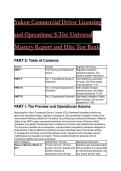
PART 0: Table of Contents
Section Content Cognitive Tier Focus
PART I The Preview and Operational Regulatory baselines,
Axioms operational physics, and
extreme-weather mechanics
PART II Tier 1: Foundational Syntax & Core definitions, pneumatic
Application formulas, and Class weight
limits (Questions 1–10)
PART III Tier 2: Complex Application & Multi-variable changes,
Simulation operational logic, and defect
analysis (Questions 11–20)
PART IV Tier 3: Grandmaster Synthesis High-stakes mitigation, kinetic
failure analysis, and survival
(Questions 21–30)
PART I: The Preview and Operational Axioms
Mastering the Yukon Commercial Driver’s License (CDL) framework translates directly into
apex-level operational safety, regulatory compliance, and mechanical oversight in some of the
most extreme driving conditions on the planet. By synthesizing mechanical tolerances, National
Safety Code (NSC) cargo securement standards, and sub-arctic Hours of Service (HoS)
mandates, the operator transcends basic compliance to achieve elite professional competence.
This document operates as an exhaustive, scenario-based competency framework designed to
forge decision-making reflexes for professional peers operating heavy commercial vehicles.
To navigate the sub-arctic commercial transport sector, operators must internalize specific
mathematical and regulatory constants. These constants dictate the absolute limits of
mechanical viability and human endurance.
Axiom Category Critical Rule / Formula Operational Implication
Hours of Service (North of 15 hours driving / 18 hours Operators gain expanded legal
60°) on-duty / 20-hour elapsed shift driving windows to compensate
window. Requires 8 for vast territorial distances, but
consecutive hours off-duty. face a strict 20-hour total
,Axiom Category Critical Rule / Formula Operational Implication
biological clock.
Air Brake Stroke Tolerances Type 30 standard chamber max Exceeding these thresholds
stroke = 51 mm (2 inches). guarantees thermal brake fade
Type 30 LS max stroke = 64 on downgrades, leading to
mm (2.5 inches). catastrophic loss of kinetic
control.
Pneumatic Warning Low-air warning must activate Defines the final cognitive
Thresholds continuously at or above 414 safety net before spring brakes
kPa (60 psi), minimum 380 kPa auto-engage violently at
(55 psi). highway speeds.
Tractor Protection The tractor protection valve Acts as a pneumatic tourniquet;
Architecture must close (pop out) before preserves the towing vehicle's
pressure drops below 138 kPa air supply during a catastrophic
(20 psi). trailer breakaway.
Radius Exemption Protocol The 160-km exemption Shifts the regulatory burden of
demands daily return to the fatigue tracking from the
home terminal and a minimum driver's daily log grid directly to
of 8 consecutive hours of rest. the carrier's administrative
records.
PART II: THE ELITE TEST BANK (Tier 1 - Foundational
Syntax & Application)
Q1: A commercial operator is tasked with navigating a Class 3 vehicle loaded with construction
materials entirely north of the 60th parallel in the Yukon. Based on the federal rules for driving
north of Latitude 60°N, which operational timeframe represents the MAXIMUM allowable driving
limit and the MAXIMUM on-duty limit before an off-duty reset is required? A) 13 hours driving
within a 14-hour on-duty shift. B) 15 hours driving within a 16-hour on-duty shift. C) 15 hours
driving within an 18-hour on-duty shift. D) 18 hours driving within a 20-hour on-duty shift.
● The Answer: C (15 hours driving within an 18-hour on-duty shift.)
● Distractor Analysis:
○ A is incorrect: This option represents the standard Canadian Hours of Service
regulations applicable south of the 60th parallel, which strictly limits driving to 13
hours.
○ B is incorrect: This choice improperly blends the extended 15-hour drive limit of the
north with the standard 16-hour elapsed work shift limit found in the southern
regulatory framework, creating an invalid hybrid.
○ D is incorrect: A 20-hour limit applies specifically to the total elapsed work shift
window (the absolute biological timeline from the start of the shift), not the
maximum allowable time spent actively operating the vehicle.
The Mentor's Analysis: The "North of 60" regulation mathematically offsets the extreme
distances and lower traffic density of the Canadian territories by expanding the standard duty
window. When operating in the Yukon, the operator is granted 15 hours of active driving nested
inside an 18-hour on-duty cap, which is enclosed within a 20-hour absolute elapsed work shift
window. By utilizing North of 60 rules, you bypass the common trap of artificially constraining
northern logistics with southern parameters. Professional/Academic Intuition: Always isolate
, the operational latitude; crossing the 60th parallel instantly expands the physiological
and legal boundaries of fatigue management.
Q2: During a daily commercial vehicle inspection, an operator measures the pushrod stroke of a
standard Type 30 clamp-type brake chamber. A full brake application is made with system
pressure between 620 to 690 kPa (90 to 100 psi). Which measurement indicates that the brake
is legally out of adjustment and requires IMMEDIATE Out-of-Service (OOS) designation? A)
44.5 mm (1 3/4 inches) B) 50.8 mm (2 inches) C) 54 mm (2 1/8 inches) D) 63.5 mm (2 1/2
inches) on a Type 30 LS chamber
● The Answer: C (54 mm (2 1/8 inches))
● Distractor Analysis:
○ A is incorrect: Measuring 44.5 mm leaves a critical 1/4 inch of reserve stroke
margin before reaching the legal threshold on a standard Type 30 chamber,
meaning it is still legally compliant.
○ B is incorrect: Exactly 50.8 mm (2 inches) is the absolute stroke limit for a standard
Type 30 chamber. While it requires adjustment very soon, strictly exceeding it is
what triggers the statutory violation.
○ D is incorrect: A Type 30 LS (Long Stroke) chamber possesses a mathematically
expanded internal geometry, granting a legal limit of 64 mm (2.5 inches); therefore,
63.5 mm is legally compliant for that specific hardware variant.
The Mentor's Analysis: Pushrod stroke is the singular metric separating controlled
deceleration from catastrophic kinetic failure. As cast iron drums heat and expand on long
descents, the required stroke distance increases. A standard Type 30 chamber exceeding 51
mm (2 inches) lacks the reserve geometry to maintain physical contact with a thermally
expanded drum. By utilizing Chamber Specific Measurement, you bypass the common trap of
treating all brake canisters identically. Professional/Academic Intuition: Identify the chamber
profile first; confusing a standard Type 30 with a Type 30 LS leads to catastrophic
false-positive safety approvals.
Q3: An operator holds a valid Yukon Class 3 driver's license without additional specialized
endorsements. Based on territorial licensing frameworks, which specific combination of vehicles
is this operator legally permitted to control? A) A 12,000 kg heavy dump truck towing a 5,000 kg
utility trailer. B) A 14,000 kg fuel delivery truck towing a 3,500 kg trailer. C) A specialized motor
coach equipped to carry 30 passengers. D) A tractor-trailer (semi-trailer) combination grossing
30,000 kg.
● The Answer: B (A 14,000 kg fuel delivery truck towing a 3,500 kg trailer.)
● Distractor Analysis:
○ A is incorrect: A Class 3 license explicitly restricts the operator to towing trailers that
do not exceed 4,550 kg. A 5,000 kg trailer crosses the legal threshold, requiring a
Class 1 license.
○ C is incorrect: Operating a bus carrying more than 24 passengers involves
completely different dynamic and life-safety liabilities, falling exclusively under the
purview of a Class 2 license.
○ D is incorrect: Operating any articulated semi-trailer combination requires the apex
commercial credential, the Class 1 license, due to the complex pivot geometry
involved.
The Mentor's Analysis: The Class 3 license serves as the foundational heavy-vehicle
credential, authorizing the operation of heavy straight trucks (vehicles over 11,000 kg with 2 or
more axles). The critical operational constraint is the towed mass, which acts as a hard legal
barrier preventing Class 3 operators from engaging in complex articulation dynamics. By
and Operations: S-Tier Universal
Mastery Report and Elite Test Bank
PART 0: Table of Contents
Section Content Cognitive Tier Focus
PART I The Preview and Operational Regulatory baselines,
Axioms operational physics, and
extreme-weather mechanics
PART II Tier 1: Foundational Syntax & Core definitions, pneumatic
Application formulas, and Class weight
limits (Questions 1–10)
PART III Tier 2: Complex Application & Multi-variable changes,
Simulation operational logic, and defect
analysis (Questions 11–20)
PART IV Tier 3: Grandmaster Synthesis High-stakes mitigation, kinetic
failure analysis, and survival
(Questions 21–30)
PART I: The Preview and Operational Axioms
Mastering the Yukon Commercial Driver’s License (CDL) framework translates directly into
apex-level operational safety, regulatory compliance, and mechanical oversight in some of the
most extreme driving conditions on the planet. By synthesizing mechanical tolerances, National
Safety Code (NSC) cargo securement standards, and sub-arctic Hours of Service (HoS)
mandates, the operator transcends basic compliance to achieve elite professional competence.
This document operates as an exhaustive, scenario-based competency framework designed to
forge decision-making reflexes for professional peers operating heavy commercial vehicles.
To navigate the sub-arctic commercial transport sector, operators must internalize specific
mathematical and regulatory constants. These constants dictate the absolute limits of
mechanical viability and human endurance.
Axiom Category Critical Rule / Formula Operational Implication
Hours of Service (North of 15 hours driving / 18 hours Operators gain expanded legal
60°) on-duty / 20-hour elapsed shift driving windows to compensate
window. Requires 8 for vast territorial distances, but
consecutive hours off-duty. face a strict 20-hour total
,Axiom Category Critical Rule / Formula Operational Implication
biological clock.
Air Brake Stroke Tolerances Type 30 standard chamber max Exceeding these thresholds
stroke = 51 mm (2 inches). guarantees thermal brake fade
Type 30 LS max stroke = 64 on downgrades, leading to
mm (2.5 inches). catastrophic loss of kinetic
control.
Pneumatic Warning Low-air warning must activate Defines the final cognitive
Thresholds continuously at or above 414 safety net before spring brakes
kPa (60 psi), minimum 380 kPa auto-engage violently at
(55 psi). highway speeds.
Tractor Protection The tractor protection valve Acts as a pneumatic tourniquet;
Architecture must close (pop out) before preserves the towing vehicle's
pressure drops below 138 kPa air supply during a catastrophic
(20 psi). trailer breakaway.
Radius Exemption Protocol The 160-km exemption Shifts the regulatory burden of
demands daily return to the fatigue tracking from the
home terminal and a minimum driver's daily log grid directly to
of 8 consecutive hours of rest. the carrier's administrative
records.
PART II: THE ELITE TEST BANK (Tier 1 - Foundational
Syntax & Application)
Q1: A commercial operator is tasked with navigating a Class 3 vehicle loaded with construction
materials entirely north of the 60th parallel in the Yukon. Based on the federal rules for driving
north of Latitude 60°N, which operational timeframe represents the MAXIMUM allowable driving
limit and the MAXIMUM on-duty limit before an off-duty reset is required? A) 13 hours driving
within a 14-hour on-duty shift. B) 15 hours driving within a 16-hour on-duty shift. C) 15 hours
driving within an 18-hour on-duty shift. D) 18 hours driving within a 20-hour on-duty shift.
● The Answer: C (15 hours driving within an 18-hour on-duty shift.)
● Distractor Analysis:
○ A is incorrect: This option represents the standard Canadian Hours of Service
regulations applicable south of the 60th parallel, which strictly limits driving to 13
hours.
○ B is incorrect: This choice improperly blends the extended 15-hour drive limit of the
north with the standard 16-hour elapsed work shift limit found in the southern
regulatory framework, creating an invalid hybrid.
○ D is incorrect: A 20-hour limit applies specifically to the total elapsed work shift
window (the absolute biological timeline from the start of the shift), not the
maximum allowable time spent actively operating the vehicle.
The Mentor's Analysis: The "North of 60" regulation mathematically offsets the extreme
distances and lower traffic density of the Canadian territories by expanding the standard duty
window. When operating in the Yukon, the operator is granted 15 hours of active driving nested
inside an 18-hour on-duty cap, which is enclosed within a 20-hour absolute elapsed work shift
window. By utilizing North of 60 rules, you bypass the common trap of artificially constraining
northern logistics with southern parameters. Professional/Academic Intuition: Always isolate
, the operational latitude; crossing the 60th parallel instantly expands the physiological
and legal boundaries of fatigue management.
Q2: During a daily commercial vehicle inspection, an operator measures the pushrod stroke of a
standard Type 30 clamp-type brake chamber. A full brake application is made with system
pressure between 620 to 690 kPa (90 to 100 psi). Which measurement indicates that the brake
is legally out of adjustment and requires IMMEDIATE Out-of-Service (OOS) designation? A)
44.5 mm (1 3/4 inches) B) 50.8 mm (2 inches) C) 54 mm (2 1/8 inches) D) 63.5 mm (2 1/2
inches) on a Type 30 LS chamber
● The Answer: C (54 mm (2 1/8 inches))
● Distractor Analysis:
○ A is incorrect: Measuring 44.5 mm leaves a critical 1/4 inch of reserve stroke
margin before reaching the legal threshold on a standard Type 30 chamber,
meaning it is still legally compliant.
○ B is incorrect: Exactly 50.8 mm (2 inches) is the absolute stroke limit for a standard
Type 30 chamber. While it requires adjustment very soon, strictly exceeding it is
what triggers the statutory violation.
○ D is incorrect: A Type 30 LS (Long Stroke) chamber possesses a mathematically
expanded internal geometry, granting a legal limit of 64 mm (2.5 inches); therefore,
63.5 mm is legally compliant for that specific hardware variant.
The Mentor's Analysis: Pushrod stroke is the singular metric separating controlled
deceleration from catastrophic kinetic failure. As cast iron drums heat and expand on long
descents, the required stroke distance increases. A standard Type 30 chamber exceeding 51
mm (2 inches) lacks the reserve geometry to maintain physical contact with a thermally
expanded drum. By utilizing Chamber Specific Measurement, you bypass the common trap of
treating all brake canisters identically. Professional/Academic Intuition: Identify the chamber
profile first; confusing a standard Type 30 with a Type 30 LS leads to catastrophic
false-positive safety approvals.
Q3: An operator holds a valid Yukon Class 3 driver's license without additional specialized
endorsements. Based on territorial licensing frameworks, which specific combination of vehicles
is this operator legally permitted to control? A) A 12,000 kg heavy dump truck towing a 5,000 kg
utility trailer. B) A 14,000 kg fuel delivery truck towing a 3,500 kg trailer. C) A specialized motor
coach equipped to carry 30 passengers. D) A tractor-trailer (semi-trailer) combination grossing
30,000 kg.
● The Answer: B (A 14,000 kg fuel delivery truck towing a 3,500 kg trailer.)
● Distractor Analysis:
○ A is incorrect: A Class 3 license explicitly restricts the operator to towing trailers that
do not exceed 4,550 kg. A 5,000 kg trailer crosses the legal threshold, requiring a
Class 1 license.
○ C is incorrect: Operating a bus carrying more than 24 passengers involves
completely different dynamic and life-safety liabilities, falling exclusively under the
purview of a Class 2 license.
○ D is incorrect: Operating any articulated semi-trailer combination requires the apex
commercial credential, the Class 1 license, due to the complex pivot geometry
involved.
The Mentor's Analysis: The Class 3 license serves as the foundational heavy-vehicle
credential, authorizing the operation of heavy straight trucks (vehicles over 11,000 kg with 2 or
more axles). The critical operational constraint is the towed mass, which acts as a hard legal
barrier preventing Class 3 operators from engaging in complex articulation dynamics. By