

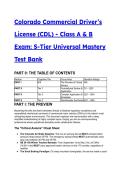
Colorado Commercial Driver’s
License (CDL) - Class A & B
Exam: S-Tier Universal Mastery
Test Bank
PART 0: THE TABLE OF CONTENTS
Section Cognitive Tier Focus Area Question Range
PART I N/A The Preview & Critical N/A
Axioms
PART II Tier 1 Foundational Syntax & Q1 – Q20
Application
PART II Tier 2 Complex Application & Q21 – Q40
Simulation
PART II Tier 3 Grandmaster Synthesis Q41 – Q60
PART I: THE PREVIEW
Mastering this elite test bank translates directly to flawless regulatory compliance and
unparalleled mechanical command of commercial motor vehicles (CMVs) in the nation's most
unforgiving alpine environments. This document replaces rote memorization with a deep,
simplified understanding of highly complex topics, forging you into an uncompromising
professional whose operational discipline averts catastrophic failures.
The "Critical Axioms" Cheat Sheet
● The Colorado Air Brake Baseline: The low air warning device MUST activate before
pressure drops below 55 PSI. The emergency spring brakes MUST automatically close
(pop out) between 20 PSI and 45 PSI.
● SB 24-100 Winter Traction Mandate: From September 1st to May 31st, all CMVs
(16,001+ lbs) MUST carry approved traction devices on the I-70 corridor, regardless of
weather.
● The Snub Braking Paradigm: On steep mountain downgrades, the service brake is used
, solely to reduce speed to 5 mph BELOW your safe target speed, at which point brakes
are released to dissipate heat.
● The Left Lane Prohibition: SB 24-100 explicitly forbids CMVs from traveling in the
furthest left lane on critical I-70 corridors unless actively passing a vehicle traveling below
the posted speed limit.
● Colorado NHS Dimensions: Colorado allows commercial vehicles up to 14.5 feet in
height strictly on designated National Highway System (NHS) routes.
PART II: THE ELITE TEST BANK
Tier 1 - Foundational Syntax & Application
Q1: A driver is performing the static Air Leakage Rate Test on a Class A combination vehicle.
The engine is off, the keys are in the "on" position, and the parking brakes are released. After
fully applying the foot brake, what is the MAXIMUM allowable air pressure loss? A) No more
than 2 PSI in one minute. B) No more than 3 PSI in one minute. C) No more than 4 PSI in one
minute. D) No more than 5 PSI in one minute.
● The Answer: C (No more than 4 PSI in one minute.)
● Distractor Analysis:
○ A is incorrect: This is a mathematically invalid threshold not supported by federal or
state standards.
○ B is incorrect: A 3 PSI loss threshold applies strictly to single commercial vehicles
(Class B), not combination vehicles.
○ D is incorrect: A 5 PSI loss indicates a catastrophic leak in the pneumatic system
that requires an Out-of-Service declaration.
The Mentor's Analysis: The pneumatic integrity of a combination vehicle is the bedrock of
stopping power. The extra 1 PSI allowance for combination vehicles accounts for the inherent
volume and connection loss through the gladhands. Professional/Academic Intuition: Rule of
thumb: 3 for Single, 4 for Combo. Any deviation is a critical failure.
Q2: Under Colorado Senate Bill 24-100, a commercial motor vehicle with a Gross Vehicle
Weight Rating (GVWR) exceeding 16,001 pounds operating on I-70 between Morrison and
Dotsero MUST carry approved tire chains during which specific timeframe? A) October 1st
through April 30th. B) September 1st through May 31st. C) November 15th through May 15th.
D) Strictly during active snow advisories issued by CDOT.
● The Answer: B (September 1st through May 31st.)
● Distractor Analysis:
○ A is incorrect: This is a legacy standard used in neighboring jurisdictions, rendering
the driver liable for fines in September and May.
○ C is incorrect: This represents a common winter tire standard for passenger
vehicles, unrelated to CMV statutory requirements.
○ D is incorrect: The Colorado "Must Carry" law is absolute regardless of clear
weather or dry pavement.
The Mentor's Analysis: High-altitude weather is fundamentally unpredictable. The state
legislature instituted a static 9-month window to eliminate operator guesswork and shift the
liability entirely onto the carrier. Professional/Academic Intuition: Compliance is
calendar-driven, not weather-dependent.
Q3: A driver is inspecting the low air warning devices during a pre-trip inspection. According to
, the current Colorado CDL manual, at what specific pressure threshold MUST the warning
buzzer and light activate? A) Before the air pressure drops below 60 PSI. B) Before the air
pressure drops below 55 PSI. C) Exactly at 45 PSI. D) Between 20 PSI and 45 PSI.
● The Answer: B (Before the air pressure drops below 55 PSI.)
● Distractor Analysis:
○ A is incorrect: While 60 PSI appears in legacy federal literature, the specific
Colorado CDL compliance manual strictly dictates 55 PSI.
○ C is incorrect: This represents the high-end maximum threshold for the emergency
spring brakes to pop out, not the warning alarm.
○ D is incorrect: This is the legal window for the tractor protection valve and parking
brake to close.
The Mentor's Analysis: The gap between 55 PSI and the 20-45 PSI pop-out window is your
only margin of survival. The warning device provides the crucial seconds needed to execute a
controlled stop. Professional/Academic Intuition: Never accept warning activation below
55 PSI; you are trading reaction time for a catastrophic uncontrolled stop.
Q4: A commercial vehicle is traveling westbound on I-70 through Glenwood Canyon. Based on
the provisions of SB 24-100, which action regarding lane usage is MOST ACCURATE? A) The
vehicle may use the far-left lane only if passing a vehicle traveling below the posted speed limit.
B) The vehicle is permanently banned from the far-left lane under all circumstances to prevent
traffic stacking. C) The vehicle may use the far-left lane provided the gross combination weight
is under 80,000 pounds. D) The vehicle must remain in the far-left lane to allow faster
passenger vehicles to merge from right-side on-ramps.
● The Answer: A (The vehicle may use the far-left lane only if passing a vehicle traveling
below the posted speed limit.)
● Distractor Analysis:
○ B is incorrect: The law provides an explicit exception for safely passing vehicles that
are traveling under the posted limit.
○ C is incorrect: The restriction is based on vehicle classification, not a sliding scale of
loaded weight.
○ D is incorrect: This directly contradicts the statutory intent of maintaining flow for
lighter vehicles.
The Mentor's Analysis: The legislative intent of SB 24-100 is to prevent "elephant racing"—two
CMVs blocking all lanes up a steep grade. However, the law cannot force a CMV to remain
behind a stalled hazard. Professional/Academic Intuition: The left lane is for transient
passing of slower hazards, never for sustained cruising.
Q5: A commercial driver approaching a railroad grade crossing in a manual transmission vehicle
makes a complete stop. As the tracks clear, what is the IMMEDIATE mechanical priority when
proceeding? A) Shift rapidly through the low gears to minimize time spent on the tracks. B)
Engage the differential lock to prevent wheel slip on the steel rails. C) Cross the tracks in a gear
low enough to traverse without manually shifting. D) Activate the four-way flashers only after the
cab has cleared the final track.
● The Answer: C (Cross the tracks in a gear low enough to traverse without manually
shifting.)
● Distractor Analysis:
○ A is incorrect: Attempting to shift gears while traversing tracks introduces the risk of
missing a gear and stalling the vehicle.
○ B is incorrect: Differential locks are for low-traction environments; using them on dry
pavement will damage the driveline.
License (CDL) - Class A & B
Exam: S-Tier Universal Mastery
Test Bank
PART 0: THE TABLE OF CONTENTS
Section Cognitive Tier Focus Area Question Range
PART I N/A The Preview & Critical N/A
Axioms
PART II Tier 1 Foundational Syntax & Q1 – Q20
Application
PART II Tier 2 Complex Application & Q21 – Q40
Simulation
PART II Tier 3 Grandmaster Synthesis Q41 – Q60
PART I: THE PREVIEW
Mastering this elite test bank translates directly to flawless regulatory compliance and
unparalleled mechanical command of commercial motor vehicles (CMVs) in the nation's most
unforgiving alpine environments. This document replaces rote memorization with a deep,
simplified understanding of highly complex topics, forging you into an uncompromising
professional whose operational discipline averts catastrophic failures.
The "Critical Axioms" Cheat Sheet
● The Colorado Air Brake Baseline: The low air warning device MUST activate before
pressure drops below 55 PSI. The emergency spring brakes MUST automatically close
(pop out) between 20 PSI and 45 PSI.
● SB 24-100 Winter Traction Mandate: From September 1st to May 31st, all CMVs
(16,001+ lbs) MUST carry approved traction devices on the I-70 corridor, regardless of
weather.
● The Snub Braking Paradigm: On steep mountain downgrades, the service brake is used
, solely to reduce speed to 5 mph BELOW your safe target speed, at which point brakes
are released to dissipate heat.
● The Left Lane Prohibition: SB 24-100 explicitly forbids CMVs from traveling in the
furthest left lane on critical I-70 corridors unless actively passing a vehicle traveling below
the posted speed limit.
● Colorado NHS Dimensions: Colorado allows commercial vehicles up to 14.5 feet in
height strictly on designated National Highway System (NHS) routes.
PART II: THE ELITE TEST BANK
Tier 1 - Foundational Syntax & Application
Q1: A driver is performing the static Air Leakage Rate Test on a Class A combination vehicle.
The engine is off, the keys are in the "on" position, and the parking brakes are released. After
fully applying the foot brake, what is the MAXIMUM allowable air pressure loss? A) No more
than 2 PSI in one minute. B) No more than 3 PSI in one minute. C) No more than 4 PSI in one
minute. D) No more than 5 PSI in one minute.
● The Answer: C (No more than 4 PSI in one minute.)
● Distractor Analysis:
○ A is incorrect: This is a mathematically invalid threshold not supported by federal or
state standards.
○ B is incorrect: A 3 PSI loss threshold applies strictly to single commercial vehicles
(Class B), not combination vehicles.
○ D is incorrect: A 5 PSI loss indicates a catastrophic leak in the pneumatic system
that requires an Out-of-Service declaration.
The Mentor's Analysis: The pneumatic integrity of a combination vehicle is the bedrock of
stopping power. The extra 1 PSI allowance for combination vehicles accounts for the inherent
volume and connection loss through the gladhands. Professional/Academic Intuition: Rule of
thumb: 3 for Single, 4 for Combo. Any deviation is a critical failure.
Q2: Under Colorado Senate Bill 24-100, a commercial motor vehicle with a Gross Vehicle
Weight Rating (GVWR) exceeding 16,001 pounds operating on I-70 between Morrison and
Dotsero MUST carry approved tire chains during which specific timeframe? A) October 1st
through April 30th. B) September 1st through May 31st. C) November 15th through May 15th.
D) Strictly during active snow advisories issued by CDOT.
● The Answer: B (September 1st through May 31st.)
● Distractor Analysis:
○ A is incorrect: This is a legacy standard used in neighboring jurisdictions, rendering
the driver liable for fines in September and May.
○ C is incorrect: This represents a common winter tire standard for passenger
vehicles, unrelated to CMV statutory requirements.
○ D is incorrect: The Colorado "Must Carry" law is absolute regardless of clear
weather or dry pavement.
The Mentor's Analysis: High-altitude weather is fundamentally unpredictable. The state
legislature instituted a static 9-month window to eliminate operator guesswork and shift the
liability entirely onto the carrier. Professional/Academic Intuition: Compliance is
calendar-driven, not weather-dependent.
Q3: A driver is inspecting the low air warning devices during a pre-trip inspection. According to
, the current Colorado CDL manual, at what specific pressure threshold MUST the warning
buzzer and light activate? A) Before the air pressure drops below 60 PSI. B) Before the air
pressure drops below 55 PSI. C) Exactly at 45 PSI. D) Between 20 PSI and 45 PSI.
● The Answer: B (Before the air pressure drops below 55 PSI.)
● Distractor Analysis:
○ A is incorrect: While 60 PSI appears in legacy federal literature, the specific
Colorado CDL compliance manual strictly dictates 55 PSI.
○ C is incorrect: This represents the high-end maximum threshold for the emergency
spring brakes to pop out, not the warning alarm.
○ D is incorrect: This is the legal window for the tractor protection valve and parking
brake to close.
The Mentor's Analysis: The gap between 55 PSI and the 20-45 PSI pop-out window is your
only margin of survival. The warning device provides the crucial seconds needed to execute a
controlled stop. Professional/Academic Intuition: Never accept warning activation below
55 PSI; you are trading reaction time for a catastrophic uncontrolled stop.
Q4: A commercial vehicle is traveling westbound on I-70 through Glenwood Canyon. Based on
the provisions of SB 24-100, which action regarding lane usage is MOST ACCURATE? A) The
vehicle may use the far-left lane only if passing a vehicle traveling below the posted speed limit.
B) The vehicle is permanently banned from the far-left lane under all circumstances to prevent
traffic stacking. C) The vehicle may use the far-left lane provided the gross combination weight
is under 80,000 pounds. D) The vehicle must remain in the far-left lane to allow faster
passenger vehicles to merge from right-side on-ramps.
● The Answer: A (The vehicle may use the far-left lane only if passing a vehicle traveling
below the posted speed limit.)
● Distractor Analysis:
○ B is incorrect: The law provides an explicit exception for safely passing vehicles that
are traveling under the posted limit.
○ C is incorrect: The restriction is based on vehicle classification, not a sliding scale of
loaded weight.
○ D is incorrect: This directly contradicts the statutory intent of maintaining flow for
lighter vehicles.
The Mentor's Analysis: The legislative intent of SB 24-100 is to prevent "elephant racing"—two
CMVs blocking all lanes up a steep grade. However, the law cannot force a CMV to remain
behind a stalled hazard. Professional/Academic Intuition: The left lane is for transient
passing of slower hazards, never for sustained cruising.
Q5: A commercial driver approaching a railroad grade crossing in a manual transmission vehicle
makes a complete stop. As the tracks clear, what is the IMMEDIATE mechanical priority when
proceeding? A) Shift rapidly through the low gears to minimize time spent on the tracks. B)
Engage the differential lock to prevent wheel slip on the steel rails. C) Cross the tracks in a gear
low enough to traverse without manually shifting. D) Activate the four-way flashers only after the
cab has cleared the final track.
● The Answer: C (Cross the tracks in a gear low enough to traverse without manually
shifting.)
● Distractor Analysis:
○ A is incorrect: Attempting to shift gears while traversing tracks introduces the risk of
missing a gear and stalling the vehicle.
○ B is incorrect: Differential locks are for low-traction environments; using them on dry
pavement will damage the driveline.


