

Lecture 3:
Chapter 2: Basic selection theory and the maintenance of variation
- Basic selection theory: constant fitnesses
o Single locus selection
o Single population, discrete generations
o Constant fitness
o Concept of balanced polymorphism
Even if you have the highest fitness it doesn’t mean that all genotypes survive, but it does mean that
this genotype has survived the most.
Absolute fitness is then the product of the survival * fertility
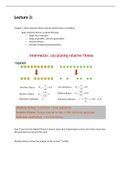
,Intermezzo: calculating relative fitness:
- Consider three genotypes of the annual plant Arabidopsis thaliana A 1A1, A1A2 and A2A2
o Survivorship and fertility differ among genotypes in a focal environment
o Genotype values for survival are 0.9, 1, 0.5
o Fertility values are 10, 4, 6
Genotype A1A1 A1A2 A2A2
Survivorship or 0.9 1 0.5
viability (vij)
Fertility (fij) 10 4 6
Absolute fitness (Wij) 9 4 3
Relative fitness (Wij) 1 0.44 0.33
-
- Absolute fitness is the product of fertility * survivorship or viability
- Relative fitness:
o The highest fitness gets a score of 1. In this case A 1A1.
o To get the relative fitness all values are divided by in this case 9.
o So = 0.44
- Calculating the selection coefficient (s) for each genotype
- The selection coefficient is defined as sij = 1 – wij
o S11 = 1 – 1 = 0
o S12 = 1 – 0.44 = 0.56
o S22 = 1 – 0.33 = 0.67
, Fitness is relative to the environment in which they live. So the fitness is not absolute.
HA (heterozygote advantage) and the maintenance of variation:
- As said (delta) q can become 0, which results in maintenance of variation
- This was an outcome not foreseen by Darwin and Wallace
o Balancing selection or balanced polymorphism
- Heterozygote advantage (or overdominance): heterozygote has highest fitness.
-
Chapter 2: Basic selection theory and the maintenance of variation
- Basic selection theory: constant fitnesses
o Single locus selection
o Single population, discrete generations
o Constant fitness
o Concept of balanced polymorphism
Even if you have the highest fitness it doesn’t mean that all genotypes survive, but it does mean that
this genotype has survived the most.
Absolute fitness is then the product of the survival * fertility
,Intermezzo: calculating relative fitness:
- Consider three genotypes of the annual plant Arabidopsis thaliana A 1A1, A1A2 and A2A2
o Survivorship and fertility differ among genotypes in a focal environment
o Genotype values for survival are 0.9, 1, 0.5
o Fertility values are 10, 4, 6
Genotype A1A1 A1A2 A2A2
Survivorship or 0.9 1 0.5
viability (vij)
Fertility (fij) 10 4 6
Absolute fitness (Wij) 9 4 3
Relative fitness (Wij) 1 0.44 0.33
-
- Absolute fitness is the product of fertility * survivorship or viability
- Relative fitness:
o The highest fitness gets a score of 1. In this case A 1A1.
o To get the relative fitness all values are divided by in this case 9.
o So = 0.44
- Calculating the selection coefficient (s) for each genotype
- The selection coefficient is defined as sij = 1 – wij
o S11 = 1 – 1 = 0
o S12 = 1 – 0.44 = 0.56
o S22 = 1 – 0.33 = 0.67
, Fitness is relative to the environment in which they live. So the fitness is not absolute.
HA (heterozygote advantage) and the maintenance of variation:
- As said (delta) q can become 0, which results in maintenance of variation
- This was an outcome not foreseen by Darwin and Wallace
o Balancing selection or balanced polymorphism
- Heterozygote advantage (or overdominance): heterozygote has highest fitness.
-


