

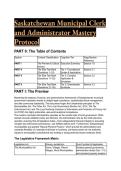
Saskatchewan Municipal Clerk
and Administrator Mastery
Protocol
PART 0: The Table of Contents
Section Content Classification Cognitive Tier Page/Section
Reference
PART I The Preview & Critical Executive Summary Section 1.0
Axioms
PART II The Elite Test Bank Tier 1: Foundational Section 2.1
(Questions 1–10) Syntax & Application
PART II The Elite Test Bank Tier 2: Complex Section 2.2
(Questions 11–20) Application &
Simulation
PART II The Elite Test Bank Tier 3: Grandmaster Section 2.3
(Questions 21–30) Synthesis
PART I: The Preview
Mastering the statutory, financial, and administrative frameworks of Saskatchewan municipal
government translates directly to airtight legal compliance, sophisticated fiscal management,
and elite community leadership. This document forges the fundamental principles of The
Municipalities Act, The Cities Act, The Local Government Election Act, 2015, The Tax
Enforcement Act, and The Local Authority Freedom of Information and Protection of Privacy Act
(LA FOIP) into highly actionable, real-world analytical competence.
The modern municipal Administrator operates as the central node of local governance. While
elected councils establish policy and direction, the Administrator acts as the chief executive
operator, ensuring that all legislative duties—from safeguarding financial integrity to executing
complex tax enforcement procedures—are fulfilled without error. Furthermore, Saskatchewan
municipalities are granted "Natural Persons Powers," which provide the administrative and
corporate flexibility of a standard individual or business, yet these powers do not arbitrarily
expand a municipality's jurisdictional law-making or taxing authority beyond statutory limits.
The Legislative Framework Matrix
Legislative Act Primary Jurisdiction Core Function & Application
The Municipalities Act Towns, Villages, Resort Dictates general governance,
Villages, Rural Municipalities administrator duties (Sec. 111),
and standard property taxation
,Legislative Act Primary Jurisdiction Core Function & Application
tools.
The Cities Act Saskatchewan Cities Provides the governance
framework for large urban
centers, including slightly
adjusted audit and assessment
deadlines.
The Northern Municipalities Northern Saskatchewan Governs northern settlements
Act, 2010 Administration District and recreational subdivisions,
mandating specific UMAAS
certification requirements.
The Tax Enforcement Act All Municipalities Outlines the highly rigid,
sequential legal mechanism for
recovering tax arrears through
property title acquisition.
LA FOIP Local Authorities Balances the public's absolute
(Municipalities, Police, Boards) right to access municipal
records with stringent personal
privacy protections and fee
structures.
The "Critical Axioms" Cheat Sheet
● The ETR 7:1 Mandate: Starting in the 2023 taxation year, the Effective Tax Rate (ETR)
limit legally restricts the maximum ratio between the highest ETR and lowest ETR across
all property classes to 7:1. This calculation must include all tax tools (uniform mill rate, mill
rate factors, base taxes, and minimum taxes).
● The LA FOIP Deposit Protocol: An initial $20 application fee is required to validate any
LA FOIP request to a local authority. The 30-day response clock halts immediately when a
formal fee estimate exceeding $100 is provided and resumes only upon receipt of the
mandatory 50% deposit.
● The Election Withdrawal Window: Nominees may only legally withdraw their candidacy
within 24 hours following the close of nominations. The withdrawal must be in writing and
properly witnessed to be valid.
● The Section 111 Authority Carve-Out: Under The Municipalities Act, the Administrator is
explicitly responsible for the hiring, suspension, and dismissal of all municipal employees
unless the municipal council expressly establishes an alternative human resources bylaw.
● The Tax Enforcement Chronology: The statutory list of tax arrears must be presented to
the head of council on or before November 15. A tax lien is registered strictly 60 days
post-advertisement and no later than January 31. A Six Month Notice (Form C) cannot be
served until exactly six months have elapsed from the lien registration date.
PART II: The Elite Test Bank
Tier 1: Foundational Syntax & Application
Q1: The Administrator of the Rural Municipality of Wheatland is tasked with overhauling the
municipality's human resources framework following a contentious local election. The newly
, elected council verbally demands the Administrator terminate the Chief Administrative Assistant
without cause. The municipality currently operates without any formal human resources or
personnel bylaw. Based on the provisions of The Municipalities Act governing the duties of the
Administrator, which action is the MOST ACCURATE? A) The Administrator must request the
provincial Ombudsman to mediate the dispute before authorizing any termination. B) The
Administrator must defer to the council's verbal directive, as elected officials possess absolute
authority over all municipal employment decisions. C) The Administrator retains the sole
statutory authority to hire, suspend, and dismiss the employee, and is not legally bound by the
council's verbal demand. D) The Administrator must immediately launch a Board of Revision
hearing to assess the legal validity of the termination.
● The Answer: C (The Administrator retains the sole statutory authority to hire, suspend,
and dismiss the employee, and is not legally bound by the council's verbal demand.)
● Distractor Analysis:
○ A is incorrect: The provincial Ombudsman handles administrative fairness
complaints from the public, not internal municipal human resources or employment
terminations.
○ B is incorrect: The Municipalities Act strictly separates political governance from
administrative execution. Without a specific bylaw reclaiming this power, council
cannot dictate operational HR actions.
○ D is incorrect: The Board of Revision is an administrative tribunal dedicated
exclusively to property assessment appeals, possessing zero jurisdiction over
municipal employment.
The Mentor's Analysis: Section 111 of The Municipalities Act is designed to protect municipal
staff from direct political interference. When facing an HR conflict without a governing bylaw, the
immediate priority is defending the administrative firewall. By utilizing the Section 111 Default
Authority, you bypass the common novice error of acquiescing to unlawful political directives
regarding personnel. Professional/Academic Intuition: Unless a council bylaw explicitly
dictates otherwise, the Administrator holds absolute default statutory authority over all
municipal employee management.
Q2: A citizen submits a formal Access to Information Request to a Saskatchewan town under
The Local Authority Freedom of Information and Protection of Privacy Act (LA FOIP), seeking
copies of all development permits issued over the past decade. The applicant submits the forms
via email but fails to include any initial payment. Based on LA FOIP regulations, what is the
IMMEDIATE requirement for processing this request? A) The town must begin processing the
request immediately and invoice the applicant for search and reproduction costs upon
completion to uphold the statutory duty to assist. B) The town must reject the request
permanently due to statutory non-compliance and instruct the applicant to petition the
Information and Privacy Commissioner. C) The applicant must pay a mandatory $20 application
fee before the request is considered legally received and the 30-day clock initiates. D) The town
must waive all fees because access to municipal information is guaranteed free of charge under
overarching provincial transparency laws.
● The Answer: C (The applicant must pay a mandatory $20 application fee before the
request is considered legally received and the 30-day clock initiates.)
● Distractor Analysis:
○ A is incorrect: Administrative processing does not commence, and the 30-day
statutory clock does not begin, until the mandatory application fee is secured by the
local authority.
○ B is incorrect: The request is not permanently rejected; the standard administrative
and Administrator Mastery
Protocol
PART 0: The Table of Contents
Section Content Classification Cognitive Tier Page/Section
Reference
PART I The Preview & Critical Executive Summary Section 1.0
Axioms
PART II The Elite Test Bank Tier 1: Foundational Section 2.1
(Questions 1–10) Syntax & Application
PART II The Elite Test Bank Tier 2: Complex Section 2.2
(Questions 11–20) Application &
Simulation
PART II The Elite Test Bank Tier 3: Grandmaster Section 2.3
(Questions 21–30) Synthesis
PART I: The Preview
Mastering the statutory, financial, and administrative frameworks of Saskatchewan municipal
government translates directly to airtight legal compliance, sophisticated fiscal management,
and elite community leadership. This document forges the fundamental principles of The
Municipalities Act, The Cities Act, The Local Government Election Act, 2015, The Tax
Enforcement Act, and The Local Authority Freedom of Information and Protection of Privacy Act
(LA FOIP) into highly actionable, real-world analytical competence.
The modern municipal Administrator operates as the central node of local governance. While
elected councils establish policy and direction, the Administrator acts as the chief executive
operator, ensuring that all legislative duties—from safeguarding financial integrity to executing
complex tax enforcement procedures—are fulfilled without error. Furthermore, Saskatchewan
municipalities are granted "Natural Persons Powers," which provide the administrative and
corporate flexibility of a standard individual or business, yet these powers do not arbitrarily
expand a municipality's jurisdictional law-making or taxing authority beyond statutory limits.
The Legislative Framework Matrix
Legislative Act Primary Jurisdiction Core Function & Application
The Municipalities Act Towns, Villages, Resort Dictates general governance,
Villages, Rural Municipalities administrator duties (Sec. 111),
and standard property taxation
,Legislative Act Primary Jurisdiction Core Function & Application
tools.
The Cities Act Saskatchewan Cities Provides the governance
framework for large urban
centers, including slightly
adjusted audit and assessment
deadlines.
The Northern Municipalities Northern Saskatchewan Governs northern settlements
Act, 2010 Administration District and recreational subdivisions,
mandating specific UMAAS
certification requirements.
The Tax Enforcement Act All Municipalities Outlines the highly rigid,
sequential legal mechanism for
recovering tax arrears through
property title acquisition.
LA FOIP Local Authorities Balances the public's absolute
(Municipalities, Police, Boards) right to access municipal
records with stringent personal
privacy protections and fee
structures.
The "Critical Axioms" Cheat Sheet
● The ETR 7:1 Mandate: Starting in the 2023 taxation year, the Effective Tax Rate (ETR)
limit legally restricts the maximum ratio between the highest ETR and lowest ETR across
all property classes to 7:1. This calculation must include all tax tools (uniform mill rate, mill
rate factors, base taxes, and minimum taxes).
● The LA FOIP Deposit Protocol: An initial $20 application fee is required to validate any
LA FOIP request to a local authority. The 30-day response clock halts immediately when a
formal fee estimate exceeding $100 is provided and resumes only upon receipt of the
mandatory 50% deposit.
● The Election Withdrawal Window: Nominees may only legally withdraw their candidacy
within 24 hours following the close of nominations. The withdrawal must be in writing and
properly witnessed to be valid.
● The Section 111 Authority Carve-Out: Under The Municipalities Act, the Administrator is
explicitly responsible for the hiring, suspension, and dismissal of all municipal employees
unless the municipal council expressly establishes an alternative human resources bylaw.
● The Tax Enforcement Chronology: The statutory list of tax arrears must be presented to
the head of council on or before November 15. A tax lien is registered strictly 60 days
post-advertisement and no later than January 31. A Six Month Notice (Form C) cannot be
served until exactly six months have elapsed from the lien registration date.
PART II: The Elite Test Bank
Tier 1: Foundational Syntax & Application
Q1: The Administrator of the Rural Municipality of Wheatland is tasked with overhauling the
municipality's human resources framework following a contentious local election. The newly
, elected council verbally demands the Administrator terminate the Chief Administrative Assistant
without cause. The municipality currently operates without any formal human resources or
personnel bylaw. Based on the provisions of The Municipalities Act governing the duties of the
Administrator, which action is the MOST ACCURATE? A) The Administrator must request the
provincial Ombudsman to mediate the dispute before authorizing any termination. B) The
Administrator must defer to the council's verbal directive, as elected officials possess absolute
authority over all municipal employment decisions. C) The Administrator retains the sole
statutory authority to hire, suspend, and dismiss the employee, and is not legally bound by the
council's verbal demand. D) The Administrator must immediately launch a Board of Revision
hearing to assess the legal validity of the termination.
● The Answer: C (The Administrator retains the sole statutory authority to hire, suspend,
and dismiss the employee, and is not legally bound by the council's verbal demand.)
● Distractor Analysis:
○ A is incorrect: The provincial Ombudsman handles administrative fairness
complaints from the public, not internal municipal human resources or employment
terminations.
○ B is incorrect: The Municipalities Act strictly separates political governance from
administrative execution. Without a specific bylaw reclaiming this power, council
cannot dictate operational HR actions.
○ D is incorrect: The Board of Revision is an administrative tribunal dedicated
exclusively to property assessment appeals, possessing zero jurisdiction over
municipal employment.
The Mentor's Analysis: Section 111 of The Municipalities Act is designed to protect municipal
staff from direct political interference. When facing an HR conflict without a governing bylaw, the
immediate priority is defending the administrative firewall. By utilizing the Section 111 Default
Authority, you bypass the common novice error of acquiescing to unlawful political directives
regarding personnel. Professional/Academic Intuition: Unless a council bylaw explicitly
dictates otherwise, the Administrator holds absolute default statutory authority over all
municipal employee management.
Q2: A citizen submits a formal Access to Information Request to a Saskatchewan town under
The Local Authority Freedom of Information and Protection of Privacy Act (LA FOIP), seeking
copies of all development permits issued over the past decade. The applicant submits the forms
via email but fails to include any initial payment. Based on LA FOIP regulations, what is the
IMMEDIATE requirement for processing this request? A) The town must begin processing the
request immediately and invoice the applicant for search and reproduction costs upon
completion to uphold the statutory duty to assist. B) The town must reject the request
permanently due to statutory non-compliance and instruct the applicant to petition the
Information and Privacy Commissioner. C) The applicant must pay a mandatory $20 application
fee before the request is considered legally received and the 30-day clock initiates. D) The town
must waive all fees because access to municipal information is guaranteed free of charge under
overarching provincial transparency laws.
● The Answer: C (The applicant must pay a mandatory $20 application fee before the
request is considered legally received and the 30-day clock initiates.)
● Distractor Analysis:
○ A is incorrect: Administrative processing does not commence, and the 30-day
statutory clock does not begin, until the mandatory application fee is secured by the
local authority.
○ B is incorrect: The request is not permanently rejected; the standard administrative


