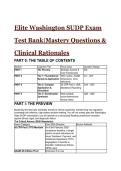
Elite Washington SUDP Exam
Test Bank|Mastery Questions &
Clinical Rationales
PART 0: THE TABLE OF CONTENTS
Section Cognitive Tier Focus Area Question Range
PART I The Preview Strategic Axioms & N/A
Core Frameworks
PART II Tier 1: Foundational WAC syntax, ASAM Q1 – Q15
Syntax & Application dimensions, Core
definitions
PART II Tier 2: Complex 42 CFR Part 2, UDA, Q16 – Q35
Application & Mandatory Reporting
Simulation
PART II Tier 3: Grandmaster Multi-variable Q36 – Q60
Synthesis cross-dimensional
clinical crises
PART I: THE PREVIEW
Mastering this test bank translates directly to clinical superiority, transforming rote regulatory
knowledge into reflexive, high-stakes decision-making. You will not merely pass the Washington
State SUDP examination; you will operate as a structurally flawless practitioner insulated
against ethical, legal, and diagnostic failure.
The Critical Axioms (2026 Standards):
Axiom Category Core 2026 Directive Source Authority
42 CFR Part 2 TPO Mandate As of the February 2026
compliance deadline, a single
patient consent authorizes all
future Treatment, Payment, and
Healthcare Operations (TPO).
Segregation of records is
obsolete; redisclosure follows
HIPAA rules.
ASAM 4th Edition Pivot Dimension 6 is now
,Axiom Category Core 2026 Directive Source Authority
Person-Centered
Considerations (SDOH, barriers
to care). Readiness to change
is integrated across all
dimensions.
The Age of Autonomy In Washington, a minor aged
13 or older possesses absolute
autonomous consent for both
outpatient and inpatient
substance use and mental
health treatment.
The Supervisor Matrix An Approved Supervisor must
possess 2,000 hours of
post-certification experience
and 28 hours of clinical
supervisor training.
The UDA Reporting Window Mandatory reporting of another
license holder's unprofessional
conduct must occur no later
than 30 calendar days from
actual knowledge.
PART II: THE ELITE TEST BANK
Tier 1: Foundational Syntax & Application (Q1–15)
Q1: Under Washington State law (RCW 71.34.500), a 14-year-old patient requests admission to
an inpatient substance use disorder treatment program but explicitly forbids the facility from
contacting their parents. Based on the legal framework for minor consent, which action is the
MOST ACCURATE? A) Admit the patient but notify the parents within 24 hours, as inpatient
care overrides minor consent. B) Deny admission until parental authorization is obtained, as
autonomous consent only applies to outpatient services. C) Admit the patient without parental
notification, provided the professional in charge concurs with the clinical need. D) Initiate a
referral to Child Protective Services (CPS) to grant emergency medical custody.
● The Answer: C (Admit the patient without parental notification, provided the professional
in charge concurs with the clinical need.)
● Distractor Analysis:
○ A is incorrect: Parental notification is not mandatory if the minor does not consent to
it, regardless of the inpatient setting.
○ B is incorrect: Washington law grants 13-and-older minors the right to consent to
both inpatient and outpatient SUD treatment.
○ D is incorrect: Seeking SUD treatment is not an indicator of abuse or neglect
requiring CPS intervention.
The Mentor's Analysis: Washington State recognizes the immediate, life-saving necessity of
behavioral health access for adolescents. At age 13, the legal threshold for medical autonomy in
behavioral health is crossed. Professional/Academic Intuition: At 13, the adolescent is the
sole legal architect of their behavioral health treatment.
, Q2: Following the February 16, 2026, compliance deadline for the updated 42 CFR Part 2
regulations, a primary care physician receives a patient's SUD records from an opioid treatment
program under a valid Treatment, Payment, and Healthcare Operations (TPO) consent. How
MUST the physician handle this data? A) The records must be strictly segregated from the
general medical record on a separate server. B) The physician may integrate the records into
the general EHR and redisclose them in accordance with standard HIPAA Privacy Rules. C) The
records may be integrated, but any subsequent redisclosure requires a new, specific Part 2
consent form. D) The physician must redact all specific substance names before placing the
record in the EHR.
● The Answer: B (The physician may integrate the records into the general EHR and
redisclose them in accordance with standard HIPAA Privacy Rules.)
● Distractor Analysis:
○ A is incorrect: The 2026 final rule explicitly removes the requirement to segregate or
segment Part 2 records.
○ C is incorrect: The core update aligns Part 2 redisclosure with HIPAA once the initial
TPO consent is executed.
○ D is incorrect: Redaction is an outdated, overly cautious legacy practice not
required under the new TPO framework.
The Mentor's Analysis: The CARES Act and subsequent HHS Final Rule were designed to
shatter the silos that caused fragmented care. Part 2 data now flows like standard HIPAA PHI
once the primary TPO consent is unlocked. Professional/Academic Intuition: Single consent
equals system-wide integration. Segregation is legally obsolete.
Q3: Under the ASAM Criteria 4th Edition, a clinician is evaluating a patient whose housing is
unstable and who lacks transportation to the clinic. Under which dimension MUST these specific
variables be documented? A) Dimension 4: Substance Use-Related Risks B) Dimension 5:
Recovery Environment Interactions C) Dimension 6: Person-Centered Considerations D)
Dimension 2: Biomedical Conditions
● The Answer: C (Dimension 6: Person-Centered Considerations)
● Distractor Analysis:
○ A is incorrect: Dimension 4 evaluates the likelihood of risky substance use or
behaviors, not structural barriers.
○ B is incorrect: While related to the environment, Dimension 5 focuses on the safety
and support within the current environment, whereas social determinants of health
(SDOH) and specific logistical barriers to care belong in Dimension 6.
○ D is incorrect: This assesses physical health, not social logistics.
The Mentor's Analysis: The 4th Edition reimagined the criteria by removing "Readiness to
Change" as a standalone dimension and creating a dedicated space for structural barriers. If the
problem involves social determinants of health, it is Dimension 6. Professional/Academic
Intuition: Dimension 6 is the operational reality of the patient; it measures the friction
between their life and your clinic.
Q4: A candidate holds a Master’s degree in Social Work from an approved school and wishes to
obtain their Washington SUDP certification. According to WAC 246-811-046, how many
supervised hours of substance use disorder counseling are REQUIRED for this specific
educational tier? A) 1,000 hours B) 1,500 hours C) 2,000 hours D) 2,500 hours
● The Answer: B (1,500 hours)
● Distractor Analysis:
○ A is incorrect: 1,000 hours is reserved for the Alternative Training pathway.
○ C is incorrect: 2,000 hours is required for candidates with a Baccalaureate degree.
Test Bank|Mastery Questions &
Clinical Rationales
PART 0: THE TABLE OF CONTENTS
Section Cognitive Tier Focus Area Question Range
PART I The Preview Strategic Axioms & N/A
Core Frameworks
PART II Tier 1: Foundational WAC syntax, ASAM Q1 – Q15
Syntax & Application dimensions, Core
definitions
PART II Tier 2: Complex 42 CFR Part 2, UDA, Q16 – Q35
Application & Mandatory Reporting
Simulation
PART II Tier 3: Grandmaster Multi-variable Q36 – Q60
Synthesis cross-dimensional
clinical crises
PART I: THE PREVIEW
Mastering this test bank translates directly to clinical superiority, transforming rote regulatory
knowledge into reflexive, high-stakes decision-making. You will not merely pass the Washington
State SUDP examination; you will operate as a structurally flawless practitioner insulated
against ethical, legal, and diagnostic failure.
The Critical Axioms (2026 Standards):
Axiom Category Core 2026 Directive Source Authority
42 CFR Part 2 TPO Mandate As of the February 2026
compliance deadline, a single
patient consent authorizes all
future Treatment, Payment, and
Healthcare Operations (TPO).
Segregation of records is
obsolete; redisclosure follows
HIPAA rules.
ASAM 4th Edition Pivot Dimension 6 is now
,Axiom Category Core 2026 Directive Source Authority
Person-Centered
Considerations (SDOH, barriers
to care). Readiness to change
is integrated across all
dimensions.
The Age of Autonomy In Washington, a minor aged
13 or older possesses absolute
autonomous consent for both
outpatient and inpatient
substance use and mental
health treatment.
The Supervisor Matrix An Approved Supervisor must
possess 2,000 hours of
post-certification experience
and 28 hours of clinical
supervisor training.
The UDA Reporting Window Mandatory reporting of another
license holder's unprofessional
conduct must occur no later
than 30 calendar days from
actual knowledge.
PART II: THE ELITE TEST BANK
Tier 1: Foundational Syntax & Application (Q1–15)
Q1: Under Washington State law (RCW 71.34.500), a 14-year-old patient requests admission to
an inpatient substance use disorder treatment program but explicitly forbids the facility from
contacting their parents. Based on the legal framework for minor consent, which action is the
MOST ACCURATE? A) Admit the patient but notify the parents within 24 hours, as inpatient
care overrides minor consent. B) Deny admission until parental authorization is obtained, as
autonomous consent only applies to outpatient services. C) Admit the patient without parental
notification, provided the professional in charge concurs with the clinical need. D) Initiate a
referral to Child Protective Services (CPS) to grant emergency medical custody.
● The Answer: C (Admit the patient without parental notification, provided the professional
in charge concurs with the clinical need.)
● Distractor Analysis:
○ A is incorrect: Parental notification is not mandatory if the minor does not consent to
it, regardless of the inpatient setting.
○ B is incorrect: Washington law grants 13-and-older minors the right to consent to
both inpatient and outpatient SUD treatment.
○ D is incorrect: Seeking SUD treatment is not an indicator of abuse or neglect
requiring CPS intervention.
The Mentor's Analysis: Washington State recognizes the immediate, life-saving necessity of
behavioral health access for adolescents. At age 13, the legal threshold for medical autonomy in
behavioral health is crossed. Professional/Academic Intuition: At 13, the adolescent is the
sole legal architect of their behavioral health treatment.
, Q2: Following the February 16, 2026, compliance deadline for the updated 42 CFR Part 2
regulations, a primary care physician receives a patient's SUD records from an opioid treatment
program under a valid Treatment, Payment, and Healthcare Operations (TPO) consent. How
MUST the physician handle this data? A) The records must be strictly segregated from the
general medical record on a separate server. B) The physician may integrate the records into
the general EHR and redisclose them in accordance with standard HIPAA Privacy Rules. C) The
records may be integrated, but any subsequent redisclosure requires a new, specific Part 2
consent form. D) The physician must redact all specific substance names before placing the
record in the EHR.
● The Answer: B (The physician may integrate the records into the general EHR and
redisclose them in accordance with standard HIPAA Privacy Rules.)
● Distractor Analysis:
○ A is incorrect: The 2026 final rule explicitly removes the requirement to segregate or
segment Part 2 records.
○ C is incorrect: The core update aligns Part 2 redisclosure with HIPAA once the initial
TPO consent is executed.
○ D is incorrect: Redaction is an outdated, overly cautious legacy practice not
required under the new TPO framework.
The Mentor's Analysis: The CARES Act and subsequent HHS Final Rule were designed to
shatter the silos that caused fragmented care. Part 2 data now flows like standard HIPAA PHI
once the primary TPO consent is unlocked. Professional/Academic Intuition: Single consent
equals system-wide integration. Segregation is legally obsolete.
Q3: Under the ASAM Criteria 4th Edition, a clinician is evaluating a patient whose housing is
unstable and who lacks transportation to the clinic. Under which dimension MUST these specific
variables be documented? A) Dimension 4: Substance Use-Related Risks B) Dimension 5:
Recovery Environment Interactions C) Dimension 6: Person-Centered Considerations D)
Dimension 2: Biomedical Conditions
● The Answer: C (Dimension 6: Person-Centered Considerations)
● Distractor Analysis:
○ A is incorrect: Dimension 4 evaluates the likelihood of risky substance use or
behaviors, not structural barriers.
○ B is incorrect: While related to the environment, Dimension 5 focuses on the safety
and support within the current environment, whereas social determinants of health
(SDOH) and specific logistical barriers to care belong in Dimension 6.
○ D is incorrect: This assesses physical health, not social logistics.
The Mentor's Analysis: The 4th Edition reimagined the criteria by removing "Readiness to
Change" as a standalone dimension and creating a dedicated space for structural barriers. If the
problem involves social determinants of health, it is Dimension 6. Professional/Academic
Intuition: Dimension 6 is the operational reality of the patient; it measures the friction
between their life and your clinic.
Q4: A candidate holds a Master’s degree in Social Work from an approved school and wishes to
obtain their Washington SUDP certification. According to WAC 246-811-046, how many
supervised hours of substance use disorder counseling are REQUIRED for this specific
educational tier? A) 1,000 hours B) 1,500 hours C) 2,000 hours D) 2,500 hours
● The Answer: B (1,500 hours)
● Distractor Analysis:
○ A is incorrect: 1,000 hours is reserved for the Alternative Training pathway.
○ C is incorrect: 2,000 hours is required for candidates with a Baccalaureate degree.