

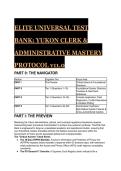
ELITE UNIVERSAL TEST
BANK: YUKON CLERK &
ADMINISTRATIVE MASTERY
PROTOCOL v11.0
PART 0: THE NAVIGATOR
Section Cognitive Tier Focus Area
PART I The Preview Critical Axioms & Foundational
Directives
PART II Tier 1 (Questions 1–15) Foundational Syntax: Statutory
Timelines & Hard Deck
Definitions
PART II Tier 2 (Questions 16–35) Complex Application: Field
Diagnostics, Conflict Resolution
& Variable Shifting
PART II Tier 3 (Questions 36–60) Grandmaster Synthesis:
High-Stakes System Failures &
Cross-Jurisdictional Clashes
PART I: THE PREVIEW
Mastering the Yukon administrative, judicial, and municipal regulatory frameworks requires
transcending basic procedural memorization to achieve true systemic synthesis. This Elite Test
Bank is engineered to forge an unparalleled academic and operational intuition, ensuring that
your theoretical mastery translates directly into flawless executive execution within the
Government of Yukon and its associated judicial and municipal bodies.
The "Critical Axioms" Cheat Sheet:
● The 30-Day ATIPPA Mandate: Access to Information and Protection of Privacy Act
(ATIPPA) requests strictly mandate a response within 30 business days, with extensions
solely authorized by the Access and Privacy Officer (APO) under rigorous consultation
constraints.
● The PD General-17 Override: A Supreme Court Registry clerk's refusal to file a
, non-compliant document is not absolute; counsel may demand judicial review via a Filing
Deficiency Insert Sheet accompanied by a formal undertaking.
● The CRC Certification Lifespan: Candidates successfully passing the Centralized
Recruitment and Certification (CRC) gauntlet (Resume, Written Assessment, BDI Oral
Interview) remain active on the candidate registry for exactly one (1) year.
● The Ex Officio Judicial Power: Under the Judicature Act (RSY 2002, c. 128), a sitting
judge possesses ex officio all the administrative powers of a clerk of the Court throughout
the Yukon.
● The Municipal Zoning Sequence: Under the Municipal Act, an Official Community Plan
(OCP) or Zoning Bylaw amendment demands rigid sequencing: 1st reading, 2 weeks of
public notification, a public hearing precisely 7 days post-notification, followed by 2nd and
3rd readings.
PART II: THE ELITE TEST BANK
Tier 1: Foundational Syntax & Application
Q1: A citizen submits a formal request to a Yukon public body under the Access to Information
and Protection of Privacy Act (ATIPPA). The request is straightforward and does not involve
third-party information or complex inter-departmental consultations. Based on the principles of
the ATIPPA, which response timeline is the MOST ACCURATE? A) The public body must
provide a complete response within 30 calendar days from the date of receipt. B) The public
body has 60 business days to respond, provided they send an acknowledgment of receipt within
the first 10 days. C) The public body must provide a complete response within 30 business days
from the date of receipt. D) The public body must provide a complete response within 15
business days, with an automatic 15-day extension granted upon request.
● The Answer: C (The public body must provide a complete response within 30 business
days from the date of receipt.)
● Distractor Analysis:
○ A is incorrect: ATIPPA specifically calculates statutory response deadlines using
business days, not calendar days.
○ B is incorrect: The baseline response metric is 30 business days, not 60. An
extension to 60 days requires specific statutory triggers.
○ D is incorrect: The 15-day metric applies to specific limited extensions by the
Access and Privacy Officer without applicant permission, not the baseline response
deadline.
The Mentor's Analysis: ATIPPA timelines are mathematically rigid to protect public
transparency while allowing functional administrative processing. When facing a standard
information request, the immediate priority is calculating the exact deadline based on
operational hours. By utilizing Business Day Calculations, you bypass the common trap of
defaulting to calendar days, which inevitably triggers compliance failures.
Professional/Academic Intuition: Under the 2018 ATIPPA, the foundational Hard Deck for
public body responses to information requests is exactly 30 business days.
Q2: An applicant successfully completes the Yukon Government's Centralized Recruitment and
Certification (CRC) process for an Administrative Assistant role, passing the resume screening,
the written assessment (Microsoft Office and Canadian Grammar), and the Behavioral
Descriptive Interview (BDI). Based on the principles of the Yukon Government CRC Framework,
, which conclusion regarding the applicant's status is the MOST ACCURATE? A) The candidate
is permanently certified and may be appointed to any AR05 to AR10 role without further
departmental screening. B) The candidate is placed on the Candidate Registry for exactly two
years and is guaranteed placement in an auxiliary-on-call position. C) The candidate is placed
on the Candidate Registry for a period of one (1) year, during which they will be notified of
available CRC opportunities. D) The candidate is immediately assigned to a specific department
but remains on probation until a secondary written assessment is completed.
● The Answer: C (The candidate is placed on the Candidate Registry for a period of one
(1) year, during which they will be notified of available CRC opportunities.)
● Distractor Analysis:
○ A is incorrect: Certification is not permanent; it expires after one year. Furthermore,
hiring departments will still review tailored applications and conduct further
assessments.
○ B is incorrect: The lifespan of the CRC registry placement is strictly one year, not
two, and it provides eligibility, not a guaranteed appointment.
○ D is incorrect: The CRC creates a pool of pre-certified applicants; it does not
automatically assign personnel to departments or mandate secondary probations.
The Mentor's Analysis: The CRC mechanism is designed to streamline administrative staffing
by pre-verifying baseline competencies. When facing public sector recruitment delays, the
immediate priority is utilizing a pre-vetted Candidate Registry. By utilizing the One-Year
Certification Lifespan, you bypass the common trap of assuming public service exams grant
permanent eligibility. Professional/Academic Intuition: A candidate's placement on the
Yukon CRC Registry is a temporary, one-year eligibility window requiring the applicant to
actively tailor their resume for specific departmental postings.
Q3: A developer submits a proposal requiring a Zoning Bylaw Amendment to the City of
Dawson. The proposal requires public consultation. Based on the principles of the Yukon
Municipal Act, Division 2, which sequence of actions is the MOST ACCURATE? A) Public
hearing, followed by 1st reading, 2 weeks of public notification, and the combined 2nd and 3rd
readings. B) 1st reading, followed immediately by the 2nd reading, a public hearing, and finally
the 3rd reading. C) 1st reading, 2 weeks of public notification, a public hearing 7 days after the
last date of notification, followed by 2nd and 3rd readings. D) 1st, 2nd, and 3rd readings
conducted consecutively, followed by a retroactive 30-day public notification period.
● The Answer: C (1st reading, 2 weeks of public notification, a public hearing 7 days after
the last date of notification, followed by 2nd and 3rd readings.)
● Distractor Analysis:
○ A is incorrect: A public hearing cannot precede the 1st reading and formal
notification; the public must have the drafted bylaw to review first.
○ B is incorrect: The 2nd reading cannot occur before the public notification and
public hearing have been fully executed.
○ D is incorrect: This represents a catastrophic violation of the Municipal Act; public
consultation must inform the final readings, not occur retroactively.
The Mentor's Analysis: Municipal zoning amendments permanently alter community
infrastructure and property rights, necessitating phased legislative scrutiny. When facing a bylaw
amendment, the immediate priority is ensuring statutory public consultation occurs exactly
between the 1st and 2nd readings. By utilizing the Legislative Buffer Sequence, you bypass the
common trap of passing bylaws that are later rendered legally void due to procedural
unfairness. Professional/Academic Intuition: Zoning Bylaw amendments mandate exactly
two weeks of public notification and a public hearing seven days post-notification,
BANK: YUKON CLERK &
ADMINISTRATIVE MASTERY
PROTOCOL v11.0
PART 0: THE NAVIGATOR
Section Cognitive Tier Focus Area
PART I The Preview Critical Axioms & Foundational
Directives
PART II Tier 1 (Questions 1–15) Foundational Syntax: Statutory
Timelines & Hard Deck
Definitions
PART II Tier 2 (Questions 16–35) Complex Application: Field
Diagnostics, Conflict Resolution
& Variable Shifting
PART II Tier 3 (Questions 36–60) Grandmaster Synthesis:
High-Stakes System Failures &
Cross-Jurisdictional Clashes
PART I: THE PREVIEW
Mastering the Yukon administrative, judicial, and municipal regulatory frameworks requires
transcending basic procedural memorization to achieve true systemic synthesis. This Elite Test
Bank is engineered to forge an unparalleled academic and operational intuition, ensuring that
your theoretical mastery translates directly into flawless executive execution within the
Government of Yukon and its associated judicial and municipal bodies.
The "Critical Axioms" Cheat Sheet:
● The 30-Day ATIPPA Mandate: Access to Information and Protection of Privacy Act
(ATIPPA) requests strictly mandate a response within 30 business days, with extensions
solely authorized by the Access and Privacy Officer (APO) under rigorous consultation
constraints.
● The PD General-17 Override: A Supreme Court Registry clerk's refusal to file a
, non-compliant document is not absolute; counsel may demand judicial review via a Filing
Deficiency Insert Sheet accompanied by a formal undertaking.
● The CRC Certification Lifespan: Candidates successfully passing the Centralized
Recruitment and Certification (CRC) gauntlet (Resume, Written Assessment, BDI Oral
Interview) remain active on the candidate registry for exactly one (1) year.
● The Ex Officio Judicial Power: Under the Judicature Act (RSY 2002, c. 128), a sitting
judge possesses ex officio all the administrative powers of a clerk of the Court throughout
the Yukon.
● The Municipal Zoning Sequence: Under the Municipal Act, an Official Community Plan
(OCP) or Zoning Bylaw amendment demands rigid sequencing: 1st reading, 2 weeks of
public notification, a public hearing precisely 7 days post-notification, followed by 2nd and
3rd readings.
PART II: THE ELITE TEST BANK
Tier 1: Foundational Syntax & Application
Q1: A citizen submits a formal request to a Yukon public body under the Access to Information
and Protection of Privacy Act (ATIPPA). The request is straightforward and does not involve
third-party information or complex inter-departmental consultations. Based on the principles of
the ATIPPA, which response timeline is the MOST ACCURATE? A) The public body must
provide a complete response within 30 calendar days from the date of receipt. B) The public
body has 60 business days to respond, provided they send an acknowledgment of receipt within
the first 10 days. C) The public body must provide a complete response within 30 business days
from the date of receipt. D) The public body must provide a complete response within 15
business days, with an automatic 15-day extension granted upon request.
● The Answer: C (The public body must provide a complete response within 30 business
days from the date of receipt.)
● Distractor Analysis:
○ A is incorrect: ATIPPA specifically calculates statutory response deadlines using
business days, not calendar days.
○ B is incorrect: The baseline response metric is 30 business days, not 60. An
extension to 60 days requires specific statutory triggers.
○ D is incorrect: The 15-day metric applies to specific limited extensions by the
Access and Privacy Officer without applicant permission, not the baseline response
deadline.
The Mentor's Analysis: ATIPPA timelines are mathematically rigid to protect public
transparency while allowing functional administrative processing. When facing a standard
information request, the immediate priority is calculating the exact deadline based on
operational hours. By utilizing Business Day Calculations, you bypass the common trap of
defaulting to calendar days, which inevitably triggers compliance failures.
Professional/Academic Intuition: Under the 2018 ATIPPA, the foundational Hard Deck for
public body responses to information requests is exactly 30 business days.
Q2: An applicant successfully completes the Yukon Government's Centralized Recruitment and
Certification (CRC) process for an Administrative Assistant role, passing the resume screening,
the written assessment (Microsoft Office and Canadian Grammar), and the Behavioral
Descriptive Interview (BDI). Based on the principles of the Yukon Government CRC Framework,
, which conclusion regarding the applicant's status is the MOST ACCURATE? A) The candidate
is permanently certified and may be appointed to any AR05 to AR10 role without further
departmental screening. B) The candidate is placed on the Candidate Registry for exactly two
years and is guaranteed placement in an auxiliary-on-call position. C) The candidate is placed
on the Candidate Registry for a period of one (1) year, during which they will be notified of
available CRC opportunities. D) The candidate is immediately assigned to a specific department
but remains on probation until a secondary written assessment is completed.
● The Answer: C (The candidate is placed on the Candidate Registry for a period of one
(1) year, during which they will be notified of available CRC opportunities.)
● Distractor Analysis:
○ A is incorrect: Certification is not permanent; it expires after one year. Furthermore,
hiring departments will still review tailored applications and conduct further
assessments.
○ B is incorrect: The lifespan of the CRC registry placement is strictly one year, not
two, and it provides eligibility, not a guaranteed appointment.
○ D is incorrect: The CRC creates a pool of pre-certified applicants; it does not
automatically assign personnel to departments or mandate secondary probations.
The Mentor's Analysis: The CRC mechanism is designed to streamline administrative staffing
by pre-verifying baseline competencies. When facing public sector recruitment delays, the
immediate priority is utilizing a pre-vetted Candidate Registry. By utilizing the One-Year
Certification Lifespan, you bypass the common trap of assuming public service exams grant
permanent eligibility. Professional/Academic Intuition: A candidate's placement on the
Yukon CRC Registry is a temporary, one-year eligibility window requiring the applicant to
actively tailor their resume for specific departmental postings.
Q3: A developer submits a proposal requiring a Zoning Bylaw Amendment to the City of
Dawson. The proposal requires public consultation. Based on the principles of the Yukon
Municipal Act, Division 2, which sequence of actions is the MOST ACCURATE? A) Public
hearing, followed by 1st reading, 2 weeks of public notification, and the combined 2nd and 3rd
readings. B) 1st reading, followed immediately by the 2nd reading, a public hearing, and finally
the 3rd reading. C) 1st reading, 2 weeks of public notification, a public hearing 7 days after the
last date of notification, followed by 2nd and 3rd readings. D) 1st, 2nd, and 3rd readings
conducted consecutively, followed by a retroactive 30-day public notification period.
● The Answer: C (1st reading, 2 weeks of public notification, a public hearing 7 days after
the last date of notification, followed by 2nd and 3rd readings.)
● Distractor Analysis:
○ A is incorrect: A public hearing cannot precede the 1st reading and formal
notification; the public must have the drafted bylaw to review first.
○ B is incorrect: The 2nd reading cannot occur before the public notification and
public hearing have been fully executed.
○ D is incorrect: This represents a catastrophic violation of the Municipal Act; public
consultation must inform the final readings, not occur retroactively.
The Mentor's Analysis: Municipal zoning amendments permanently alter community
infrastructure and property rights, necessitating phased legislative scrutiny. When facing a bylaw
amendment, the immediate priority is ensuring statutory public consultation occurs exactly
between the 1st and 2nd readings. By utilizing the Legislative Buffer Sequence, you bypass the
common trap of passing bylaws that are later rendered legally void due to procedural
unfairness. Professional/Academic Intuition: Zoning Bylaw amendments mandate exactly
two weeks of public notification and a public hearing seven days post-notification,


