S-Tier Pennsylvania Civil Service &
Clerical Mastery Test Bank
PART 0: THE NAVIGATOR
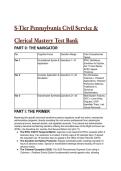
Tier Cognitive Focus Question Range Core Competencies
Tested
Tier 1 Foundational Syntax & Questions 1–10 RTKL Definitions,
Application Sunshine Act Syntax,
Act 71 Hard Decks,
SCSC Appeal
Timelines.
Tier 2 Complex Application & Questions 11–20 Fee Schedules,
Simulation Coleman v. Parkland
Applications, Veterans'
Preference Matrices,
Traditional vs.
Technical
Discrimination.
Tier 3 Grandmaster Synthesis Questions 21–30 Multi-System Failures,
DOC v. Lynn Hiring
Disputes, OOR
Appellate Traps, Just
Cause Removals.
PART I: THE PRIMER
Mastering this specific test bank transforms passive regulatory recall into active, mechanistic
administrative judgment, directly insulating the civil service professional from catastrophic
procedural errors, deemed denials, and appellate reversals. True clerical and administrative
mastery demands architecting solutions utilizing the immutable laws of the Right-to-Know Law
(RTKL), the Sunshine Act, and the Civil Service Reform Act (Act 71).
● The RTKL 5/30/15 Temporal Matrix: Agencies must respond to RTKL requests within 5
business days. If an extension is invoked, it strictly caps at 30 calendar days. If denied,
the requester has 15 business days to appeal to the Office of Open Records (OOR).
● The Sunshine Act Notice Protocols: Regular scheduled public meetings mandate 72
hours of advance notice. Special or rescheduled meetings demand exactly 24 hours of
advance notice.
● The Coleman Exception (2025): The 2025 Pennsylvania Supreme Court ruling in
Coleman v. Parkland School District fundamentally rewrote agenda rules, allowing
, agencies to add action items to a published agenda at the start of the meeting via a
majority vote.
● Act 71 & The Rule of Three: The Office of Administration (OA) certifies the top three
highest-scoring eligibles. Veterans within this Rule of Three receive a mandatory
appointment preference.
● The DOC v. Lynn Mandate (2023): Veterans' Preference strictly does not apply to
promotions. However, moving from the unclassified service to the classified service is
legally an appointment—not a promotion—triggering full Veterans' Preference rights.
● SCSC Discriminatory Delineation: SCSC appeals strictly bifurcate discrimination.
Traditional discrimination involves non-merit factors (race, union affiliation). Technical
discrimination requires proving a procedural violation of Act 71 that directly caused the
appellant harm.
PART II: THE ELITE TEST BANK
Tier 1 - Foundational Syntax & Application
Q1: A local township's Open Records Officer receives a written Right-to-Know Law (RTKL)
request on Friday at 4:55 PM. The agency requires additional time to redact exempt information.
Based on the statutory timelines of the RTKL, what is the LATEST date the agency can provide
its final response without triggering a deemed denial? A) The following Friday, assuming no
municipal holidays exist during the week. B) Exactly 30 calendar days from the date the request
was physically received. C) Five business days to issue an interim response, plus an additional
30 calendar days. D) Thirty business days from the close of business on the following Monday.
● The Answer: C (Five business days to issue an interim response, plus an additional 30
calendar days.)
● Distractor Analysis:
○ A is incorrect: This calculation isolates only the initial 5-business-day window but
fatally ignores the agency's statutory right to invoke a 30-day extension for required
redactions.
○ B is incorrect: An agency cannot immediately default to a 30-day timeline upon
receipt; it must first issue a formal interim response within the initial 5-business-day
window to legally trigger the extension.
○ D is incorrect: Extensions are strictly calculated using calendar days, not business
days. Applying business days to an extension is a severe clerical error resulting in
an automatic deemed denial and potential appellate sanctions.
The Mentor's Analysis: The RTKL clock is an unforgiving jurisdictional mechanism. Requests
received after the close of regular business hours are officially recorded on the next business
day. When facing complex redactions, the immediate priority is locking in the 30-calendar-day
extension by issuing an interim response within the initial 5-business-day window. By utilizing
Interim Response Protocols, the agency bypasses the trap of a deemed denial.
| Action Phase | Timeframe Metric | Legal Consequence of Failure |
| :--- | :--- | :--- | | Initial Response | 5 Business Days | Deemed Denial | | Interim Extension | Up
to 30 Calendar Days | Deemed Denial | | Requester Appeal | 15 Business Days | Loss of
Appellate Standing |
Professional/Academic Intuition: The Right-to-Know Law uses business days for initial
responses and appeals, but strictly uses calendar days for extensions.
, Q2: A public school board intends to hold a special meeting to discuss the immediate purchase
of a new athletic facility. According to the Pennsylvania Sunshine Act, which action regarding
public notice is the MOST ACCURATE? A) The board must publish notice of the meeting at
least 72 hours in advance. B) The board must publish notice of the meeting at least 24 hours in
advance. C) The board may hold the meeting without public notice if it enters an executive
session. D) The board must publish the agenda 48 hours in advance, but the meeting requires
24 hours' notice.
● The Answer: B (The board must publish notice of the meeting at least 24 hours in
advance.)
● Distractor Analysis:
○ A is incorrect: The 72-hour notice requirement applies exclusively to regular,
prearranged public meetings, not special meetings scheduled off-cycle.
○ C is incorrect: Real estate purchases can be discussed in executive session, but
the executive session itself must be announced at a properly noticed open meeting.
○ D is incorrect: The Sunshine Act explicitly mandates 24 hours of advance notice for
both the meeting advertisement and the agenda posting for a special meeting.
The Mentor's Analysis: The Sunshine Act differentiates strictly between regular and special
agency operations. When facing an off-cycle administrative requirement, the immediate priority
is securing a 24-hour public notice. By utilizing Special Meeting Notice Protocols, the
administration bypasses the common trap of applying standard 72-hour regular meeting rules to
urgent civic business. Professional/Academic Intuition: Regular meetings require 3 days (72
hours); off-cycle, non-emergency disruptions require 1 day (24 hours).
Q3: An applicant takes a civil service examination administered by the Office of Administration
(OA). The applicant is an eligible veteran. According to the Veterans' Preference Act and Act 71,
how must the OA INITIALLY apply the applicant's preference? A) By guaranteeing an interview
for any classified position the applicant bids on. B) By advancing the applicant to the top of the
eligible list regardless of their exam score. C) By adding 10 points to the applicant's final
passing examination score. D) By placing the applicant in the unclassified service to bypass the
examination requirement.
● The Answer: C (By adding 10 points to the applicant's final passing examination score.)
● Distractor Analysis:
○ A is incorrect: Veterans' Preference guarantees preference in appointment if the
candidate reaches the Rule of Three, but it does not categorically guarantee an
interview for all internal bids or promotions.
○ B is incorrect: Absolute priority without score consideration was deemed
unconstitutional by the Pennsylvania Supreme Court. The preference is applied
mechanically via points, not arbitrary placement.
○ D is incorrect: Unclassified service positions are exempt from civil service
examination requirements entirely, meaning examination points do not apply to
them.
The Mentor's Analysis: Veterans' Preference in Pennsylvania operates on a two-tiered
mechanical system: points and mandatory selection. When processing a veteran's application,
the immediate priority is verifying a passing score, after which the OA applies exactly 10 points.
By utilizing Examination Points Preference, the system bypasses the trap of unconstitutional
absolute preference. Professional/Academic Intuition: The veteran must first pass the exam
on their own merit; only then do the 10 statutory points materialize.
Q4: A classified civil service employee receives a written notice of an involuntary demotion due
to alleged performance failures. The employee wishes to challenge this action. Under the Rules
Clerical Mastery Test Bank
PART 0: THE NAVIGATOR
Tier Cognitive Focus Question Range Core Competencies
Tested
Tier 1 Foundational Syntax & Questions 1–10 RTKL Definitions,
Application Sunshine Act Syntax,
Act 71 Hard Decks,
SCSC Appeal
Timelines.
Tier 2 Complex Application & Questions 11–20 Fee Schedules,
Simulation Coleman v. Parkland
Applications, Veterans'
Preference Matrices,
Traditional vs.
Technical
Discrimination.
Tier 3 Grandmaster Synthesis Questions 21–30 Multi-System Failures,
DOC v. Lynn Hiring
Disputes, OOR
Appellate Traps, Just
Cause Removals.
PART I: THE PRIMER
Mastering this specific test bank transforms passive regulatory recall into active, mechanistic
administrative judgment, directly insulating the civil service professional from catastrophic
procedural errors, deemed denials, and appellate reversals. True clerical and administrative
mastery demands architecting solutions utilizing the immutable laws of the Right-to-Know Law
(RTKL), the Sunshine Act, and the Civil Service Reform Act (Act 71).
● The RTKL 5/30/15 Temporal Matrix: Agencies must respond to RTKL requests within 5
business days. If an extension is invoked, it strictly caps at 30 calendar days. If denied,
the requester has 15 business days to appeal to the Office of Open Records (OOR).
● The Sunshine Act Notice Protocols: Regular scheduled public meetings mandate 72
hours of advance notice. Special or rescheduled meetings demand exactly 24 hours of
advance notice.
● The Coleman Exception (2025): The 2025 Pennsylvania Supreme Court ruling in
Coleman v. Parkland School District fundamentally rewrote agenda rules, allowing
, agencies to add action items to a published agenda at the start of the meeting via a
majority vote.
● Act 71 & The Rule of Three: The Office of Administration (OA) certifies the top three
highest-scoring eligibles. Veterans within this Rule of Three receive a mandatory
appointment preference.
● The DOC v. Lynn Mandate (2023): Veterans' Preference strictly does not apply to
promotions. However, moving from the unclassified service to the classified service is
legally an appointment—not a promotion—triggering full Veterans' Preference rights.
● SCSC Discriminatory Delineation: SCSC appeals strictly bifurcate discrimination.
Traditional discrimination involves non-merit factors (race, union affiliation). Technical
discrimination requires proving a procedural violation of Act 71 that directly caused the
appellant harm.
PART II: THE ELITE TEST BANK
Tier 1 - Foundational Syntax & Application
Q1: A local township's Open Records Officer receives a written Right-to-Know Law (RTKL)
request on Friday at 4:55 PM. The agency requires additional time to redact exempt information.
Based on the statutory timelines of the RTKL, what is the LATEST date the agency can provide
its final response without triggering a deemed denial? A) The following Friday, assuming no
municipal holidays exist during the week. B) Exactly 30 calendar days from the date the request
was physically received. C) Five business days to issue an interim response, plus an additional
30 calendar days. D) Thirty business days from the close of business on the following Monday.
● The Answer: C (Five business days to issue an interim response, plus an additional 30
calendar days.)
● Distractor Analysis:
○ A is incorrect: This calculation isolates only the initial 5-business-day window but
fatally ignores the agency's statutory right to invoke a 30-day extension for required
redactions.
○ B is incorrect: An agency cannot immediately default to a 30-day timeline upon
receipt; it must first issue a formal interim response within the initial 5-business-day
window to legally trigger the extension.
○ D is incorrect: Extensions are strictly calculated using calendar days, not business
days. Applying business days to an extension is a severe clerical error resulting in
an automatic deemed denial and potential appellate sanctions.
The Mentor's Analysis: The RTKL clock is an unforgiving jurisdictional mechanism. Requests
received after the close of regular business hours are officially recorded on the next business
day. When facing complex redactions, the immediate priority is locking in the 30-calendar-day
extension by issuing an interim response within the initial 5-business-day window. By utilizing
Interim Response Protocols, the agency bypasses the trap of a deemed denial.
| Action Phase | Timeframe Metric | Legal Consequence of Failure |
| :--- | :--- | :--- | | Initial Response | 5 Business Days | Deemed Denial | | Interim Extension | Up
to 30 Calendar Days | Deemed Denial | | Requester Appeal | 15 Business Days | Loss of
Appellate Standing |
Professional/Academic Intuition: The Right-to-Know Law uses business days for initial
responses and appeals, but strictly uses calendar days for extensions.
, Q2: A public school board intends to hold a special meeting to discuss the immediate purchase
of a new athletic facility. According to the Pennsylvania Sunshine Act, which action regarding
public notice is the MOST ACCURATE? A) The board must publish notice of the meeting at
least 72 hours in advance. B) The board must publish notice of the meeting at least 24 hours in
advance. C) The board may hold the meeting without public notice if it enters an executive
session. D) The board must publish the agenda 48 hours in advance, but the meeting requires
24 hours' notice.
● The Answer: B (The board must publish notice of the meeting at least 24 hours in
advance.)
● Distractor Analysis:
○ A is incorrect: The 72-hour notice requirement applies exclusively to regular,
prearranged public meetings, not special meetings scheduled off-cycle.
○ C is incorrect: Real estate purchases can be discussed in executive session, but
the executive session itself must be announced at a properly noticed open meeting.
○ D is incorrect: The Sunshine Act explicitly mandates 24 hours of advance notice for
both the meeting advertisement and the agenda posting for a special meeting.
The Mentor's Analysis: The Sunshine Act differentiates strictly between regular and special
agency operations. When facing an off-cycle administrative requirement, the immediate priority
is securing a 24-hour public notice. By utilizing Special Meeting Notice Protocols, the
administration bypasses the common trap of applying standard 72-hour regular meeting rules to
urgent civic business. Professional/Academic Intuition: Regular meetings require 3 days (72
hours); off-cycle, non-emergency disruptions require 1 day (24 hours).
Q3: An applicant takes a civil service examination administered by the Office of Administration
(OA). The applicant is an eligible veteran. According to the Veterans' Preference Act and Act 71,
how must the OA INITIALLY apply the applicant's preference? A) By guaranteeing an interview
for any classified position the applicant bids on. B) By advancing the applicant to the top of the
eligible list regardless of their exam score. C) By adding 10 points to the applicant's final
passing examination score. D) By placing the applicant in the unclassified service to bypass the
examination requirement.
● The Answer: C (By adding 10 points to the applicant's final passing examination score.)
● Distractor Analysis:
○ A is incorrect: Veterans' Preference guarantees preference in appointment if the
candidate reaches the Rule of Three, but it does not categorically guarantee an
interview for all internal bids or promotions.
○ B is incorrect: Absolute priority without score consideration was deemed
unconstitutional by the Pennsylvania Supreme Court. The preference is applied
mechanically via points, not arbitrary placement.
○ D is incorrect: Unclassified service positions are exempt from civil service
examination requirements entirely, meaning examination points do not apply to
them.
The Mentor's Analysis: Veterans' Preference in Pennsylvania operates on a two-tiered
mechanical system: points and mandatory selection. When processing a veteran's application,
the immediate priority is verifying a passing score, after which the OA applies exactly 10 points.
By utilizing Examination Points Preference, the system bypasses the trap of unconstitutional
absolute preference. Professional/Academic Intuition: The veteran must first pass the exam
on their own merit; only then do the 10 statutory points materialize.
Q4: A classified civil service employee receives a written notice of an involuntary demotion due
to alleged performance failures. The employee wishes to challenge this action. Under the Rules