D637 Objective Assessment
(Curriculum and Instructional
Strategies for Meaningful Learning)
Expert Strategies, Review of Key
Practice Questions and Verified
Detailed Answers; for Guaranteed
Success WGU
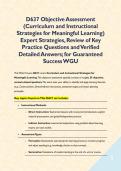
This WGU Course D637 covers Curriculum and Instructional Strategies for
Meaningful Learning. This objective assessment typically consists of roughly 55 objective,
scenario-based questions. The exam tests your ability to identify and apply learning theories
(e.g., Constructivism, Direct/Indirect Instruction), assessment types, and lesson planning
principles.
Key topics found on This D637 set include:
• Instructional Methods:
o Direct Instruction: Teacher-led lessons with structured introductions, explicit
material presentation, and guided/independent practice.
o Indirect Instruction: Learner-led exploration using problem-based learning,
inquiry, and case studies.
• Assessment Types:
o Formative: Assessments used during the learning process to monitor progress
and adjust teaching (e.g., knowledge checks, in-class surveys).
o Summative: Evaluations of student learning at the end of a unit or course.
1
, • Learning Theories & Alignment: Matching teaching strategies with appropriate
philosophies like Cognitivism, Humanism, and Behaviorism.
Q1. Which strategy should be used as an effective direct instruction method to
introduce content for the standard: 'Describe the shared characteristics of
mammals'? [Multiple Choice]
A) Present information about mammals using a lecture
B) Have students assemble habitats in small groups without introduction
C) Assign an unstructured research project on animal diversity
D) Use only peer-led presentations without teacher framing
Answer: Present information about mammals using a lecture
Explanation: Direct instruction often uses lectures to introduce factual content; presenting
mammal characteristics via lecture is an example. Distractors are other methods not described as
an 'effective direct instruction strategy' for introducing content: purely hands-on inquiry,
cooperative projects, or independent research may be effective later but do not represent the
direct instructional approach named.
Q2. What is the focus of behaviorism? [Multiple Choice]
A) Passive and external learning
B) Active internal processing and reflection
C) Student-centered autonomy and self-discovery
D) Social negotiation of knowledge among peers
Answer: Passive and external learning
2
, Explanation: Behaviorism emphasizes observable behaviors shaped by external stimuli and
reinforcement, which is described as passive and external learning in the source. Distractors
mischaracterize behaviorism: internal cognitive processing, student autonomy, and social
construction are central to other theories (cognitivism, humanism, constructivism respectively)
and therefore are not accurate descriptions of behaviorism's focus.
Q3. Which standard aligns with the objective: 'Given a major division of the
nervous system, the student can identify its function 80% of the time'? [Multiple
Choice]
A) Explain the purpose of each division of the nervous system.
B) Memorize the Latin names of all nerves without reference to function.
C) Practice surgical techniques related to nervous tissue on models.
D) List only the anatomical locations of nerves without describing their roles.
Answer: Explain the purpose of each division of the nervous system.
Explanation: The objective that matches asking students to identify functions of nervous system
divisions is to explain the purpose of each division. That wording requires students to connect
structure (division) to function. Distractors are incorrect because they ask for unrelated tasks
(labeling only without function), memorizing names without explanation, or performing medical
procedures rather than describing function.
Q4. Which objective is in alignment with the standard 'Write a research paper
with properly cited sources'? [Multiple Choice]
A) Write a 5-8 page research paper for an assigned topic, correctly citing at least four
academic sources.
B) Give an oral summary of a topic using only internet blogs without citation standards.
C) Write a one-page opinion piece based on personal experience without external
sources.
3
(Curriculum and Instructional
Strategies for Meaningful Learning)
Expert Strategies, Review of Key
Practice Questions and Verified
Detailed Answers; for Guaranteed
Success WGU
This WGU Course D637 covers Curriculum and Instructional Strategies for
Meaningful Learning. This objective assessment typically consists of roughly 55 objective,
scenario-based questions. The exam tests your ability to identify and apply learning theories
(e.g., Constructivism, Direct/Indirect Instruction), assessment types, and lesson planning
principles.
Key topics found on This D637 set include:
• Instructional Methods:
o Direct Instruction: Teacher-led lessons with structured introductions, explicit
material presentation, and guided/independent practice.
o Indirect Instruction: Learner-led exploration using problem-based learning,
inquiry, and case studies.
• Assessment Types:
o Formative: Assessments used during the learning process to monitor progress
and adjust teaching (e.g., knowledge checks, in-class surveys).
o Summative: Evaluations of student learning at the end of a unit or course.
1
, • Learning Theories & Alignment: Matching teaching strategies with appropriate
philosophies like Cognitivism, Humanism, and Behaviorism.
Q1. Which strategy should be used as an effective direct instruction method to
introduce content for the standard: 'Describe the shared characteristics of
mammals'? [Multiple Choice]
A) Present information about mammals using a lecture
B) Have students assemble habitats in small groups without introduction
C) Assign an unstructured research project on animal diversity
D) Use only peer-led presentations without teacher framing
Answer: Present information about mammals using a lecture
Explanation: Direct instruction often uses lectures to introduce factual content; presenting
mammal characteristics via lecture is an example. Distractors are other methods not described as
an 'effective direct instruction strategy' for introducing content: purely hands-on inquiry,
cooperative projects, or independent research may be effective later but do not represent the
direct instructional approach named.
Q2. What is the focus of behaviorism? [Multiple Choice]
A) Passive and external learning
B) Active internal processing and reflection
C) Student-centered autonomy and self-discovery
D) Social negotiation of knowledge among peers
Answer: Passive and external learning
2
, Explanation: Behaviorism emphasizes observable behaviors shaped by external stimuli and
reinforcement, which is described as passive and external learning in the source. Distractors
mischaracterize behaviorism: internal cognitive processing, student autonomy, and social
construction are central to other theories (cognitivism, humanism, constructivism respectively)
and therefore are not accurate descriptions of behaviorism's focus.
Q3. Which standard aligns with the objective: 'Given a major division of the
nervous system, the student can identify its function 80% of the time'? [Multiple
Choice]
A) Explain the purpose of each division of the nervous system.
B) Memorize the Latin names of all nerves without reference to function.
C) Practice surgical techniques related to nervous tissue on models.
D) List only the anatomical locations of nerves without describing their roles.
Answer: Explain the purpose of each division of the nervous system.
Explanation: The objective that matches asking students to identify functions of nervous system
divisions is to explain the purpose of each division. That wording requires students to connect
structure (division) to function. Distractors are incorrect because they ask for unrelated tasks
(labeling only without function), memorizing names without explanation, or performing medical
procedures rather than describing function.
Q4. Which objective is in alignment with the standard 'Write a research paper
with properly cited sources'? [Multiple Choice]
A) Write a 5-8 page research paper for an assigned topic, correctly citing at least four
academic sources.
B) Give an oral summary of a topic using only internet blogs without citation standards.
C) Write a one-page opinion piece based on personal experience without external
sources.
3