

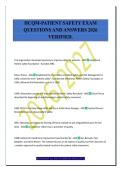
HCQM-PATIENT SAFETY EXAM
QUESTIONS AND ANSWERS 2026
VERIFIED.
First organization developed expressly to improve safety for patients. - ANS Anesthesia
Patient Safety Foundation - founded 1985.
Ellison Pierce - ANS Established the Committee on Patient Safety and Risk Management in
1982; coined the term "patient safety", founded the Anesthesia Patient Safety Foundation in
1985; delivered the Rovenstine Lecture in 1996.
1996's Rovenstine Lecture (40 Years behind the Mask: Safety Revisited) - ANS Ellison Pierce
described the beginning of anesthesiology's patient safety movement
1982 20/20's The Deep Sleep: 6000 will Die or Suffer Brain Damage - ANS Inspired Pierce's
Rovenstine Lecture about patient safety
After attending a workshop by Deming, Berwick realized he was misguided because he had
been - ANS An inspector rather than a promoter of quality.
1988 Institute for Healthcare Improvement was founded by - ANS Don Berwick, Paul
Batalden, and Gene Nelson. The institute focuses on all aspects of quality, but their discovery of
a modern approach to quality helped transform the patient safety movement.
@COPYRIGHT ALL RIGHTS RESERVED PAGE 1 OF 11
, Harvard Medical Practice Study I and II - ANS Published in 1991 by the New England Journal
of Medicine it had the results from two large studies of adverse medical events and provided
the evidence that significant numbers of patients are harmed by medical treatment and a
framework for understanding the types of harm they experience.
Harvard Medical Practice Study I - ANS 30,000 Medical records from 1984 non psych
hospitals in NYS were screened for adverse events (injury caused by medical management
rather than underlying disease and prolonged the hospitalization or produced a disability at the
time of discharge) and negligence (care falling below the standard expected of physicians in
their community).
Harvard Medical Practice Study II - ANS Classified the injuries described in Study I and the
management errors that were responsible.
Results of Harvard Medical Study II - ANS Adverse events occurred in 3.7% of hospitalizations
and 27.6% of the events were due to negligence. 70.5% gave rise to disability lasting less than
six months, 2.6% caused permanently disabling injuries and 13.6% led to death. Unfortunately it
did not lead to immediate change.
Lucian Leape - ANS Co-author of the Harvard Medical Practice Study; prominent leader in the
patient safety movement; discovered how cognitive psychology and human factors engineering
were important aspects of improving patient safety
1994's Error in Medicine published in the Journal of the American Medical Association -
ANS Written by Lucian Leape it presented statistical evidence of the occurrence of harm
caused by medical errors along with lessons from other high risk industries such as aviation.
The first mainstream article in healthcare literature arguing for a systems approach to safety. -
ANS Error in Medicine by Lucian Leape.
@COPYRIGHT ALL RIGHTS RESERVED PAGE 2 OF 11
QUESTIONS AND ANSWERS 2026
VERIFIED.
First organization developed expressly to improve safety for patients. - ANS Anesthesia
Patient Safety Foundation - founded 1985.
Ellison Pierce - ANS Established the Committee on Patient Safety and Risk Management in
1982; coined the term "patient safety", founded the Anesthesia Patient Safety Foundation in
1985; delivered the Rovenstine Lecture in 1996.
1996's Rovenstine Lecture (40 Years behind the Mask: Safety Revisited) - ANS Ellison Pierce
described the beginning of anesthesiology's patient safety movement
1982 20/20's The Deep Sleep: 6000 will Die or Suffer Brain Damage - ANS Inspired Pierce's
Rovenstine Lecture about patient safety
After attending a workshop by Deming, Berwick realized he was misguided because he had
been - ANS An inspector rather than a promoter of quality.
1988 Institute for Healthcare Improvement was founded by - ANS Don Berwick, Paul
Batalden, and Gene Nelson. The institute focuses on all aspects of quality, but their discovery of
a modern approach to quality helped transform the patient safety movement.
@COPYRIGHT ALL RIGHTS RESERVED PAGE 1 OF 11
, Harvard Medical Practice Study I and II - ANS Published in 1991 by the New England Journal
of Medicine it had the results from two large studies of adverse medical events and provided
the evidence that significant numbers of patients are harmed by medical treatment and a
framework for understanding the types of harm they experience.
Harvard Medical Practice Study I - ANS 30,000 Medical records from 1984 non psych
hospitals in NYS were screened for adverse events (injury caused by medical management
rather than underlying disease and prolonged the hospitalization or produced a disability at the
time of discharge) and negligence (care falling below the standard expected of physicians in
their community).
Harvard Medical Practice Study II - ANS Classified the injuries described in Study I and the
management errors that were responsible.
Results of Harvard Medical Study II - ANS Adverse events occurred in 3.7% of hospitalizations
and 27.6% of the events were due to negligence. 70.5% gave rise to disability lasting less than
six months, 2.6% caused permanently disabling injuries and 13.6% led to death. Unfortunately it
did not lead to immediate change.
Lucian Leape - ANS Co-author of the Harvard Medical Practice Study; prominent leader in the
patient safety movement; discovered how cognitive psychology and human factors engineering
were important aspects of improving patient safety
1994's Error in Medicine published in the Journal of the American Medical Association -
ANS Written by Lucian Leape it presented statistical evidence of the occurrence of harm
caused by medical errors along with lessons from other high risk industries such as aviation.
The first mainstream article in healthcare literature arguing for a systems approach to safety. -
ANS Error in Medicine by Lucian Leape.
@COPYRIGHT ALL RIGHTS RESERVED PAGE 2 OF 11


