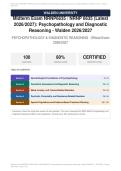
Midterm Exam NRNP6635 / NRNP 6635 (Latest 2026/2027): Psychopathology and Diagnostic Reasoning - Walden 2026/2027 2026/2027 | Page 1 | Passing
Score: 80%
WALDEN UNIVERSITY
Midterm Exam NRNP6635 / NRNP 6635 (Latest
2026/2027): Psychopathology and Diagnostic
Reasoning - Walden 2026/2027
PSYCHOPATHOLOGY & DIAGNOSTIC REASONING · Official Exam
2026/2027
100 80% CERTIFIED
QUESTIONS PASSING SCORE RECERTIFICATION
TABLE OF CONTENTS
Section 1 Neurobiological Foundations of Psychopathology Q1-20
Section 2 Psychiatric Assessment and Diagnostic Reasoning Q21-40
Section 3 Mood, Anxiety, and Trauma-Related Disorders Q41-60
Section 4 Psychotic, Personality, and Substance-Related Disorders Q61-80
Section 5 Special Populations and Evidence-Based Treatment Planning Q81-100
Instructions: Select the single best answer for each question. This exam is designed for NRNP 6635 Psychopathology and
Diagnostic Reasoning midterm exam preparation. Passing score: 80% (80 questions correct).
Midterm Exam NRNP6635 / NRNP 6635 (Latest 2026/2027): Psychopathology and Diagnostic Reasoning - Walden 2026/2027 — 2026/2027 | Passing
Score: 80% | Page 1 of 51
, SECTION 1 | Neurobiological Foundations of Psychopathology | Q1-Q20 | Midterm Exam NRNP6635 / NRNP 6635 (Latest
2026/2027): Psychopathology and Diagnostic Reasoning - Walden 2026/2027 2026/2027
Q1 Question 1 of 100
A 34-year-old patient presents with persistent hallucinations and disorganized speech.
Neuroimaging reveals enlarged ventricles and reduced gray matter in the prefrontal cortex.
Which neurotransmitter imbalance is most closely associated with these findings?
A. A. Excessive serotonin in the raphe nuclei
B. B. Dopamine hyperactivity in the mesolimbic pathway
C. C. Deficient GABA in the cerebellar cortex
D. D. Elevated norepinephrine in the locus coeruleus
Correct Answer: B
Rationale:
Dopamine hyperactivity in the mesolimbic pathway is strongly associated with positive symptoms of psychosis,
including hallucinations and disorganized speech. Enlarged ventricles and reduced prefrontal gray matter are
structural findings consistent with schizophrenia, where mesolimbic dopamine overactivity drives positive
symptoms while mesocortical hypoactivity contributes to negative symptoms.
Q2 Question 2 of 100
A 28-year-old woman with major depressive disorder shows poor response to SSRIs.
Genetic testing reveals a polymorphism affecting the serotonin transporter gene
(5-HTTLPR). This finding best illustrates which principle of psychopathology?
A. B. The neurodevelopmental hypothesis of depression
B. C. The kindling model of recurrent mood episodes
C. D. The two-hit hypothesis of psychiatric disorders
D. A. The diathesis-stress model of mental illness
Correct Answer: D
Rationale:
The 5-HTTLPR polymorphism represents a genetic vulnerability (diathesis) that increases susceptibility to
depression when combined with environmental stressors. The diathesis-stress model explains how genetic
predisposition interacts with life events to produce psychopathology, and this transporter gene variant
specifically moderates stress sensitivity.
Midterm Exam NRNP6635 / NRNP 6635 (Latest 2026/2027): Psychopathology and Diagnostic Reasoning - Walden 2026/2027 — 2026/2027 | Passing
Score: 80% | Page 2 of 51
, Q3 Question 3 of 100
A 42-year-old man with bipolar I disorder experiences a manic episode after starting a
dopaminergic medication for Parkinson disease. This reaction best demonstrates which
neurobiological concept?
A. A. The kindling effect in mood disorders
B. B. The two-process theory of emotion regulation
C. C. The neurotransmitter dysregulation hypothesis
D. D. The behavioral sensitization model
Correct Answer: C
Rationale:
The neurotransmitter dysregulation hypothesis posits that psychiatric symptoms arise from imbalances in
neurotransmitter systems. In bipolar disorder, excessive dopaminergic stimulation directly triggers mania,
demonstrating how altered neurotransmitter activity can precipitate mood episodes in vulnerable individuals.
Q4 Question 4 of 100
A research team discovers that patients with treatment-resistant depression have reduced
brain-derived neurotrophic factor (BDNF) levels in the hippocampus. Which treatment
mechanism directly addresses this deficit?
A. C. Glutamate modulation via ketamine
B. A. Selective serotonin reuptake inhibition
C. B. Cognitive restructuring through psychotherapy
D. D. Dopamine blockade with antipsychotics
Correct Answer: A
Rationale:
Ketamine rapidly increases BDNF levels and promotes synaptic plasticity in the hippocampus through glutamate
modulation at NMDA receptors. This mechanism directly addresses the neurotrophic deficit observed in
treatment-resistant depression, unlike SSRIs which primarily affect serotonin reuptake or psychotherapy which
operates through cognitive pathways.
Midterm Exam NRNP6635 / NRNP 6635 (Latest 2026/2027): Psychopathology and Diagnostic Reasoning - Walden 2026/2027 — 2026/2027 | Passing
Score: 80% | Page 3 of 51
, Q5 Question 5 of 100
A 55-year-old patient with chronic alcohol use disorder presents with confabulation, ataxia,
and ophthalmoplegia. Which brain region is most severely affected in this condition?
A. A. The basal ganglia and substantia nigra
B. C. The amygdala and hippocampal formation
C. D. The prefrontal cortex and anterior cingulate
D. B. The mammillary bodies and dorsomedial thalamus
Correct Answer: D
Rationale:
This patient presents with Wernicke-Korsakoff syndrome, which primarily damages the mammillary bodies and
dorsomedial thalamus due to thiamine deficiency from chronic alcohol use. The basal ganglia are affected in
Parkinson disease, while the amygdala and hippocampus are more associated with anxiety and memory
disorders respectively.
Q6 Question 6 of 100
A 19-year-old college student experiences auditory hallucinations for the first time during a
period of sleep deprivation and cannabis use. According to the neurodevelopmental
hypothesis, which factor most likely contributed to this presentation?
A. A. An acute dopaminergic surge from cannabis exposure alone
B. C. A purely psychogenic response to academic stress
C. B. Early neurodevelopmental abnormalities that lower the threshold for psychosis
D. D. A transient serotonin syndrome from sleep loss
Correct Answer: C
Rationale:
The neurodevelopmental hypothesis proposes that early brain development abnormalities create a vulnerability
to psychosis that can be triggered later by environmental factors such as substance use or stress. Cannabis and
sleep deprivation serve as triggers that unmask an underlying vulnerability rather than causing psychosis de
novo in isolation.
Midterm Exam NRNP6635 / NRNP 6635 (Latest 2026/2027): Psychopathology and Diagnostic Reasoning - Walden 2026/2027 — 2026/2027 | Passing
Score: 80% | Page 4 of 51
Score: 80%
WALDEN UNIVERSITY
Midterm Exam NRNP6635 / NRNP 6635 (Latest
2026/2027): Psychopathology and Diagnostic
Reasoning - Walden 2026/2027
PSYCHOPATHOLOGY & DIAGNOSTIC REASONING · Official Exam
2026/2027
100 80% CERTIFIED
QUESTIONS PASSING SCORE RECERTIFICATION
TABLE OF CONTENTS
Section 1 Neurobiological Foundations of Psychopathology Q1-20
Section 2 Psychiatric Assessment and Diagnostic Reasoning Q21-40
Section 3 Mood, Anxiety, and Trauma-Related Disorders Q41-60
Section 4 Psychotic, Personality, and Substance-Related Disorders Q61-80
Section 5 Special Populations and Evidence-Based Treatment Planning Q81-100
Instructions: Select the single best answer for each question. This exam is designed for NRNP 6635 Psychopathology and
Diagnostic Reasoning midterm exam preparation. Passing score: 80% (80 questions correct).
Midterm Exam NRNP6635 / NRNP 6635 (Latest 2026/2027): Psychopathology and Diagnostic Reasoning - Walden 2026/2027 — 2026/2027 | Passing
Score: 80% | Page 1 of 51
, SECTION 1 | Neurobiological Foundations of Psychopathology | Q1-Q20 | Midterm Exam NRNP6635 / NRNP 6635 (Latest
2026/2027): Psychopathology and Diagnostic Reasoning - Walden 2026/2027 2026/2027
Q1 Question 1 of 100
A 34-year-old patient presents with persistent hallucinations and disorganized speech.
Neuroimaging reveals enlarged ventricles and reduced gray matter in the prefrontal cortex.
Which neurotransmitter imbalance is most closely associated with these findings?
A. A. Excessive serotonin in the raphe nuclei
B. B. Dopamine hyperactivity in the mesolimbic pathway
C. C. Deficient GABA in the cerebellar cortex
D. D. Elevated norepinephrine in the locus coeruleus
Correct Answer: B
Rationale:
Dopamine hyperactivity in the mesolimbic pathway is strongly associated with positive symptoms of psychosis,
including hallucinations and disorganized speech. Enlarged ventricles and reduced prefrontal gray matter are
structural findings consistent with schizophrenia, where mesolimbic dopamine overactivity drives positive
symptoms while mesocortical hypoactivity contributes to negative symptoms.
Q2 Question 2 of 100
A 28-year-old woman with major depressive disorder shows poor response to SSRIs.
Genetic testing reveals a polymorphism affecting the serotonin transporter gene
(5-HTTLPR). This finding best illustrates which principle of psychopathology?
A. B. The neurodevelopmental hypothesis of depression
B. C. The kindling model of recurrent mood episodes
C. D. The two-hit hypothesis of psychiatric disorders
D. A. The diathesis-stress model of mental illness
Correct Answer: D
Rationale:
The 5-HTTLPR polymorphism represents a genetic vulnerability (diathesis) that increases susceptibility to
depression when combined with environmental stressors. The diathesis-stress model explains how genetic
predisposition interacts with life events to produce psychopathology, and this transporter gene variant
specifically moderates stress sensitivity.
Midterm Exam NRNP6635 / NRNP 6635 (Latest 2026/2027): Psychopathology and Diagnostic Reasoning - Walden 2026/2027 — 2026/2027 | Passing
Score: 80% | Page 2 of 51
, Q3 Question 3 of 100
A 42-year-old man with bipolar I disorder experiences a manic episode after starting a
dopaminergic medication for Parkinson disease. This reaction best demonstrates which
neurobiological concept?
A. A. The kindling effect in mood disorders
B. B. The two-process theory of emotion regulation
C. C. The neurotransmitter dysregulation hypothesis
D. D. The behavioral sensitization model
Correct Answer: C
Rationale:
The neurotransmitter dysregulation hypothesis posits that psychiatric symptoms arise from imbalances in
neurotransmitter systems. In bipolar disorder, excessive dopaminergic stimulation directly triggers mania,
demonstrating how altered neurotransmitter activity can precipitate mood episodes in vulnerable individuals.
Q4 Question 4 of 100
A research team discovers that patients with treatment-resistant depression have reduced
brain-derived neurotrophic factor (BDNF) levels in the hippocampus. Which treatment
mechanism directly addresses this deficit?
A. C. Glutamate modulation via ketamine
B. A. Selective serotonin reuptake inhibition
C. B. Cognitive restructuring through psychotherapy
D. D. Dopamine blockade with antipsychotics
Correct Answer: A
Rationale:
Ketamine rapidly increases BDNF levels and promotes synaptic plasticity in the hippocampus through glutamate
modulation at NMDA receptors. This mechanism directly addresses the neurotrophic deficit observed in
treatment-resistant depression, unlike SSRIs which primarily affect serotonin reuptake or psychotherapy which
operates through cognitive pathways.
Midterm Exam NRNP6635 / NRNP 6635 (Latest 2026/2027): Psychopathology and Diagnostic Reasoning - Walden 2026/2027 — 2026/2027 | Passing
Score: 80% | Page 3 of 51
, Q5 Question 5 of 100
A 55-year-old patient with chronic alcohol use disorder presents with confabulation, ataxia,
and ophthalmoplegia. Which brain region is most severely affected in this condition?
A. A. The basal ganglia and substantia nigra
B. C. The amygdala and hippocampal formation
C. D. The prefrontal cortex and anterior cingulate
D. B. The mammillary bodies and dorsomedial thalamus
Correct Answer: D
Rationale:
This patient presents with Wernicke-Korsakoff syndrome, which primarily damages the mammillary bodies and
dorsomedial thalamus due to thiamine deficiency from chronic alcohol use. The basal ganglia are affected in
Parkinson disease, while the amygdala and hippocampus are more associated with anxiety and memory
disorders respectively.
Q6 Question 6 of 100
A 19-year-old college student experiences auditory hallucinations for the first time during a
period of sleep deprivation and cannabis use. According to the neurodevelopmental
hypothesis, which factor most likely contributed to this presentation?
A. A. An acute dopaminergic surge from cannabis exposure alone
B. C. A purely psychogenic response to academic stress
C. B. Early neurodevelopmental abnormalities that lower the threshold for psychosis
D. D. A transient serotonin syndrome from sleep loss
Correct Answer: C
Rationale:
The neurodevelopmental hypothesis proposes that early brain development abnormalities create a vulnerability
to psychosis that can be triggered later by environmental factors such as substance use or stress. Cannabis and
sleep deprivation serve as triggers that unmask an underlying vulnerability rather than causing psychosis de
novo in isolation.
Midterm Exam NRNP6635 / NRNP 6635 (Latest 2026/2027): Psychopathology and Diagnostic Reasoning - Walden 2026/2027 — 2026/2027 | Passing
Score: 80% | Page 4 of 51