Academic and Professional Mastery Report:
Ontario Property and Casualty Insurance Systems,
Legacy Frameworks, and Regulatory Compliance
(The Elite Universal Test Bank)
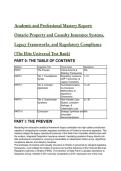
PART 0: THE TABLE OF CONTENTS
Section Cognitive Tier Focus Area Questions
PART I The Preview Critical Axioms & N/A
Statutory Frameworks
PART II Tier 1: Foundational Regulatory Licensure, 1–10
Syntax OAP 1 Directives, &
Legacy Transitions
PART II Tier 2: Complex Fault Determination, 11–20
Application Co-Insurance
Mathematics, &
Algorithmic
Governance
PART II Tier 3: Grandmaster Multi-Variable Case 21–30
Synthesis Studies, Limitation
Arbitrage, &
Catastrophic Loss
PART III Conclusion Strategic Synthesis and N/A
Actionable
Recommendations
PART I: THE PREVIEW
Mastering this exhaustive analytical framework forges candidates into high-caliber practitioners
capable of navigating the complex regulatory architecture of Ontario’s insurance apparatus. This
mastery bridges the legacy operational protocols of the State Farm Canadian infrastructure with
the modern, integrated Desjardins Insurance network, translating academic theory directly into
elite professional competence, ensuring invulnerability to catastrophic claims errors, algorithmic
compliance failures, and statutory breaches.
The landscape of property and casualty insurance in Ontario is governed by stringent legislative
frameworks, most notably the Ontario Insurance Act and the directives of the Financial Services
Regulatory Authority of Ontario (FSRA). The transition of State Farm's Canadian operations to
Desjardins Group, initiated in 2014 and fully completed by 2019, represents one of the most
,significant structural integrations in North American financial services, transferring over 1.2
million clients and 500 exclusive agencies into a new corporate ecosystem. Furthermore, the
industry is currently facing unprecedented scrutiny regarding the application of artificial
intelligence in claims adjudication. Landmark civil rights litigation, such as the algorithmic bias
lawsuit filed by Sanford Heisler Sharp McKnight against State Farm, underscores the critical
need for absolute compliance with equitable claims handling practices.
The Critical Axioms Framework
The following data structure outlines the non-negotiable operational rules governing the Ontario
insurance sector.
Axiom Category Statutory/Operational Rule Professional Implication
Regulatory Licensure An Agent (OTL) represents a Market intermediaries cannot
single direct-writing insurer and be conflated with direct-writing
is governed by the FSRA; a representatives; their fiduciary
Broker (RIBO) is an vectors and statutory regulators
independent intermediary. are inherently distinct.
Limitation Protocols Under Section 148 (Statutory This aggressively overrides the
Condition 14) of the Ontario standard two-year statutory
Insurance Act, the limitation baseline found in the
period for property/fire claims is Limitations Act, 2002, requiring
strictly one year from the date immediate procedural action
of loss. upon loss.
Financial Mathematics The formula for claim recovery Elite practitioners utilize this
under a co-insurance penalty calculation to prevent punitive
is: (Did Carry / Should Carry) × depreciations on underinsured
Amount of Loss = Payout. commercial risks.
Risk Transfer Mechanisms The OPCF 49 (Agreement Not An insured who executes this
to Recover for Loss or endorsement completely
Damage), effective January 1, waives all rights to
2024, entirely removes Direct compensation for vehicle
Compensation - Property damage, even if they are 100%
Damage (DCPD) coverage. not at fault.
Algorithmic Governance Artificial intelligence utilized in Failure to audit demographic
claims processing must proxies risks violating the Fair
undergo rigorous disparate Housing Act by manifesting
impact auditing to avoid proxy algorithmic bias, characterized
discrimination. by statistically disproportionate
evidentiary demands.
PART II: THE ELITE TEST BANK
Tier 1: Foundational Syntax & Application
The foundational syntax of the Ontario insurance ecosystem requires absolute fluency in
regulatory licensure, the mechanics of the Ontario Automobile Policy (OAP 1), and the historical
context of corporate integrations. The acquisition of State Farm Canada by Desjardins Group
necessitated an 18-month phased rebranding strategy that prioritized the retention of brand
, equity and localized agent-client relationships over immediate structural liquidation.
Simultaneously, candidates entering this direct-writer environment must secure the Other Than
Life (OTL) agent license, distinctly separating them from the Registered Insurance Brokers of
Ontario (RIBO) framework. The following analytical scenarios test these foundational principles.
Q1: An aspiring insurance professional in Ontario wishes to operate under the legacy State
Farm business model, now integrated within the Desjardins Insurance network. To legally
execute binding authority and process physical damage coverages exclusively for this single
corporate entity, which primary credential MUST the candidate secure? A) The Registered
Insurance Brokers of Ontario (RIBO) Level 1 License. B) The Life License Qualification Program
(LLQP) Certification. C) The Other Than Life (OTL) Agent License regulated by the FSRA. D)
The Canadian Certified Insurance Broker (CCIB) Designation.
● The Answer: C (The Other Than Life (OTL) Agent License regulated by the FSRA.)
● Distractor Analysis:
○ A is incorrect: The RIBO license is strictly reserved for independent brokers who
represent multiple, competing insurance companies, not exclusive captive agents
operating for a single direct writer.
○ B is incorrect: The LLQP permits the sale of life insurance and accident/sickness
policies, conferring absolutely no regulatory authority to underwrite or process
property, casualty, or automobile insurance contracts.
○ D is incorrect: The CCIB is an advanced, senior-level professional designation for
established independent brokers, not the foundational regulatory requirement for
captive agent operation.
The Mentor's Analysis: The core architecture of Ontario’s regulatory landscape sharply divides
captive agents and independent brokers. Operating within a direct-writing environment (such as
the post-acquisition Desjardins network) necessitates the OTL credential, heavily monitored by
the Financial Services Regulatory Authority of Ontario (FSRA). By utilizing the OTL framework,
you bypass the common trap of misapplying independent broker regulations to captive agent
environments. Professional/Academic Intuition: Never conflate market intermediaries
(Brokers/RIBO) with direct-writing representatives (Agents/OTL); their fiduciary vectors,
product limitations, and statutory regulators are inherently distinct.
Q2: Following Desjardins Group's acquisition of State Farm’s Canadian operations, a strategic
transformation was mandated across the exclusive agent network. Based on the fundamental
principles of corporate acquisitions and change management within the insurance sector, what
was the PRIMARY operational objective during the 18-month transition phase concluding in
2019? A) To completely liquidate all State Farm property and casualty policies into non-standard
Facility Association pools. B) To rebrand the physical and digital infrastructure while transferring
brand equity and preserving the localized, exclusive agent-client service relationships. C) To
force all existing captive agents to abandon their exclusive contracts and become independent
RIBO-certified brokers. D) To eliminate the life insurance portfolio acquired from State Farm to
strictly focus on standard auto policies.
● The Answer: B (To rebrand the physical and digital infrastructure while transferring brand
equity and preserving the localized, exclusive agent-client service relationships.)
● Distractor Analysis:
○ A is incorrect: Liquidating performing assets into the Facility Association (a market
of last resort for high-risk drivers) is financially catastrophic and runs completely
counter to the objective of an acquisition aimed at market expansion.
○ C is incorrect: The acquisition relied fundamentally upon maintaining the highly
profitable captive agent model; forcing agents into the RIBO framework would
Ontario Property and Casualty Insurance Systems,
Legacy Frameworks, and Regulatory Compliance
(The Elite Universal Test Bank)
PART 0: THE TABLE OF CONTENTS
Section Cognitive Tier Focus Area Questions
PART I The Preview Critical Axioms & N/A
Statutory Frameworks
PART II Tier 1: Foundational Regulatory Licensure, 1–10
Syntax OAP 1 Directives, &
Legacy Transitions
PART II Tier 2: Complex Fault Determination, 11–20
Application Co-Insurance
Mathematics, &
Algorithmic
Governance
PART II Tier 3: Grandmaster Multi-Variable Case 21–30
Synthesis Studies, Limitation
Arbitrage, &
Catastrophic Loss
PART III Conclusion Strategic Synthesis and N/A
Actionable
Recommendations
PART I: THE PREVIEW
Mastering this exhaustive analytical framework forges candidates into high-caliber practitioners
capable of navigating the complex regulatory architecture of Ontario’s insurance apparatus. This
mastery bridges the legacy operational protocols of the State Farm Canadian infrastructure with
the modern, integrated Desjardins Insurance network, translating academic theory directly into
elite professional competence, ensuring invulnerability to catastrophic claims errors, algorithmic
compliance failures, and statutory breaches.
The landscape of property and casualty insurance in Ontario is governed by stringent legislative
frameworks, most notably the Ontario Insurance Act and the directives of the Financial Services
Regulatory Authority of Ontario (FSRA). The transition of State Farm's Canadian operations to
Desjardins Group, initiated in 2014 and fully completed by 2019, represents one of the most
,significant structural integrations in North American financial services, transferring over 1.2
million clients and 500 exclusive agencies into a new corporate ecosystem. Furthermore, the
industry is currently facing unprecedented scrutiny regarding the application of artificial
intelligence in claims adjudication. Landmark civil rights litigation, such as the algorithmic bias
lawsuit filed by Sanford Heisler Sharp McKnight against State Farm, underscores the critical
need for absolute compliance with equitable claims handling practices.
The Critical Axioms Framework
The following data structure outlines the non-negotiable operational rules governing the Ontario
insurance sector.
Axiom Category Statutory/Operational Rule Professional Implication
Regulatory Licensure An Agent (OTL) represents a Market intermediaries cannot
single direct-writing insurer and be conflated with direct-writing
is governed by the FSRA; a representatives; their fiduciary
Broker (RIBO) is an vectors and statutory regulators
independent intermediary. are inherently distinct.
Limitation Protocols Under Section 148 (Statutory This aggressively overrides the
Condition 14) of the Ontario standard two-year statutory
Insurance Act, the limitation baseline found in the
period for property/fire claims is Limitations Act, 2002, requiring
strictly one year from the date immediate procedural action
of loss. upon loss.
Financial Mathematics The formula for claim recovery Elite practitioners utilize this
under a co-insurance penalty calculation to prevent punitive
is: (Did Carry / Should Carry) × depreciations on underinsured
Amount of Loss = Payout. commercial risks.
Risk Transfer Mechanisms The OPCF 49 (Agreement Not An insured who executes this
to Recover for Loss or endorsement completely
Damage), effective January 1, waives all rights to
2024, entirely removes Direct compensation for vehicle
Compensation - Property damage, even if they are 100%
Damage (DCPD) coverage. not at fault.
Algorithmic Governance Artificial intelligence utilized in Failure to audit demographic
claims processing must proxies risks violating the Fair
undergo rigorous disparate Housing Act by manifesting
impact auditing to avoid proxy algorithmic bias, characterized
discrimination. by statistically disproportionate
evidentiary demands.
PART II: THE ELITE TEST BANK
Tier 1: Foundational Syntax & Application
The foundational syntax of the Ontario insurance ecosystem requires absolute fluency in
regulatory licensure, the mechanics of the Ontario Automobile Policy (OAP 1), and the historical
context of corporate integrations. The acquisition of State Farm Canada by Desjardins Group
necessitated an 18-month phased rebranding strategy that prioritized the retention of brand
, equity and localized agent-client relationships over immediate structural liquidation.
Simultaneously, candidates entering this direct-writer environment must secure the Other Than
Life (OTL) agent license, distinctly separating them from the Registered Insurance Brokers of
Ontario (RIBO) framework. The following analytical scenarios test these foundational principles.
Q1: An aspiring insurance professional in Ontario wishes to operate under the legacy State
Farm business model, now integrated within the Desjardins Insurance network. To legally
execute binding authority and process physical damage coverages exclusively for this single
corporate entity, which primary credential MUST the candidate secure? A) The Registered
Insurance Brokers of Ontario (RIBO) Level 1 License. B) The Life License Qualification Program
(LLQP) Certification. C) The Other Than Life (OTL) Agent License regulated by the FSRA. D)
The Canadian Certified Insurance Broker (CCIB) Designation.
● The Answer: C (The Other Than Life (OTL) Agent License regulated by the FSRA.)
● Distractor Analysis:
○ A is incorrect: The RIBO license is strictly reserved for independent brokers who
represent multiple, competing insurance companies, not exclusive captive agents
operating for a single direct writer.
○ B is incorrect: The LLQP permits the sale of life insurance and accident/sickness
policies, conferring absolutely no regulatory authority to underwrite or process
property, casualty, or automobile insurance contracts.
○ D is incorrect: The CCIB is an advanced, senior-level professional designation for
established independent brokers, not the foundational regulatory requirement for
captive agent operation.
The Mentor's Analysis: The core architecture of Ontario’s regulatory landscape sharply divides
captive agents and independent brokers. Operating within a direct-writing environment (such as
the post-acquisition Desjardins network) necessitates the OTL credential, heavily monitored by
the Financial Services Regulatory Authority of Ontario (FSRA). By utilizing the OTL framework,
you bypass the common trap of misapplying independent broker regulations to captive agent
environments. Professional/Academic Intuition: Never conflate market intermediaries
(Brokers/RIBO) with direct-writing representatives (Agents/OTL); their fiduciary vectors,
product limitations, and statutory regulators are inherently distinct.
Q2: Following Desjardins Group's acquisition of State Farm’s Canadian operations, a strategic
transformation was mandated across the exclusive agent network. Based on the fundamental
principles of corporate acquisitions and change management within the insurance sector, what
was the PRIMARY operational objective during the 18-month transition phase concluding in
2019? A) To completely liquidate all State Farm property and casualty policies into non-standard
Facility Association pools. B) To rebrand the physical and digital infrastructure while transferring
brand equity and preserving the localized, exclusive agent-client service relationships. C) To
force all existing captive agents to abandon their exclusive contracts and become independent
RIBO-certified brokers. D) To eliminate the life insurance portfolio acquired from State Farm to
strictly focus on standard auto policies.
● The Answer: B (To rebrand the physical and digital infrastructure while transferring brand
equity and preserving the localized, exclusive agent-client service relationships.)
● Distractor Analysis:
○ A is incorrect: Liquidating performing assets into the Facility Association (a market
of last resort for high-risk drivers) is financially catastrophic and runs completely
counter to the objective of an acquisition aimed at market expansion.
○ C is incorrect: The acquisition relied fundamentally upon maintaining the highly
profitable captive agent model; forcing agents into the RIBO framework would