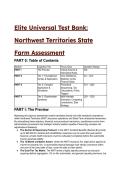
Elite Universal Test Bank:
Northwest Territories State
Farm Assessment
PART 0: Table of Contents
Section Cognitive Tier Focus Area Question Range
PART I The Preview Critical Axioms & N/A
Hard-Deck Rules
PART II Tier 1: Foundational Core Definitions, Q1 – Q10
Syntax & Application Statutory Limits,
Financial Data
PART II Tier 2: Complex Procedural Q11 – Q20
Application & Sequencing, Tax
Simulation Calculations, Policy
Triggers
PART II Tier 3: Grandmaster Multi-Variable Q21 – Q30
Synthesis Scenarios, Competing
Jurisdictions, Elite
Strategy
PART I: The Preview
Mastering this rigorous assessment matrix translates directly into elite analytical competence
within Northwest Territories (NWT) insurance operations and State Farm enterprise frameworks.
By internalizing these statutory, financial, and procedural mechanics, practitioners evolve from
administrative processors into strategic industry leaders capable of executing complex risk
adjudications flawlessly.
● The Section B Supremacy Protocol: In the NWT, Accident Benefits (Section B) provide
up to $25,000 for medical and rehabilitation expenses over an exact four-year period;
however, private health insurance must be exhausted completely before the automobile
insurer assumes liability.
● The 12-Month Limitation Axiom: Under the NWT Insurance Act, legal action against an
insurer for property, fire, or automobile physical damage must strictly commence within
one year of the exact date of loss, never the date of claim denial.
● The Dual-Tier Tax Matrix: The NWT levies a highly specific premium tax structure
requiring distinct segregation: 3% on life, automobile, and general casualty premiums, but
, exactly 1% on designated fire insurance premiums.
● The 2025 Financial Reality: State Farm's 2025 performance reported a $1.5 billion
Property & Casualty underwriting gain, powering a historic $5 billion auto dividend,
despite absorbing $15 billion in catastrophic claims.
● The SLCP Filter: State Farm utilizes the Sales & Leadership Career Profile (SLCP) to
evaluate potential independent contractor agents, strictly measuring 13 behavioral sales
and leadership traits over raw technical knowledge.
PART II: The Elite Test Bank
Tier 1: Foundational Syntax & Application
Q1: A newly licensed independent adjuster in Yellowknife is finalizing a standard automobile
policy (SPF No. 1) for a local resident. According to the Northwest Territories Insurance Act,
which combination of coverages represents the EXACT minimum mandatory auto insurance
requirement? A) $200,000 Third-Party Liability, Collision Coverage, and Accident Benefits. B)
$500,000 Third-Party Liability, Direct Compensation Property Damage (DCPD), and Uninsured
Automobile Coverage. C) $200,000 Third-Party Liability, Accident Benefits, and
Uninsured/Unidentified Automobile Coverage. D) $200,000 Third-Party Liability, Accident
Benefits, and Comprehensive Perils Coverage.
● The Answer: C ($200,000 Third-Party Liability, Accident Benefits, and
Uninsured/Unidentified Automobile Coverage.)
● Distractor Analysis:
○ A is incorrect: Collision is an optional physical damage coverage designed to
protect the insured's own vehicle. It is heavily recommended but never statutorily
mandated in any Canadian territory.
○ B is incorrect: While $500,000 is the minimum third-party limit in Nova Scotia, the
NWT requires only $200,000. Furthermore, DCPD is not statutorily mandated in the
NWT, unlike in Alberta, Ontario, or New Brunswick.
○ D is incorrect: Comprehensive coverage, protecting against static perils such as
theft, vandalism, or fire, remains strictly optional and falls outside the mandatory
legislative framework.
The Mentor's Analysis: Mastering the hard-deck statutory minimums is non-negotiable for
NWT compliance. When facing policy underwriting or initial claims triage, the immediate priority
is verifying that the territorial legislative trifecta (Third-Party Liability, Section B, and Uninsured
Motorist) is active. By utilizing Accident Benefits alongside Uninsured Automobile Coverage,
you bypass the common trap of confusing southern provincial DCPD regimes with the NWT's
distinct tort-based system. Professional/Academic Intuition: Never project southern
provincial frameworks onto territorial statutes; the NWT mandates exactly TPL ($200k),
Section B, and Uninsured coverage.
Q2: During a macro-level review of State Farm's global financial performance for the 2025 fiscal
year, an executive analyst is evaluating the Property and Casualty (P&C) sector. What was the
REPORTED combined underwriting outcome for the State Farm P&C affiliates in 2025? A) An
underwriting loss of $6.1 billion due to $15 billion in catastrophic wildfire claims. B) An
underwriting gain of $1.5 billion, achieved on $111.6 billion in earned premium. C) A pre-tax
operating profit of $12.9 billion driven exclusively by life insurance dividends. D) An underwriting
gain of $8.5 billion, derived purely from capital asset liquidation and stock portfolio yields.
, ● The Answer: B (An underwriting gain of $1.5 billion, achieved on $111.6 billion in earned
premium.)
● Distractor Analysis:
○ A is incorrect: The $6.1 billion underwriting loss was reported during the 2024 fiscal
year. The 2025 year saw a return to underwriting profitability despite massive
catastrophic payouts.
○ C is incorrect: $12.9 billion represents the total net income across the entire
enterprise, encompassing all product lines and investment yields, not the specific
P&C underwriting gain.
○ D is incorrect: $8.5 billion represents the pre-tax operating profit when combining
the $1.5 billion underwriting gain with $7.0 billion in investment and other income.
Underwriting outcomes must exclude investment yields.
The Mentor's Analysis: Financial fluency requires distinguishing between core operational
metrics and auxiliary investment income. When facing macro-level corporate assessments, the
immediate priority is isolating pure premium revenue against incurred claims. By utilizing the
Underwriting Gain metric, you bypass the common trap of artificially inflating operational
success with stock market yields. Professional/Academic Intuition: An insurer's core
operational health is measured strictly by its underwriting ratio; investment income is
secondary padding.
Q3: A policyholder residing in Inuvik sustains minor soft-tissue injuries in a motor vehicle
collision. They submit a claim for physical therapy under Section B (Accident Benefits). Based
on NWT insurance regulations, what is the FIRST action the claims professional must take
regarding this treatment billing? A) Approve the treatment up to a hard statutory cap of $1,000
specifically allocated for chiropractic and massage therapies. B) Mandate that the insured utilize
their private employer-sponsored health benefits (e.g., Sunlife, Blue Cross) prior to disbursing
any Section B funds. C) Deny the claim entirely unless the injury is classified by a physician as a
Whiplash Associated Disorder (WAD) II or higher. D) Immediately issue an advance lump-sum
payment of $140 per week to cover all anticipated rehabilitation costs.
● The Answer: B (Mandate that the insured utilize their private employer-sponsored health
benefits (e.g., Sunlife, Blue Cross) prior to disbursing any Section B funds.)
● Distractor Analysis:
○ A is incorrect: The $1,000 specific sub-limit for chiropractic and massage therapies
is an Alberta policy framework constraint. The NWT allows up to $25,000 with no
isolated sub-limits per treatment modality.
○ C is incorrect: The WAD diagnostic protocol dictates treatment limits in Alberta
(e.g., 10 treatments for WAD I, 21 for WAD II), but the NWT makes no legal
distinction for whiplash versus non-whiplash injuries under Section B.
○ D is incorrect: $140 per week is the maximum statutory cap for Disability Income
Loss, not an advance payment structure for medical rehabilitation invoices.
The Mentor's Analysis: NWT medical benefits operate on a strict secondary-payer basis when
concurrent coverage exists. When facing a Section B medical claim, the immediate priority is
verifying the existence of third-party employer or private health plans. By utilizing the Private
Healthcare Offset, the insurer bypasses the common trap of prematurely bleeding auto reserves
for claims that legally belong to a primary health carrier. Professional/Academic Intuition: In
the NWT, Section B medical coverage is always the payer of last resort behind existing
private health insurance.
Q4: A candidate applying to become a State Farm independent contractor agent must undergo
the Sales & Leadership Career Profile (SLCP). Which of the following MOST ACCURATELY
Northwest Territories State
Farm Assessment
PART 0: Table of Contents
Section Cognitive Tier Focus Area Question Range
PART I The Preview Critical Axioms & N/A
Hard-Deck Rules
PART II Tier 1: Foundational Core Definitions, Q1 – Q10
Syntax & Application Statutory Limits,
Financial Data
PART II Tier 2: Complex Procedural Q11 – Q20
Application & Sequencing, Tax
Simulation Calculations, Policy
Triggers
PART II Tier 3: Grandmaster Multi-Variable Q21 – Q30
Synthesis Scenarios, Competing
Jurisdictions, Elite
Strategy
PART I: The Preview
Mastering this rigorous assessment matrix translates directly into elite analytical competence
within Northwest Territories (NWT) insurance operations and State Farm enterprise frameworks.
By internalizing these statutory, financial, and procedural mechanics, practitioners evolve from
administrative processors into strategic industry leaders capable of executing complex risk
adjudications flawlessly.
● The Section B Supremacy Protocol: In the NWT, Accident Benefits (Section B) provide
up to $25,000 for medical and rehabilitation expenses over an exact four-year period;
however, private health insurance must be exhausted completely before the automobile
insurer assumes liability.
● The 12-Month Limitation Axiom: Under the NWT Insurance Act, legal action against an
insurer for property, fire, or automobile physical damage must strictly commence within
one year of the exact date of loss, never the date of claim denial.
● The Dual-Tier Tax Matrix: The NWT levies a highly specific premium tax structure
requiring distinct segregation: 3% on life, automobile, and general casualty premiums, but
, exactly 1% on designated fire insurance premiums.
● The 2025 Financial Reality: State Farm's 2025 performance reported a $1.5 billion
Property & Casualty underwriting gain, powering a historic $5 billion auto dividend,
despite absorbing $15 billion in catastrophic claims.
● The SLCP Filter: State Farm utilizes the Sales & Leadership Career Profile (SLCP) to
evaluate potential independent contractor agents, strictly measuring 13 behavioral sales
and leadership traits over raw technical knowledge.
PART II: The Elite Test Bank
Tier 1: Foundational Syntax & Application
Q1: A newly licensed independent adjuster in Yellowknife is finalizing a standard automobile
policy (SPF No. 1) for a local resident. According to the Northwest Territories Insurance Act,
which combination of coverages represents the EXACT minimum mandatory auto insurance
requirement? A) $200,000 Third-Party Liability, Collision Coverage, and Accident Benefits. B)
$500,000 Third-Party Liability, Direct Compensation Property Damage (DCPD), and Uninsured
Automobile Coverage. C) $200,000 Third-Party Liability, Accident Benefits, and
Uninsured/Unidentified Automobile Coverage. D) $200,000 Third-Party Liability, Accident
Benefits, and Comprehensive Perils Coverage.
● The Answer: C ($200,000 Third-Party Liability, Accident Benefits, and
Uninsured/Unidentified Automobile Coverage.)
● Distractor Analysis:
○ A is incorrect: Collision is an optional physical damage coverage designed to
protect the insured's own vehicle. It is heavily recommended but never statutorily
mandated in any Canadian territory.
○ B is incorrect: While $500,000 is the minimum third-party limit in Nova Scotia, the
NWT requires only $200,000. Furthermore, DCPD is not statutorily mandated in the
NWT, unlike in Alberta, Ontario, or New Brunswick.
○ D is incorrect: Comprehensive coverage, protecting against static perils such as
theft, vandalism, or fire, remains strictly optional and falls outside the mandatory
legislative framework.
The Mentor's Analysis: Mastering the hard-deck statutory minimums is non-negotiable for
NWT compliance. When facing policy underwriting or initial claims triage, the immediate priority
is verifying that the territorial legislative trifecta (Third-Party Liability, Section B, and Uninsured
Motorist) is active. By utilizing Accident Benefits alongside Uninsured Automobile Coverage,
you bypass the common trap of confusing southern provincial DCPD regimes with the NWT's
distinct tort-based system. Professional/Academic Intuition: Never project southern
provincial frameworks onto territorial statutes; the NWT mandates exactly TPL ($200k),
Section B, and Uninsured coverage.
Q2: During a macro-level review of State Farm's global financial performance for the 2025 fiscal
year, an executive analyst is evaluating the Property and Casualty (P&C) sector. What was the
REPORTED combined underwriting outcome for the State Farm P&C affiliates in 2025? A) An
underwriting loss of $6.1 billion due to $15 billion in catastrophic wildfire claims. B) An
underwriting gain of $1.5 billion, achieved on $111.6 billion in earned premium. C) A pre-tax
operating profit of $12.9 billion driven exclusively by life insurance dividends. D) An underwriting
gain of $8.5 billion, derived purely from capital asset liquidation and stock portfolio yields.
, ● The Answer: B (An underwriting gain of $1.5 billion, achieved on $111.6 billion in earned
premium.)
● Distractor Analysis:
○ A is incorrect: The $6.1 billion underwriting loss was reported during the 2024 fiscal
year. The 2025 year saw a return to underwriting profitability despite massive
catastrophic payouts.
○ C is incorrect: $12.9 billion represents the total net income across the entire
enterprise, encompassing all product lines and investment yields, not the specific
P&C underwriting gain.
○ D is incorrect: $8.5 billion represents the pre-tax operating profit when combining
the $1.5 billion underwriting gain with $7.0 billion in investment and other income.
Underwriting outcomes must exclude investment yields.
The Mentor's Analysis: Financial fluency requires distinguishing between core operational
metrics and auxiliary investment income. When facing macro-level corporate assessments, the
immediate priority is isolating pure premium revenue against incurred claims. By utilizing the
Underwriting Gain metric, you bypass the common trap of artificially inflating operational
success with stock market yields. Professional/Academic Intuition: An insurer's core
operational health is measured strictly by its underwriting ratio; investment income is
secondary padding.
Q3: A policyholder residing in Inuvik sustains minor soft-tissue injuries in a motor vehicle
collision. They submit a claim for physical therapy under Section B (Accident Benefits). Based
on NWT insurance regulations, what is the FIRST action the claims professional must take
regarding this treatment billing? A) Approve the treatment up to a hard statutory cap of $1,000
specifically allocated for chiropractic and massage therapies. B) Mandate that the insured utilize
their private employer-sponsored health benefits (e.g., Sunlife, Blue Cross) prior to disbursing
any Section B funds. C) Deny the claim entirely unless the injury is classified by a physician as a
Whiplash Associated Disorder (WAD) II or higher. D) Immediately issue an advance lump-sum
payment of $140 per week to cover all anticipated rehabilitation costs.
● The Answer: B (Mandate that the insured utilize their private employer-sponsored health
benefits (e.g., Sunlife, Blue Cross) prior to disbursing any Section B funds.)
● Distractor Analysis:
○ A is incorrect: The $1,000 specific sub-limit for chiropractic and massage therapies
is an Alberta policy framework constraint. The NWT allows up to $25,000 with no
isolated sub-limits per treatment modality.
○ C is incorrect: The WAD diagnostic protocol dictates treatment limits in Alberta
(e.g., 10 treatments for WAD I, 21 for WAD II), but the NWT makes no legal
distinction for whiplash versus non-whiplash injuries under Section B.
○ D is incorrect: $140 per week is the maximum statutory cap for Disability Income
Loss, not an advance payment structure for medical rehabilitation invoices.
The Mentor's Analysis: NWT medical benefits operate on a strict secondary-payer basis when
concurrent coverage exists. When facing a Section B medical claim, the immediate priority is
verifying the existence of third-party employer or private health plans. By utilizing the Private
Healthcare Offset, the insurer bypasses the common trap of prematurely bleeding auto reserves
for claims that legally belong to a primary health carrier. Professional/Academic Intuition: In
the NWT, Section B medical coverage is always the payer of last resort behind existing
private health insurance.
Q4: A candidate applying to become a State Farm independent contractor agent must undergo
the Sales & Leadership Career Profile (SLCP). Which of the following MOST ACCURATELY