Section 3 – Waves
13/9/24
Wave on a string
Transverse wave is also known as a progressive wave.
18/9/24
Standing waves
Superposition – Total displacement of 2 waves is vector sum of 2
individual displacements.
Interference – waves meet another wave in either constructive or
destructive interference.
Nodes – Stationary points of waves that have the same amplitude and do
not oscillate (amplitude equals 0 always).
Antinodes - 2 waves meet in phase so displacement goes from 0 to
maximum value of double the individual amplitudes.
Antiphase = 180degrees out of phase so exactly cancels.
If a string has fixed ends, these cannot oscillate, and so any stationary
wave established on it must have nodes at both ends. The length of the
string L is related to the wavelength of possible standing waves λ by
, where n=1,2,3...
The frequencies of the standing waves which can be supported in this
example will be
The 1st harmonic (fundamental frequency) is the lowest frequency of
standing wave that can be supported on the system. The second, third,
fourth and so on harmonics are simple multiples of this fundamental
frequency.
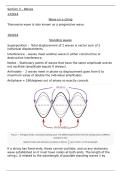
Black = first harmonic (fundamental frequency) – ½ wavelength
Dark grey = second harmonic – 1 wavelength.
Light grey = third harmonic – 1.5 wavelengths.
In contrast, if one of the ends of the string is free, it must be an antinode.
So, the length of the string and the wavelength are related by
where n=1,2,3...
In this case the frequencies of the standing waves that can be supported
in the medium are f=λc=(2n−1)4Lc. Hence if the fundamental frequency
is f0 then the higher harmonics supported will be 3f0,5f0,7f0, etc. Only the
odd harmonics are present - the even harmonics are missing.
, Black = first harmonic (fundamental frequency) – ¼ wavelength.
Dark grey = third harmonic – ¾ wavelengths.
Light grey = fifth harmonic – 1.25 wavelengths.
Although sound waves in a pipe are longitudinal rather than transverse,
the same type of conditions apply.
For a pipe closed at one end, the condition for standing waves is the same
as above in the case of a string with one free end.
For a pipe open at both ends, there must be antinodes at the ends so,
similarly to the string fixed at both ends, the length of the pipe relates to
the wavelength by
L=nλ/2
Same as with nodes at both ends, except moved up by ½ wavelength.
19/9/24
Longitudinal and transverse waves
13/9/24
Wave on a string
Transverse wave is also known as a progressive wave.
18/9/24
Standing waves
Superposition – Total displacement of 2 waves is vector sum of 2
individual displacements.
Interference – waves meet another wave in either constructive or
destructive interference.
Nodes – Stationary points of waves that have the same amplitude and do
not oscillate (amplitude equals 0 always).
Antinodes - 2 waves meet in phase so displacement goes from 0 to
maximum value of double the individual amplitudes.
Antiphase = 180degrees out of phase so exactly cancels.
If a string has fixed ends, these cannot oscillate, and so any stationary
wave established on it must have nodes at both ends. The length of the
string L is related to the wavelength of possible standing waves λ by
, where n=1,2,3...
The frequencies of the standing waves which can be supported in this
example will be
The 1st harmonic (fundamental frequency) is the lowest frequency of
standing wave that can be supported on the system. The second, third,
fourth and so on harmonics are simple multiples of this fundamental
frequency.
Black = first harmonic (fundamental frequency) – ½ wavelength
Dark grey = second harmonic – 1 wavelength.
Light grey = third harmonic – 1.5 wavelengths.
In contrast, if one of the ends of the string is free, it must be an antinode.
So, the length of the string and the wavelength are related by
where n=1,2,3...
In this case the frequencies of the standing waves that can be supported
in the medium are f=λc=(2n−1)4Lc. Hence if the fundamental frequency
is f0 then the higher harmonics supported will be 3f0,5f0,7f0, etc. Only the
odd harmonics are present - the even harmonics are missing.
, Black = first harmonic (fundamental frequency) – ¼ wavelength.
Dark grey = third harmonic – ¾ wavelengths.
Light grey = fifth harmonic – 1.25 wavelengths.
Although sound waves in a pipe are longitudinal rather than transverse,
the same type of conditions apply.
For a pipe closed at one end, the condition for standing waves is the same
as above in the case of a string with one free end.
For a pipe open at both ends, there must be antinodes at the ends so,
similarly to the string fixed at both ends, the length of the pipe relates to
the wavelength by
L=nλ/2
Same as with nodes at both ends, except moved up by ½ wavelength.
19/9/24
Longitudinal and transverse waves