Hoorcollege 1
Introductie
Management accounting measures and reports financial and non-financial information and
helps and motivates managers to make good decisions to fulfill an organization’s goals
Management accounting is a value-adding continuous improvement process of planning,
designing, measuring and operating both non-financial information systems and financial
information systems that guides management action, motivates behavior, and supports and
creates the cultural value necessary to achieve an organization’s strategic, tactical and
operating objectives.
Cost accounting measures and reports financial and non-financial data that relates to the
cost of acquiring or consuming resources by an organization.
MA: twee rollen
Decision facilitating: het is belangrijk om de link tussen strategie en financiële controle te
versterken. MA kan expertise inzetten om scenario’s of strategische opties te vergelijken.
Managment accounting uses information from operations to produce reports that provide
ongoing insight into business performance, such as profit margin and labor utilization, so
managers have data-driven input to make everyday decisions
- Cost accounting
- Make or buy decisions: outsource or do we do it ourselves
- Break-even analyses: what should I sell to make money?
- Relevant cost decisions: new investment of stick to old technology?
- Budget reports, balanced scorecards to see where we improve
Decision influencing:
- ‘How to motivate people into the organization to provide effort for the principal’:
bonus pay-outs, monitoring, targets after contract signed
- ‘How to attract the right workers to my company to make sure they are willing to
work?’: screening, ex-ante targets, interviewing
Decision influencing: guide people towards creating value for firm
Motivating employees: management accounting provides a selection of best alternative
methods of doing things. It motivates employees to improve their performance by setting
targets and using incentive schemes.
Coordinating among departments: management accounting is helpful in coordinating the
departments of an organization by applying thorough functional budgeting and providing
reports for the same to the management on a regular basis.
Controlling performance: in order to assure effective control, various techniques are
used by a management accountant such as budgetary control, standard costing,
management audit, etc. Management accounting provides a proper management control
system to the management. Reports are provided to the management regarding the
effective and efficient use of resources.
,MA in actie:
Planning: decide on company’s goals, decide how to attain these goals, plan resource
usage and allocation, predict results.
Decision making: cost accounting decisions
- Costs for inventory and external reporting
- Cost accounting for important decisions to assist marketing, operations, …
Evaluation profitability of products, customers, etc.
Cost data for pricing, quality investments, outsourcing decisions
Cost reduction, break-even for start-ups or new ventures
Decision control: management control: evaluation towards goals
- Translate plans into concrete actions budgets, responsibility centers
- Deviations of operations against original plant variance analyses, BSC
- Performance management and evaluation bonus, compensation
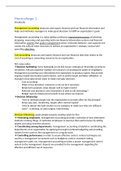
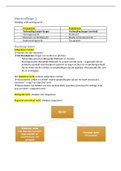
Management accounting vs. Financial accounting
,Strategic management accounting is a type of accounting that focuses not only on internal
factors of a company, but factors that are external. This includes industry-wide financials,
averages and upcoming trends.
Next to cost, we
- Look at market trends: what are our customers willing to pay and does cost need to
go down? (target costing)
- Look at predictors for financial results / KPI’s: is quality of the products important for
profit margin? (value chain analysis, total quality management)
- Examine what do we need to achieve on both financials and non-financials in order
to realize our strategy (balanced score card)
- Study risk management: which risk factors are we exposed to and how can we
manage them?
- Have a long-term perspective: not only on current profits, but what about customer
life time value, customer profitability, long term pricing.
Hoorcollege 2
Cost accounting concepts
Wat zijn kosten?
‘Resource sacrificed to achieve a given objective’
Usually expressed in monetary terms
Goals: find out the true costs (e.g. of producing a car)
Crucial for decision making
Responsibility accounting
If decentralized organization structure: responsibility centers
Different types of responsibility centers
- Cost center: accountable for costs
- Revenue center: accountable for revenues
- Profit center: accountable for revenues and costs
- Investment center: accountable for revenues, costs and investments
The choice of responsibility centers is based on the controllability principle: keep managers
and employees accountable for the items they control
Idea: who has the best information/knowledge to explain deviations from targets?
Not: who can we blame for deviations from targets?
Cost object: ‘thing’ for which cost information is needed
, Examples:
- Products or product lines
- Departments or business unit
- Projects or programs
- Service
- Customers
Depends on individual situation or interest!
Cost = Σ monetary values of all resources needed to achieve the cost object (complex)
Cost accumulation: stage 1 = bookkeeping
Cost assignment: stage 2 = tracing and allocating
COMPLEX: assigning to departments (cost object) is already difficult, to the product level
even more complex
Direct vs. indirect costs
Indirect/direct depends on cost object:
E.g. wage production manager direct if cost object is prod. Department
E.g. wage production manager indirect when cost object is product (e.g. car)
Introductie
Management accounting measures and reports financial and non-financial information and
helps and motivates managers to make good decisions to fulfill an organization’s goals
Management accounting is a value-adding continuous improvement process of planning,
designing, measuring and operating both non-financial information systems and financial
information systems that guides management action, motivates behavior, and supports and
creates the cultural value necessary to achieve an organization’s strategic, tactical and
operating objectives.
Cost accounting measures and reports financial and non-financial data that relates to the
cost of acquiring or consuming resources by an organization.
MA: twee rollen
Decision facilitating: het is belangrijk om de link tussen strategie en financiële controle te
versterken. MA kan expertise inzetten om scenario’s of strategische opties te vergelijken.
Managment accounting uses information from operations to produce reports that provide
ongoing insight into business performance, such as profit margin and labor utilization, so
managers have data-driven input to make everyday decisions
- Cost accounting
- Make or buy decisions: outsource or do we do it ourselves
- Break-even analyses: what should I sell to make money?
- Relevant cost decisions: new investment of stick to old technology?
- Budget reports, balanced scorecards to see where we improve
Decision influencing:
- ‘How to motivate people into the organization to provide effort for the principal’:
bonus pay-outs, monitoring, targets after contract signed
- ‘How to attract the right workers to my company to make sure they are willing to
work?’: screening, ex-ante targets, interviewing
Decision influencing: guide people towards creating value for firm
Motivating employees: management accounting provides a selection of best alternative
methods of doing things. It motivates employees to improve their performance by setting
targets and using incentive schemes.
Coordinating among departments: management accounting is helpful in coordinating the
departments of an organization by applying thorough functional budgeting and providing
reports for the same to the management on a regular basis.
Controlling performance: in order to assure effective control, various techniques are
used by a management accountant such as budgetary control, standard costing,
management audit, etc. Management accounting provides a proper management control
system to the management. Reports are provided to the management regarding the
effective and efficient use of resources.
,MA in actie:
Planning: decide on company’s goals, decide how to attain these goals, plan resource
usage and allocation, predict results.
Decision making: cost accounting decisions
- Costs for inventory and external reporting
- Cost accounting for important decisions to assist marketing, operations, …
Evaluation profitability of products, customers, etc.
Cost data for pricing, quality investments, outsourcing decisions
Cost reduction, break-even for start-ups or new ventures
Decision control: management control: evaluation towards goals
- Translate plans into concrete actions budgets, responsibility centers
- Deviations of operations against original plant variance analyses, BSC
- Performance management and evaluation bonus, compensation
Management accounting vs. Financial accounting
,Strategic management accounting is a type of accounting that focuses not only on internal
factors of a company, but factors that are external. This includes industry-wide financials,
averages and upcoming trends.
Next to cost, we
- Look at market trends: what are our customers willing to pay and does cost need to
go down? (target costing)
- Look at predictors for financial results / KPI’s: is quality of the products important for
profit margin? (value chain analysis, total quality management)
- Examine what do we need to achieve on both financials and non-financials in order
to realize our strategy (balanced score card)
- Study risk management: which risk factors are we exposed to and how can we
manage them?
- Have a long-term perspective: not only on current profits, but what about customer
life time value, customer profitability, long term pricing.
Hoorcollege 2
Cost accounting concepts
Wat zijn kosten?
‘Resource sacrificed to achieve a given objective’
Usually expressed in monetary terms
Goals: find out the true costs (e.g. of producing a car)
Crucial for decision making
Responsibility accounting
If decentralized organization structure: responsibility centers
Different types of responsibility centers
- Cost center: accountable for costs
- Revenue center: accountable for revenues
- Profit center: accountable for revenues and costs
- Investment center: accountable for revenues, costs and investments
The choice of responsibility centers is based on the controllability principle: keep managers
and employees accountable for the items they control
Idea: who has the best information/knowledge to explain deviations from targets?
Not: who can we blame for deviations from targets?
Cost object: ‘thing’ for which cost information is needed
, Examples:
- Products or product lines
- Departments or business unit
- Projects or programs
- Service
- Customers
Depends on individual situation or interest!
Cost = Σ monetary values of all resources needed to achieve the cost object (complex)
Cost accumulation: stage 1 = bookkeeping
Cost assignment: stage 2 = tracing and allocating
COMPLEX: assigning to departments (cost object) is already difficult, to the product level
even more complex
Direct vs. indirect costs
Indirect/direct depends on cost object:
E.g. wage production manager direct if cost object is prod. Department
E.g. wage production manager indirect when cost object is product (e.g. car)