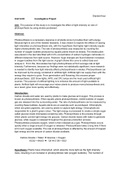
Compare uniprocessor systems with multiprocessor systems for the following
aspects.
a. Ease of programming
b. The need for synchronization
c. Performance evaluation
d. Run time system
a. Ease of programming:
Uniprocessor: single processing systems support kernel synchronization and CPU scheduling.
Therefore, they are more user-friendly and easier to program than multi-processor systems
Multiprocessor: Essentially, programming a parallel system is much more difficult than
programming a single processor with a single thread of control. Because it requires a very
complex operating system to schedule, balance and coordinate the input, output, and
processing activities of multiple processors.
b. Need for synchronization:
The main difference between an OS for a multi-processor system and an OS for a single-
processor system is scheduling. One of the many tasks of the operating system is to schedule
processes that use the CPU. In the execution process, it gives the control of the CPU to
various applications. When the application no longer needs the CPU or abandons the CPU
while waiting for other resources, the operating system will rely on the processor to regain
control.
Multi-processor systems face a series of challenges compared to uniprocessor systems,
because they must schedule multiple processors. The way the operating system allocates
processes to processors is a major design consideration.
c. Performance evaluation:
Uniprocessor: Performance in uniprocessor systems is lower than multiprocessor systems
since uniprocessor systems have a single processor. This leads to higher response time and
low throughput.
aspects.
a. Ease of programming
b. The need for synchronization
c. Performance evaluation
d. Run time system
a. Ease of programming:
Uniprocessor: single processing systems support kernel synchronization and CPU scheduling.
Therefore, they are more user-friendly and easier to program than multi-processor systems
Multiprocessor: Essentially, programming a parallel system is much more difficult than
programming a single processor with a single thread of control. Because it requires a very
complex operating system to schedule, balance and coordinate the input, output, and
processing activities of multiple processors.
b. Need for synchronization:
The main difference between an OS for a multi-processor system and an OS for a single-
processor system is scheduling. One of the many tasks of the operating system is to schedule
processes that use the CPU. In the execution process, it gives the control of the CPU to
various applications. When the application no longer needs the CPU or abandons the CPU
while waiting for other resources, the operating system will rely on the processor to regain
control.
Multi-processor systems face a series of challenges compared to uniprocessor systems,
because they must schedule multiple processors. The way the operating system allocates
processes to processors is a major design consideration.
c. Performance evaluation:
Uniprocessor: Performance in uniprocessor systems is lower than multiprocessor systems
since uniprocessor systems have a single processor. This leads to higher response time and
low throughput.