Obedience- Social-Psychological Factors
Key terms
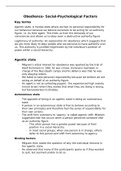
Agentic state- A mental state where we feel no personal responsibility for
our behaviour because we believe ourselves to be acting for an authority
figure, i.e. As their agent. This frees us from the demands of our
consciences and allows us to obey even a destructive authority figure.
Legitimacy of authority- An explanation for obedience which suggests that
we are more likely to obey people who we perceive to have authority over
us. This authority is justified (legitimate) by the individual’s position of
power within a social hierarchy.
Agentic state
- Milgram’s initial interest for obedience was sparked by the trial of
Adolf Eichmann in 1961 for war crimes. Eichmann had been in
charge of the Nazi death camps and his defence was that he was
only obeying orders.
- We failed to take personal responsibility because we believe we are
acting on behalf of an authority figure.
- An agent is not an unfeeling puppet - the experienced high anxiety
(moral strain) when they realise that what they are doing is wrong,
but feel powerless to disobey.
Autonomous state
- The opposite of being in an agentic state is being an autonomous
state.
- A person in an autonomous state is free to behave according to
their own principles and therefore feel the sense of responsibility for
their own actions.
- The shift from autonomy to ‘agency’ is called agentic shift. Milgram
suggested that this occurs when a person perceives someone else
as an authority figure.
→ This other person has a greater power because of their
position in a social hierarchy.
→ In most social groups, when one person is in charge, others
defer to this person and shift from autonomy to agency.
Binding factors
- Milgram then raised the question of why the individual remains in
the agentic state.
- He observed that many of the participants spoke as if they wanted
to quit, but seemed unable to do so.
Key terms
Agentic state- A mental state where we feel no personal responsibility for
our behaviour because we believe ourselves to be acting for an authority
figure, i.e. As their agent. This frees us from the demands of our
consciences and allows us to obey even a destructive authority figure.
Legitimacy of authority- An explanation for obedience which suggests that
we are more likely to obey people who we perceive to have authority over
us. This authority is justified (legitimate) by the individual’s position of
power within a social hierarchy.
Agentic state
- Milgram’s initial interest for obedience was sparked by the trial of
Adolf Eichmann in 1961 for war crimes. Eichmann had been in
charge of the Nazi death camps and his defence was that he was
only obeying orders.
- We failed to take personal responsibility because we believe we are
acting on behalf of an authority figure.
- An agent is not an unfeeling puppet - the experienced high anxiety
(moral strain) when they realise that what they are doing is wrong,
but feel powerless to disobey.
Autonomous state
- The opposite of being in an agentic state is being an autonomous
state.
- A person in an autonomous state is free to behave according to
their own principles and therefore feel the sense of responsibility for
their own actions.
- The shift from autonomy to ‘agency’ is called agentic shift. Milgram
suggested that this occurs when a person perceives someone else
as an authority figure.
→ This other person has a greater power because of their
position in a social hierarchy.
→ In most social groups, when one person is in charge, others
defer to this person and shift from autonomy to agency.
Binding factors
- Milgram then raised the question of why the individual remains in
the agentic state.
- He observed that many of the participants spoke as if they wanted
to quit, but seemed unable to do so.