Conformity- Types and explanations
Key terms
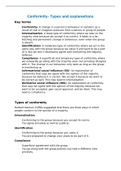
- Conformity- A change in a person’s behaviour or opinions as a
result of real or imagines pressure from a person or group of people.
- Internalisation- A deep type of conformity where we take on the
majority view because we accept it as correct. It leads to a far-
fetching and permanent change in behaviour, even when the group
is absent.
- Identification- A moderate type of conformity where we act in the
same way with the group because we value it and want to be a part
of it. But we don’t necessarily agree with everything the majority
believes.
- Compliance- A superficial and temporary type of conformity where
we outwardly go along with the majority view, but privately disagree
with it. The change in our behaviour only lasts as long as the group
is monitoring us.
- Informational social influence (ISI)- An explanation of
conformity that says we agree with the opinion of the majority
because we believe it is correct. We accept it because we want to
be correct as well. This may lead to internalisation.
- Normative social influence (NSI)- An explanation of conformity
that says we agree with the opinion of the majority because we
want to be accepted, gain social approval, and be liked. This may
lead to compliance.
Types of conformity
Herbert Kelman (1958) suggested that there are three ways in which
people conform to the opinion of a majority.
Internalisation
- Conforming to the group because you accept its norms.
- You agree privately as well as publicly.
Identification
- Conforming to the group because you value it.
- You are prepared to change your views to be part of it.
Compliance
- Superficial agreement with the group.
- You go along with the group publicly but hold a different view
privately.
Key terms
- Conformity- A change in a person’s behaviour or opinions as a
result of real or imagines pressure from a person or group of people.
- Internalisation- A deep type of conformity where we take on the
majority view because we accept it as correct. It leads to a far-
fetching and permanent change in behaviour, even when the group
is absent.
- Identification- A moderate type of conformity where we act in the
same way with the group because we value it and want to be a part
of it. But we don’t necessarily agree with everything the majority
believes.
- Compliance- A superficial and temporary type of conformity where
we outwardly go along with the majority view, but privately disagree
with it. The change in our behaviour only lasts as long as the group
is monitoring us.
- Informational social influence (ISI)- An explanation of
conformity that says we agree with the opinion of the majority
because we believe it is correct. We accept it because we want to
be correct as well. This may lead to internalisation.
- Normative social influence (NSI)- An explanation of conformity
that says we agree with the opinion of the majority because we
want to be accepted, gain social approval, and be liked. This may
lead to compliance.
Types of conformity
Herbert Kelman (1958) suggested that there are three ways in which
people conform to the opinion of a majority.
Internalisation
- Conforming to the group because you accept its norms.
- You agree privately as well as publicly.
Identification
- Conforming to the group because you value it.
- You are prepared to change your views to be part of it.
Compliance
- Superficial agreement with the group.
- You go along with the group publicly but hold a different view
privately.