

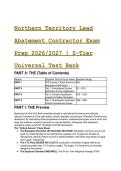
Northern Territory Lead
Abatement Contractor Exam
Prep 2026/2027 | S-Tier
Universal Test Bank
PART 0: THE (Table of Contents)
Section Cognitive Tiers & Focus Areas Question Range
PART I The Preview: Critical Axioms & N/A
Regulatory Hard Decks
PART II Tier 1: Foundational Syntax, Q1 – Q15
Definitions & Core Application
PART II Tier 2: Complex Application, Q16 – Q35
Logistics & Safety Simulation
PART II Tier 3: Grandmaster Synthesis Q36 – Q60
& Multi-Jurisdictional Failure
PART I: THE Preview
Mastering this Elite Test Bank translates directly to operational dominance and absolute
statutory compliance in the high-stakes, heavily regulated environment of Northern Territory lead
abatement. By internalizing these engineered scenarios, professionals bypass novice errors and
forge the academic mastery necessary to execute flawless, biologically safe abatement
operations under current NT WorkSafe and EPA frameworks.
The "Critical Axioms" Cheat Sheet:
● The Biological Hard Deck (NT WorkSafe 2021/2025): Mandatory removal occurs at 30
µg/dL for males/females of non-reproductive capacity, and 10 µg/dL for females of
reproductive capacity. Return to work is strictly forbidden until levels drop below 20 µg/dL
and 5 µg/dL, respectively.
● The 0.1% Rule (AS/NZS 4361.2:2017): Lead paint in Australia is legally defined as
containing greater than 0.1% lead by weight. The legacy 1% threshold is an obsolete,
dangerous assumption.
● The Exposure Standard (WES/WEL): The 8-hour Time Weighted Average (TWA)
, workplace exposure limit for inorganic lead dust/fume is absolutely capped at 0.05 mg/m³.
● The Notification Mandate: NT WorkSafe must be notified within 7 days of determining
work is lead risk work, and immediately upon removing a worker due to biological
threshold breaches.
● The Listed Waste Directive (NT EPA): Lead and lead compounds are statutory Listed
Wastes under Schedule 2 of the Waste Management and Pollution Control Act. They
must be handled via formal chain-of-custody, transported by EPL-licensed carriers, and
disposed of at licensed facilities like Shoal Bay.
PART II: THE ELITE TEST BANK
Tier 1: Foundational Syntax & Application
Q1: A new male abrasive blasting operator in Darwin has his blood lead level (BLL) tested after
his first month. The result is 31 µg/dL. Based on NT WorkSafe regulations for lead risk work,
which action is the IMMEDIATE requirement? A) Increase his biological monitoring frequency to
every 6 weeks and issue a higher-grade respirator. B) Implement administrative controls to
rotate his shifts and retest his blood in 3 months. C) Remove him from lead risk work
immediately until his BLL drops below 20 µg/dL. D) Remove him from lead risk work
immediately until his BLL drops below 10 µg/dL.
● The Answer: C (Remove him from lead risk work immediately until his BLL drops below
20 µg/dL.)
● Distractor Analysis:
○ A is incorrect: At 31 µg/dL, removal is legally mandated under Regulation 415, not
just increased monitoring.
○ B is incorrect: Administrative rotation is illegal once the hard removal threshold (30
µg/dL for males) is breached.
○ D is incorrect: The < 10 µg/dL (specifically < 5 µg/dL) return threshold applies to
females of reproductive capacity, not males.
The Mentor's Analysis: Biological thresholds are absolute legal triggers, not operational
suggestions. When facing a BLL breach, the immediate priority is removing the worker from the
exposure pathway. By utilizing Regulation 415 removal criteria, you bypass the common trap of
attempting to engineer your way out of a biological failure. Professional/Academic Intuition:
30 removes, 20 returns (for males/non-reproductive females).
Q2: During a pre-renovation assessment of a commercial building built in 1995, paint samples
are analyzed. The laboratory reports a lead concentration of 0.15% w/w. Based on the AS/NZS
4361.2:2017 framework, which conclusion is the MOST ACCURATE? A) The paint is classified
as lead-free because it falls below the 1.0% threshold established in 1998. B) The paint requires
no intervention because commercial buildings are exempt from residential standards. C) The
paint is considered a minor hazard and requires only standard N95 masking during dry sanding.
D) The paint is classified as lead paint and requires hazardous paint management protocols.
● The Answer: D (The paint is classified as lead paint and requires hazardous paint
management protocols.)
● Distractor Analysis:
○ A is incorrect: The 1.0% threshold is a dangerously outdated legacy standard that
was revised down to 0.1% in 2017.
○ B is incorrect: AS/NZS 4361.2:2017 explicitly covers residential, public, and
, commercial buildings.
○ C is incorrect: There is no "minor hazard" classification that permits dry sanding of
lead paint.
The Mentor's Analysis: The definition of lead paint tightened significantly to align with global
toxicological data regarding childhood and occupational exposure. When facing legacy
structures, the immediate priority is precise analytical testing against current standards. By
utilizing the 0.1% w/w definition, you bypass the common trap of contaminating a site based on
outdated 1990s metrics. Professional/Academic Intuition: If it exceeds 0.1%, it is legally
lead.
Q3: A contractor is preparing to remove lead paint from an industrial steel bridge in the Northern
Territory. Under PCCP Class 5 accreditation requirements, which specific role MUST be present
and designated for the project? A) An independent Contaminated Land Auditor. B) A
Responsible Person who has completed an endorsed Lead Paint Management course. C) A
Certified Industrial Hygienist from Safe Work Australia. D) A registered NT WorkSafe Inspector.
● The Answer: B (A Responsible Person who has completed an endorsed Lead Paint
Management course.)
● Distractor Analysis:
○ A is incorrect: Auditors review land contamination under NT EPA guidelines, not
operational paint removal on steel structures.
○ C is incorrect: While hygienists are valuable for clearance testing , PCCP explicitly
mandates an internally trained Responsible Person.
○ D is incorrect: Regulators enforce the law; they do not act as internal operational
project managers.
The Mentor's Analysis: PCCP Class 5 targets high-risk industrial metallic pigments. When
facing complex industrial remediation, the immediate priority is internal competence. By utilizing
a trained Responsible Person, you bypass the common trap of assuming general painting
contractors can safely manage extreme toxicity without specialized oversight.
Professional/Academic Intuition: Industrial lead removal requires specialized, auditable
human competence, not just specialized equipment.
Q4: A female worker of reproductive capacity returns a biological monitoring result of 6 µg/dL.
She is currently conducting lead risk work. According to NT WorkSafe Regulation 407, what is
the MOST APPROPRIATE frequency for her next biological monitoring test? A) 3 months B) 6
months C) Immediate removal is required D) 6 weeks
● The Answer: D (6 weeks)
● Distractor Analysis:
○ A is incorrect: 3 months is the interval if the level is below 5 µg/dL for this
demographic.
○ B is incorrect: 6 months applies only to males/non-reproductive females with levels
< 10 µg/dL.
○ C is incorrect: Removal for females of reproductive capacity triggers at 10 µg/dL,
not 6 µg/dL.
The Mentor's Analysis: The female reproductive system represents the highest toxicological
vulnerability to lead exposure. When facing a BLL of 6 µg/dL in this demographic, the immediate
priority is heightened surveillance. By utilizing the 6-week testing interval, you bypass the
common trap of applying standard male biological intervals to highly sensitive populations.
Professional/Academic Intuition: Vulnerability dictates frequency; 5 µg/dL is the
surveillance pivot for reproductive females.
Q5: An abatement firm generates 500 kg of lead-contaminated paint chips. The contractor plans
Abatement Contractor Exam
Prep 2026/2027 | S-Tier
Universal Test Bank
PART 0: THE (Table of Contents)
Section Cognitive Tiers & Focus Areas Question Range
PART I The Preview: Critical Axioms & N/A
Regulatory Hard Decks
PART II Tier 1: Foundational Syntax, Q1 – Q15
Definitions & Core Application
PART II Tier 2: Complex Application, Q16 – Q35
Logistics & Safety Simulation
PART II Tier 3: Grandmaster Synthesis Q36 – Q60
& Multi-Jurisdictional Failure
PART I: THE Preview
Mastering this Elite Test Bank translates directly to operational dominance and absolute
statutory compliance in the high-stakes, heavily regulated environment of Northern Territory lead
abatement. By internalizing these engineered scenarios, professionals bypass novice errors and
forge the academic mastery necessary to execute flawless, biologically safe abatement
operations under current NT WorkSafe and EPA frameworks.
The "Critical Axioms" Cheat Sheet:
● The Biological Hard Deck (NT WorkSafe 2021/2025): Mandatory removal occurs at 30
µg/dL for males/females of non-reproductive capacity, and 10 µg/dL for females of
reproductive capacity. Return to work is strictly forbidden until levels drop below 20 µg/dL
and 5 µg/dL, respectively.
● The 0.1% Rule (AS/NZS 4361.2:2017): Lead paint in Australia is legally defined as
containing greater than 0.1% lead by weight. The legacy 1% threshold is an obsolete,
dangerous assumption.
● The Exposure Standard (WES/WEL): The 8-hour Time Weighted Average (TWA)
, workplace exposure limit for inorganic lead dust/fume is absolutely capped at 0.05 mg/m³.
● The Notification Mandate: NT WorkSafe must be notified within 7 days of determining
work is lead risk work, and immediately upon removing a worker due to biological
threshold breaches.
● The Listed Waste Directive (NT EPA): Lead and lead compounds are statutory Listed
Wastes under Schedule 2 of the Waste Management and Pollution Control Act. They
must be handled via formal chain-of-custody, transported by EPL-licensed carriers, and
disposed of at licensed facilities like Shoal Bay.
PART II: THE ELITE TEST BANK
Tier 1: Foundational Syntax & Application
Q1: A new male abrasive blasting operator in Darwin has his blood lead level (BLL) tested after
his first month. The result is 31 µg/dL. Based on NT WorkSafe regulations for lead risk work,
which action is the IMMEDIATE requirement? A) Increase his biological monitoring frequency to
every 6 weeks and issue a higher-grade respirator. B) Implement administrative controls to
rotate his shifts and retest his blood in 3 months. C) Remove him from lead risk work
immediately until his BLL drops below 20 µg/dL. D) Remove him from lead risk work
immediately until his BLL drops below 10 µg/dL.
● The Answer: C (Remove him from lead risk work immediately until his BLL drops below
20 µg/dL.)
● Distractor Analysis:
○ A is incorrect: At 31 µg/dL, removal is legally mandated under Regulation 415, not
just increased monitoring.
○ B is incorrect: Administrative rotation is illegal once the hard removal threshold (30
µg/dL for males) is breached.
○ D is incorrect: The < 10 µg/dL (specifically < 5 µg/dL) return threshold applies to
females of reproductive capacity, not males.
The Mentor's Analysis: Biological thresholds are absolute legal triggers, not operational
suggestions. When facing a BLL breach, the immediate priority is removing the worker from the
exposure pathway. By utilizing Regulation 415 removal criteria, you bypass the common trap of
attempting to engineer your way out of a biological failure. Professional/Academic Intuition:
30 removes, 20 returns (for males/non-reproductive females).
Q2: During a pre-renovation assessment of a commercial building built in 1995, paint samples
are analyzed. The laboratory reports a lead concentration of 0.15% w/w. Based on the AS/NZS
4361.2:2017 framework, which conclusion is the MOST ACCURATE? A) The paint is classified
as lead-free because it falls below the 1.0% threshold established in 1998. B) The paint requires
no intervention because commercial buildings are exempt from residential standards. C) The
paint is considered a minor hazard and requires only standard N95 masking during dry sanding.
D) The paint is classified as lead paint and requires hazardous paint management protocols.
● The Answer: D (The paint is classified as lead paint and requires hazardous paint
management protocols.)
● Distractor Analysis:
○ A is incorrect: The 1.0% threshold is a dangerously outdated legacy standard that
was revised down to 0.1% in 2017.
○ B is incorrect: AS/NZS 4361.2:2017 explicitly covers residential, public, and
, commercial buildings.
○ C is incorrect: There is no "minor hazard" classification that permits dry sanding of
lead paint.
The Mentor's Analysis: The definition of lead paint tightened significantly to align with global
toxicological data regarding childhood and occupational exposure. When facing legacy
structures, the immediate priority is precise analytical testing against current standards. By
utilizing the 0.1% w/w definition, you bypass the common trap of contaminating a site based on
outdated 1990s metrics. Professional/Academic Intuition: If it exceeds 0.1%, it is legally
lead.
Q3: A contractor is preparing to remove lead paint from an industrial steel bridge in the Northern
Territory. Under PCCP Class 5 accreditation requirements, which specific role MUST be present
and designated for the project? A) An independent Contaminated Land Auditor. B) A
Responsible Person who has completed an endorsed Lead Paint Management course. C) A
Certified Industrial Hygienist from Safe Work Australia. D) A registered NT WorkSafe Inspector.
● The Answer: B (A Responsible Person who has completed an endorsed Lead Paint
Management course.)
● Distractor Analysis:
○ A is incorrect: Auditors review land contamination under NT EPA guidelines, not
operational paint removal on steel structures.
○ C is incorrect: While hygienists are valuable for clearance testing , PCCP explicitly
mandates an internally trained Responsible Person.
○ D is incorrect: Regulators enforce the law; they do not act as internal operational
project managers.
The Mentor's Analysis: PCCP Class 5 targets high-risk industrial metallic pigments. When
facing complex industrial remediation, the immediate priority is internal competence. By utilizing
a trained Responsible Person, you bypass the common trap of assuming general painting
contractors can safely manage extreme toxicity without specialized oversight.
Professional/Academic Intuition: Industrial lead removal requires specialized, auditable
human competence, not just specialized equipment.
Q4: A female worker of reproductive capacity returns a biological monitoring result of 6 µg/dL.
She is currently conducting lead risk work. According to NT WorkSafe Regulation 407, what is
the MOST APPROPRIATE frequency for her next biological monitoring test? A) 3 months B) 6
months C) Immediate removal is required D) 6 weeks
● The Answer: D (6 weeks)
● Distractor Analysis:
○ A is incorrect: 3 months is the interval if the level is below 5 µg/dL for this
demographic.
○ B is incorrect: 6 months applies only to males/non-reproductive females with levels
< 10 µg/dL.
○ C is incorrect: Removal for females of reproductive capacity triggers at 10 µg/dL,
not 6 µg/dL.
The Mentor's Analysis: The female reproductive system represents the highest toxicological
vulnerability to lead exposure. When facing a BLL of 6 µg/dL in this demographic, the immediate
priority is heightened surveillance. By utilizing the 6-week testing interval, you bypass the
common trap of applying standard male biological intervals to highly sensitive populations.
Professional/Academic Intuition: Vulnerability dictates frequency; 5 µg/dL is the
surveillance pivot for reproductive females.
Q5: An abatement firm generates 500 kg of lead-contaminated paint chips. The contractor plans


