

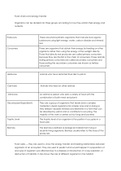
Food chains and energy transfer
Organisms can be divided into three groups according to how they obtain their energy and
nutrients.
Producers These are photosynthetic organisms that manufacture organic
substances using light energy, water, carbon dioxide and mineral
ions
Consumers These are organisms that obtain their energy by feeding on other
organisms rather than using the energy of the sunlight directly.
Those that directly eat producers are called primary consumers
because they are the first in the chain of consumers. Those animals
eating primary consumers are called secondary consumers and
those eating the secondary consumers are known as tertiary
consumers
Herbivore Animals who have restricted their diet to plants
Carnivore Animals who feed on other animals
Omnivore An animal or person who eats a variety of food with the
combination of both meat and plants
Decomposer/Saprobionts They are a group of organisms that break down complex
materials in dead organisms into simpler ones and in doing so
they release valuable minerals and elements in a form that can
be absorbed by plants and so contribute to recycling. The
majority of this work is carried out by fungi and bacteria
Trophic level The trophic level of an organism is the position it occupies in a
food web.
Biomass The biomass is defined as biological material from living or
recently living organisms. Biomass usually refers to the mass of the
producers.
Food webs → they are used to, show the energy transfer and feeding relationships between
organisms of an ecosystem. They are used to predict what would happen if a population of
one type of organism was affected due to a disease or introduction of a new predator, or
destruction of habitats. It also shows the role of different organisms in the habitat.
Organisms can be divided into three groups according to how they obtain their energy and
nutrients.
Producers These are photosynthetic organisms that manufacture organic
substances using light energy, water, carbon dioxide and mineral
ions
Consumers These are organisms that obtain their energy by feeding on other
organisms rather than using the energy of the sunlight directly.
Those that directly eat producers are called primary consumers
because they are the first in the chain of consumers. Those animals
eating primary consumers are called secondary consumers and
those eating the secondary consumers are known as tertiary
consumers
Herbivore Animals who have restricted their diet to plants
Carnivore Animals who feed on other animals
Omnivore An animal or person who eats a variety of food with the
combination of both meat and plants
Decomposer/Saprobionts They are a group of organisms that break down complex
materials in dead organisms into simpler ones and in doing so
they release valuable minerals and elements in a form that can
be absorbed by plants and so contribute to recycling. The
majority of this work is carried out by fungi and bacteria
Trophic level The trophic level of an organism is the position it occupies in a
food web.
Biomass The biomass is defined as biological material from living or
recently living organisms. Biomass usually refers to the mass of the
producers.
Food webs → they are used to, show the energy transfer and feeding relationships between
organisms of an ecosystem. They are used to predict what would happen if a population of
one type of organism was affected due to a disease or introduction of a new predator, or
destruction of habitats. It also shows the role of different organisms in the habitat.


