
11. Measurement (J. De Weerdt)
1. Introduction
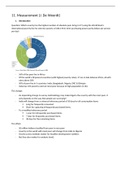
Question: Which country has the highest number of absolute poor living in it? (using the World Bank’s
international poverty line for extreme poverty of US$1.90 in 2011 purchasing power parity dollars per person
per day)
- 56% of the poor live in Africa
- Of the world’s 28 poorest countries (with highest poverty rates), 27 are in Sub-Saharan Africa, all with
rates above 30%
- 50% of poor live in 5 countries: India, Bangladesh, Nigeria, DRC & Ethiopia
- India has 13% poverty rate but most poor because of high population (1.3b).
The change:
- An impending change to survey methodology may make Nigeria the country with the most poor. It
only depends on the way that people are surveying!!
- India will change from a universal reference period of 30 days for all consumption items
Long for frequently consumed
Short for capturing infrequently purchased items.
- To a modified reference period
1 year for infrequently purchased items
7 days for frequently purchased items
30 days for the remaining items
The effect:
- 50 million Indians classified from poor to non-poor
- Country in the world with most poor will change from India to Nigeria
- Clearly survey methods matter for headline development statistics
- But they also matter for analysis (next)
, 2. Standard measurement error
Classical measurement error
Very good summary here https://www.youtube.com/watch?v=Pz4ephK-f94
For a more formal treatment see section 1, 2.0 and 2.1 in Bound, John, Charles Brown, and Nancy Mathiowetz.
2001. Measurement Error in Survey Data. In Handbook of Econometrics, vol. 5, edited by James J. Heckman
and Edward Leamer, 3705–3843. Amsterdam: Elsevier Science. Paywall broken here:
https://www.psc.isr.umich.edu/pubs/abs/1252 (read what we have seen in the slides!)
Bound et al. 2001
Assume true model is:
Where 𝑦* and 𝑋* are true values
Instead of 𝑦* and 𝑋* we only observe 𝑦 and 𝑋 with
One (very) special case known as classical measurement error: the errors ( and 𝜐) are uncorrelated with the
true values of X, Y and the error term in the model (𝑋*, 𝑦* and ε).s
Classical measurement error in dependent variable
True model is:
With we are really estimating
(𝜀 + 𝜐) is new error term, under classical measurement error assumptions this means:
- OLS remains unbiased and consistent
- Only efficiency is reduced because v𝑎𝑟(𝜀 + 𝜐) > 𝑣𝑎𝑟(𝜀)
- If 𝐸[𝜐] ≠ 0 then 𝛽0 (the constant term) is biased
Graphically, vertical shifts of observations do not change slope
1. Introduction
Question: Which country has the highest number of absolute poor living in it? (using the World Bank’s
international poverty line for extreme poverty of US$1.90 in 2011 purchasing power parity dollars per person
per day)
- 56% of the poor live in Africa
- Of the world’s 28 poorest countries (with highest poverty rates), 27 are in Sub-Saharan Africa, all with
rates above 30%
- 50% of poor live in 5 countries: India, Bangladesh, Nigeria, DRC & Ethiopia
- India has 13% poverty rate but most poor because of high population (1.3b).
The change:
- An impending change to survey methodology may make Nigeria the country with the most poor. It
only depends on the way that people are surveying!!
- India will change from a universal reference period of 30 days for all consumption items
Long for frequently consumed
Short for capturing infrequently purchased items.
- To a modified reference period
1 year for infrequently purchased items
7 days for frequently purchased items
30 days for the remaining items
The effect:
- 50 million Indians classified from poor to non-poor
- Country in the world with most poor will change from India to Nigeria
- Clearly survey methods matter for headline development statistics
- But they also matter for analysis (next)
, 2. Standard measurement error
Classical measurement error
Very good summary here https://www.youtube.com/watch?v=Pz4ephK-f94
For a more formal treatment see section 1, 2.0 and 2.1 in Bound, John, Charles Brown, and Nancy Mathiowetz.
2001. Measurement Error in Survey Data. In Handbook of Econometrics, vol. 5, edited by James J. Heckman
and Edward Leamer, 3705–3843. Amsterdam: Elsevier Science. Paywall broken here:
https://www.psc.isr.umich.edu/pubs/abs/1252 (read what we have seen in the slides!)
Bound et al. 2001
Assume true model is:
Where 𝑦* and 𝑋* are true values
Instead of 𝑦* and 𝑋* we only observe 𝑦 and 𝑋 with
One (very) special case known as classical measurement error: the errors ( and 𝜐) are uncorrelated with the
true values of X, Y and the error term in the model (𝑋*, 𝑦* and ε).s
Classical measurement error in dependent variable
True model is:
With we are really estimating
(𝜀 + 𝜐) is new error term, under classical measurement error assumptions this means:
- OLS remains unbiased and consistent
- Only efficiency is reduced because v𝑎𝑟(𝜀 + 𝜐) > 𝑣𝑎𝑟(𝜀)
- If 𝐸[𝜐] ≠ 0 then 𝛽0 (the constant term) is biased
Graphically, vertical shifts of observations do not change slope


