Name: David De Souza Date:05/02/2017
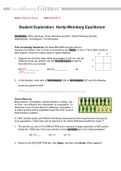
Student Exploration: Hardy-Weinberg Equilibrium
Vocabulary: allele, genotype, Hardy-Weinberg equation, Hardy-Weinberg principle,
heterozygous, homozygous, Punnett square
Prior Knowledge Questions (Do these BEFORE using the Gizmo.)
Suppose the feather color of a bird is controlled by two alleles, D and d. The D allele results in
dark feathers, while the d allele results in lighter feathers.
1. Suppose two Dd birds mate. What percentages of DD, Dd, and dd
offspring would you predict? Use the Punnett square at right to
help determine your answer.
DD 25%__________ Dd 50%__________ d
d
_25%_________
2. In this situation, what ratio of heterozygous (Dd) to homozygous (DD and d
d) offspring
would you expect to find?
_1:1___________________________________________________
Gizmo Warm-up
Many factors—immigration, natural selection, hunting, and
so forth—can influence the composition of a population. To
determine if one of these factors is affecting a population, it
is useful to know what a population looks like when none of
these factors is present.
In 1908, Godfrey Hardy and Wilhelm Weinberg independently discovered the laws that govern
such populations. These laws can be explored in the Hardy-Weinberg Equilibrium Gizmo™.
1. The parrots you see on the SIMULATION pane represent a larger population of 500 parrots.
Select the TABLE tab. How many parrots of each genotype are in the initial population?
DD 250___ Dd 100 dd 150
2. Return to the DESCRIPTION tab. Click Begin, and then click Breed. What happens?
, The parrots pair up and probuce eggs
3. Click Hatch, and look on the TABLE tab. What are the parrot populations now?
DD 181 Dd 237 dd 82
Activity A: Get the Gizmo ready:
Alleles and ● On the DESCRIPTION tab, click Reset.
genotypes ● Check that DD is 50% and dd is 30%.
Question: How will the proportion of genotypes and alleles change over time when
mating is random and no natural selection is occurring?
1. Predict: How do you expect the proportions of D and d alleles to change over time?
I think the proportions are going to decrease over time
2. Gather data: Run a generation in the Gizmo. After clicking Hatch, fill in the allele and
genotype percentages for generation 1. Repeat this process for 5 generations.
Initial Generation
values 1 2 3 4 5
% D alleles 60 60.1 58.8 59.4 59.7 58.3
% d alleles 40 39.9 41.2 40.6 40.3 41.7
% of DD genotype 50 36 34.4 32.8 36.8 37.2
% of Dd genotype 20 48.2 48.8 53.2 45.8 42.2
% of dd genotype 30 15.8 16.8 14 17.4 20.6
3. Analyze: What patterns do you see in your data? I realize that the percent of D and d alleles
remain fairly constant while the genotypes change after the first generation and don’t really
Student Exploration: Hardy-Weinberg Equilibrium
Vocabulary: allele, genotype, Hardy-Weinberg equation, Hardy-Weinberg principle,
heterozygous, homozygous, Punnett square
Prior Knowledge Questions (Do these BEFORE using the Gizmo.)
Suppose the feather color of a bird is controlled by two alleles, D and d. The D allele results in
dark feathers, while the d allele results in lighter feathers.
1. Suppose two Dd birds mate. What percentages of DD, Dd, and dd
offspring would you predict? Use the Punnett square at right to
help determine your answer.
DD 25%__________ Dd 50%__________ d
d
_25%_________
2. In this situation, what ratio of heterozygous (Dd) to homozygous (DD and d
d) offspring
would you expect to find?
_1:1___________________________________________________
Gizmo Warm-up
Many factors—immigration, natural selection, hunting, and
so forth—can influence the composition of a population. To
determine if one of these factors is affecting a population, it
is useful to know what a population looks like when none of
these factors is present.
In 1908, Godfrey Hardy and Wilhelm Weinberg independently discovered the laws that govern
such populations. These laws can be explored in the Hardy-Weinberg Equilibrium Gizmo™.
1. The parrots you see on the SIMULATION pane represent a larger population of 500 parrots.
Select the TABLE tab. How many parrots of each genotype are in the initial population?
DD 250___ Dd 100 dd 150
2. Return to the DESCRIPTION tab. Click Begin, and then click Breed. What happens?
, The parrots pair up and probuce eggs
3. Click Hatch, and look on the TABLE tab. What are the parrot populations now?
DD 181 Dd 237 dd 82
Activity A: Get the Gizmo ready:
Alleles and ● On the DESCRIPTION tab, click Reset.
genotypes ● Check that DD is 50% and dd is 30%.
Question: How will the proportion of genotypes and alleles change over time when
mating is random and no natural selection is occurring?
1. Predict: How do you expect the proportions of D and d alleles to change over time?
I think the proportions are going to decrease over time
2. Gather data: Run a generation in the Gizmo. After clicking Hatch, fill in the allele and
genotype percentages for generation 1. Repeat this process for 5 generations.
Initial Generation
values 1 2 3 4 5
% D alleles 60 60.1 58.8 59.4 59.7 58.3
% d alleles 40 39.9 41.2 40.6 40.3 41.7
% of DD genotype 50 36 34.4 32.8 36.8 37.2
% of Dd genotype 20 48.2 48.8 53.2 45.8 42.2
% of dd genotype 30 15.8 16.8 14 17.4 20.6
3. Analyze: What patterns do you see in your data? I realize that the percent of D and d alleles
remain fairly constant while the genotypes change after the first generation and don’t really