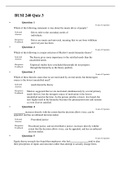
BUSI 240 Quiz 3
• Question 1
0 out of 2 points
Which of the following statements is true about the innate drives of people?
Selected Drives refer to the secondary needs of
Answer:
individuals.
Response Drives are innate and universal, meaning that we are born withthem
Feedback:
and everyone has them.
• Question 2
0 out of 2 points
Which of the following is a major criticism of Maslow's needs hierarchy theory?
Selected The theory gives more importance to the satisfied needs than the
Answer:
unsatisfied needs.
Response Empirical studies have concluded that people do not progress
Feedback:
through the hierarchy as the theory predicts.
• Question 3
2 out of 2 points
Which of these theories states that we are motivated by several needs, but thestrongest
source is the lowest unsatisfied need?
Selected needs hierarchy theory
Answer:
Response Maslow suggested that we are motivated simultaneously by several primary
Feedback:
needs (drives), but the strongest source of motivation is the lowest
unsatisfied need at the time. As the person satisfies a lower- level need, the
next higher need in the hierarchy becomes the primarymotivator and remains
so even if never satisfied.
• Question 4
2 out of 2 points
increases directly with the extent that the decision allows voice, can be
appealed, and has an unbiased decision maker.
Selected Procedural justice
Answer:
Response Procedural justice, and not distributive justice, increases directly withthe
Feedback:
extent that the decision allows voice, can be appealed, and has an unbiased
decision maker.
• Question 5
0 out of 2 points
Equity theory research has found that employees who feel tend to alter
their perceptions of inputs and outcomes rather than attempt to actually change them.
, Selected perceptions of equity
Answer:
Response A common response to over-reward inequity is that the over-
Feedback:
rewarded employee changes his or her perceptions to justify themore
favorable outcomes.
• Question 6
0 out of 2 points
According to equity theory
Selected improving job security and working conditions will improve job
Answer:
satisfaction and, consequently, employee motivation.
Response According to equity theory, the selection of the comparison othervaries
Feedback:
from one person to the next and is not easily identifiable.
• Question 7
2 out of 2 points
According to theory, social norms, past experience, and personal values
translate emotional signals into goal-directed effort.
Selected the four-
Answer:
drive
Response Drives produce emotions; our self-concept, social norms, and past experience
Feedback:
translate these emotions into goal-directed needs, and these individual
characteristics also translate needs into decisions andbehavior.
• Question 8
2 out of 2 points
According to expectancy theory, a skill-development training program would
Selected mainly increase the effort-to-performance expectancy.
Answer:
Response E-to-P expectancies are influenced by the individual's belief that he orshe can
Feedback:
successfully complete the task. Some companies increase these expectancies
by assuring employees that they have the necessary competencies, clear role
perceptions, and necessary resources such as counseling, training programs,
and coaching to reach the desired levels of performance.
• Question 9
2 out of 2 points
Scenario B
Jessie and Paul have worked in the same office at DEF Insurance LLC for 6 years.Jessie has
always taken extra care to follow the office norms and ensure that everyone has a happy and
harmonious working experience. Paul has been very
• Question 1
0 out of 2 points
Which of the following statements is true about the innate drives of people?
Selected Drives refer to the secondary needs of
Answer:
individuals.
Response Drives are innate and universal, meaning that we are born withthem
Feedback:
and everyone has them.
• Question 2
0 out of 2 points
Which of the following is a major criticism of Maslow's needs hierarchy theory?
Selected The theory gives more importance to the satisfied needs than the
Answer:
unsatisfied needs.
Response Empirical studies have concluded that people do not progress
Feedback:
through the hierarchy as the theory predicts.
• Question 3
2 out of 2 points
Which of these theories states that we are motivated by several needs, but thestrongest
source is the lowest unsatisfied need?
Selected needs hierarchy theory
Answer:
Response Maslow suggested that we are motivated simultaneously by several primary
Feedback:
needs (drives), but the strongest source of motivation is the lowest
unsatisfied need at the time. As the person satisfies a lower- level need, the
next higher need in the hierarchy becomes the primarymotivator and remains
so even if never satisfied.
• Question 4
2 out of 2 points
increases directly with the extent that the decision allows voice, can be
appealed, and has an unbiased decision maker.
Selected Procedural justice
Answer:
Response Procedural justice, and not distributive justice, increases directly withthe
Feedback:
extent that the decision allows voice, can be appealed, and has an unbiased
decision maker.
• Question 5
0 out of 2 points
Equity theory research has found that employees who feel tend to alter
their perceptions of inputs and outcomes rather than attempt to actually change them.
, Selected perceptions of equity
Answer:
Response A common response to over-reward inequity is that the over-
Feedback:
rewarded employee changes his or her perceptions to justify themore
favorable outcomes.
• Question 6
0 out of 2 points
According to equity theory
Selected improving job security and working conditions will improve job
Answer:
satisfaction and, consequently, employee motivation.
Response According to equity theory, the selection of the comparison othervaries
Feedback:
from one person to the next and is not easily identifiable.
• Question 7
2 out of 2 points
According to theory, social norms, past experience, and personal values
translate emotional signals into goal-directed effort.
Selected the four-
Answer:
drive
Response Drives produce emotions; our self-concept, social norms, and past experience
Feedback:
translate these emotions into goal-directed needs, and these individual
characteristics also translate needs into decisions andbehavior.
• Question 8
2 out of 2 points
According to expectancy theory, a skill-development training program would
Selected mainly increase the effort-to-performance expectancy.
Answer:
Response E-to-P expectancies are influenced by the individual's belief that he orshe can
Feedback:
successfully complete the task. Some companies increase these expectancies
by assuring employees that they have the necessary competencies, clear role
perceptions, and necessary resources such as counseling, training programs,
and coaching to reach the desired levels of performance.
• Question 9
2 out of 2 points
Scenario B
Jessie and Paul have worked in the same office at DEF Insurance LLC for 6 years.Jessie has
always taken extra care to follow the office norms and ensure that everyone has a happy and
harmonious working experience. Paul has been very